Malaysia drops appeal against acquittal of wife of ex-PM Najib in money laundering, tax evasion case

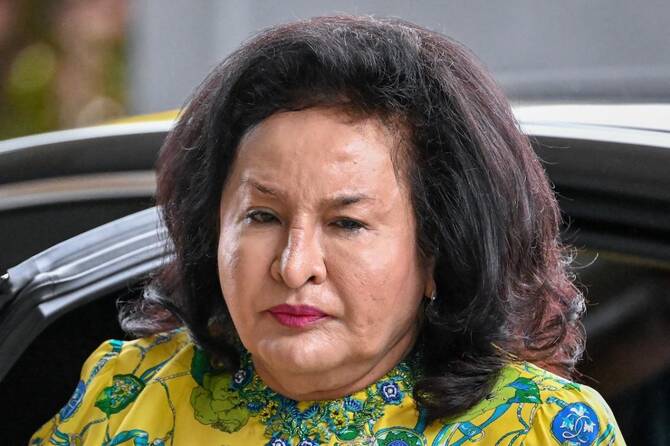
Rosmah Mansor was acquitted of 12 money laundering charges and five tax evasion charges by the Kuala Lumpur High Court in December 2024. (AFP file photo)
Short Url
Updated 12 December 2025
Follow

Malaysia drops appeal against acquittal of wife of ex-PM Najib in money laundering, tax evasion case

  • Rosmah Mansor was widely scorned in Malaysia for her extravagant lifestyle and penchant for luxury handbags
  • She was acquitted of 12 money laundering charges and five tax evasion charges by the Kuala Lumpur High Court

KUALA LUMPUR: Malaysian prosecutors have dropped their appeal against the acquittal of Rosmah Mansor, the wife of jailed former Prime Minister Najib Razak, in a case involving money laundering and tax evasion, saying they saw no prospect of success. Since 2018, the couple have been subject to multiple graft investigations surrounding Najib’s alleged role in the multi-billion dollar 1MDB scandal. Both have repeatedly denied all wrongdoing.
Rosmah, widely scorned in Malaysia for her extravagant lifestyle and penchant for luxury handbags, was acquitted of 12 money laundering charges and five tax evasion charges by the Kuala Lumpur High Court in December 2024.
The Attorney-General’s Chambers initially decided to appeal the decision but withdrew its application on Tuesday, saying it could not definitively prove that Rosmah committed the offenses.
“If the appeal proceeded, the prosecution would not be able to prove the case beyond reasonable doubt as required in a criminal trial, as key witnesses needed to prove the charges against the accused have died,” the AGC said in a statement late on Thursday.
Amer Hamzah Arshad, a lawyer for Rosmah, said on Friday that they welcomed the prosecution’s appeal withdrawal, adding that Rosmah “maintained her innocence throughout.”
The decision does not affect other ongoing trials against Rosmah, the AGC said.
Rosmah is currently free on bail pending an appeal against a 10-year jail sentence in 2022 for soliciting and receiving bribes to help a company win a $279 million solar power supply project from Najib’s government.
The AGC’s appeal withdrawal against Rosmah’s acquittal comes ahead of major court verdicts involving Najib, who is serving a six-year jail sentence after being found guilty of graft and money laundering.
Najib’s conviction was one of several cases investigating his involvement in the alleged theft of billions of dollars from 1Malaysia Development Berhad, a state fund he helped establish in 2009 while he was premier. The Kuala Lumpur High Court will decide on December 22 whether the jailed former premier can serve his sentence under house arrest. Just days later on December 26, it will deliver its verdict in the biggest trial that Najib faces concerning 1MDB. Some 1MDB-linked charges against Najib have been dropped. He has denied all of the charges brought against him.


Afghan polio survivor’s sock factory provides hope by employing disabled workers

Updated 6 sec ago
Follow

Afghan polio survivor’s sock factory provides hope by employing disabled workers

HERAT: In a tiny room in the center of Herat, Afghanistan’s westernmost city, Shahabuddin uses his hands to propel himself along the floor to a freshly-made pile of socks waiting to be sorted and packaged.
A double amputee since a roadside bomb took both his legs a decade ago, when Afghanistan was mired in conflict between US-led forces and Taliban insurgents, the 36-year-old father of four had struggled to find work. Unemployed for the last decade, he had been forced to rely on relatives for his family’s survival.
But a new sock production workshop in Herat employing only disabled workers has given him new hope.
“I became disabled due to the explosion. Both my legs were amputated,” Shahabuddin, who like many Afghans goes by only one name, said during a brief pause in his work in early December. “Now I work here in a sock factory, and I am very happy that I have been given a job here.”
The workshop is the brainchild of Mohammad Amiri, 35, a former grocery shop worker who started the business about a month ago. Amiri, himself disabled by childhood polio, wanted to create jobs and help provide income for other people with disabilities, particularly as many of them were injured during the conflict and have no other means of income.
He teamed up with another polio survivor to start the sock factory with a workforce of men disabled either through traumatic injuries or because of congenital issues or other reasons. They make four types of socks: long and short, for winter and summer.
“The factory, which is funded and supported by people with disabilities, began operations last month and currently employs around 50 people with disabilities,” Amiri said. “They are busy in the production, packaging and sale of socks in the city.”
A combination of decades of conflict, a weak health care system and struggling economy have contributed to high levels of disability in Afghanistan. Data from a 2019 Model Disability Survey conducted by The Asia Foundation nonprofit organization indicates that nearly 25 percent of adults live with a mild disability, while 40 percent have moderate and about 14 percent have severe disabilities.
“These figures compel us to act with greater urgency and commitment,” the UN Assistance Mission in Afghanistan said in a statement released on the International Day of Persons with Disabilities on Dec. 3, quoting the same figures. “Persons with disabilities must not be treated as an afterthought; they must be fully integrated into every stage of planning, decision-making, and service delivery.”
Meanwhile, Afghanistan is one of only two countries — along with neighboring Pakistan — where wild poliovirus remains endemic. The infectious disease can cause flu-like symptoms, but can also cause severe reactions, including paralysis, disability and death.
The Afghan Ministry of Martyrs and Disabled Affairs says 189,635 disabled people across the country are registered and receiving financial support from the government.
Amiri said his business faces serious competition from cheap imports of textiles, and expressed the hope that the government would stop imports from abroad. He has hopes of getting a contract to provide the Afghan security forces with socks, and wants to expand his workforce to 2,000 people.
His current employees include former refugees who have recently returned to Afghanistan after spending years abroad.
One such man is Mohammad Arif Jafari, 40, an economics graduate and polio survivor who lived in Iran for years. Returning to Afghanistan has been hard, he said.
“I suffered a lot due to unemployment. But fortunately, now I produce several types of socks,” he said while selling his wares from a stall on the streets of Herat. “I am happy that I am working here and earning an income.”