Wife of jailed former Malaysian PM Najib Razak acquitted in latest graft case

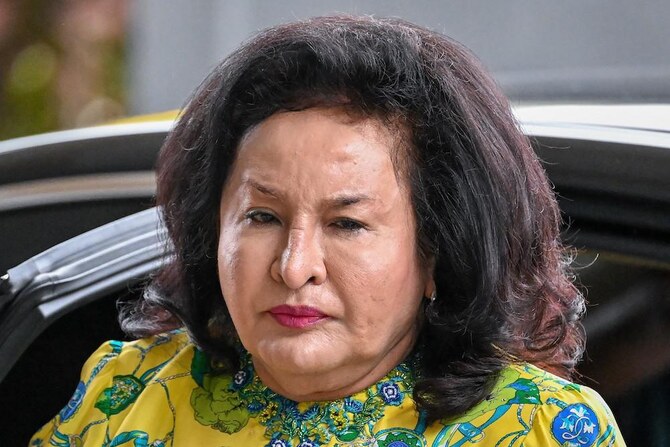
Rosmah Mansor has long been criticized by Malaysians for her reported vast collection of designer handbags, clothing and jewelry, acquired on overseas shopping trips. (AFP file photo)
Short Url
Updated 19 December 2024
Follow

Wife of jailed former Malaysian PM Najib Razak acquitted in latest graft case

  • Rosmah Mansor faced 12 charges of money laundering and five charges of failing to declare her income
  • Rosmah was sentenced to 10 years in jail on separate graft charges in September 2022 but has appealed

KUALA LUMPUR: A Malaysian court threw out more than a dozen money laundering and tax evasion charges on Thursday lodged against the wife of jailed former Malaysian prime minister Najib Razak.
Rosmah Mansor, 73, faced 12 charges of money laundering involving 7.1 million ringgit ($1.6 million) and five charges of failing to declare her income between December 4, 2013, and June 8, 2017.
High Court judge K. Muniandy struck out all 17 charges, saying they lacked “probity, propriety and legality” and ordered a “discharge amounting to an acquittal,” according to a copy of the decision seen by AFP.
The Attorney-General’s office said it would appeal against the decision, Malaysian media reported.
Rosmah was sentenced to 10 years in jail on separate graft charges in September 2022 but has appealed against that conviction and remains free on bail.
She was charged in that case with seeking and receiving bribes for helping a company secure a solar power project for rural schools in the Malaysian section of Borneo island during her husband’s rule.
Rosmah has long been criticized by Malaysians for her reported vast collection of designer handbags, clothing and jewelry, acquired on overseas shopping trips.
Her collection of luxury items came under the spotlight after police raids on their family home in 2018 following her husband’s election defeat.
It drew unflattering comparisons with former Philippines first lady Imelda Marcos and contributed to accusations that the ousted ruling establishment had lost touch with economically struggling and middle-class Malaysians.
Najib is serving a six-year jail term for corruption related to a massive financial scandal at sovereign wealth fund 1MDB.
He has filed an appeal to serve the rest of his sentence under house arrest and a hearing has been fixed for January 6.
The 1MDB scandal, allegedly involving billions of dollars siphoned from the now-defunct state company, sparked investigations in the United States, Switzerland and Singapore.


Hungary to release 1.8 million barrels of crude oil from strategic reserves

Updated 5 sec ago
Follow

Hungary to release 1.8 million barrels of crude oil from strategic reserves

  • Croatia’s JANAF pipeline operator, however, said there was no need for Budapest to tap its reserves
  • Hungary and Slovakia have been trying to secure supply since flows were halted on January 27

BUDAPEST: Hungary’s government will release about 1.8 million barrels of crude oil from its strategic reserves after a drone attack on the Druzhba pipeline late last month stopped oil flow, according to a government decree published late on Thursday.
Croatia’s JANAF pipeline operator, however, said there was no need for Budapest to tap its reserves after Hungary’s oil company MOL said on Friday JANAF must allow transit of Russian seaborne oil to Hungary and Slovakia during the Druzhba outage.
“At this ⁠moment, a significant ⁠quantity of non-Russian crude oil is being transported via JANAF’s pipeline for MOL Group, while three additional tankers carrying non-Russian oil, also for MOL Group, are on their way to the Omisalj Terminal,” JANAF said in a statement.
“There was no need to tap into (their) reserves since oil transport via the JANAF pipeline toward MOL’s refineries is being carried out continuously and without ⁠delays.”
Hungary and Slovakia, which have the only remaining refineries in the EU using Russian oil through Druzhba, have been trying to secure supply since flows were halted on January 27 following what Ukraine said was a Russian drone attack that damaged pipeline infrastructure.
Both countries have blamed Ukraine for the delay in restarting the flows for political reasons.

SCRAMBLE FOR CRUDE SUPPLIES
MOL is entitled to priority access to released crude oil reserves, and it will have access to the freed reserves until April 15 and has to return them by August 24, the Hungarian government decree said.
At the end of January, ⁠Hungary had ⁠enough crude oil and petroleum product reserves to cover 96 days, according to data on the Hungarian Hydrocarbon Stockpiling Association’s website.
As the two countries scramble to ensure supplies, MOL ordered tankers delivering Saudi, Norwegian, Kazakh, Libyan and Russian oil to supply its Hungarian and Slovak refineries and halted diesel deliveries to Ukraine earlier this week.
MOL said that first shipments were expected to arrive at the port of Omisalj in Croatia in early March. After that, it will take a further 5-12 days for the crude oil to reach its refineries.
The Slovak government has also declared an oil emergency situation and has pledged to release 1.825 million barrels of oil following a request from Slovakia’s Slovnaft refinery, which is owned by MOL.