First climate migrants arrive in Australia from sinking Tuvalu in South Pacific

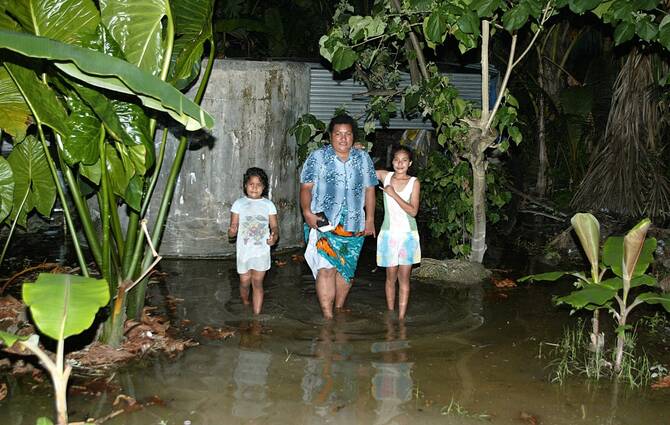
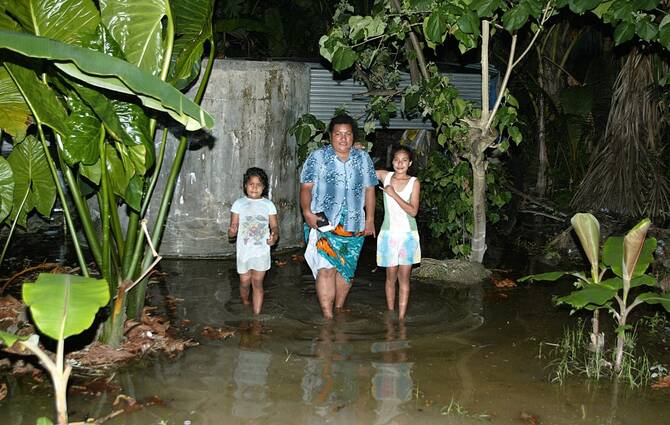
A photo dated 2004 shows a family returning to their flooded property in Funafuti, Tuvalu. (AFP)
Short Url
Updated 11 December 2025
Follow

First climate migrants arrive in Australia from sinking Tuvalu in South Pacific

  • The intake is capped at 280 visas annually to prevent a brain drain in the small island nation

SYDNEY: The first climate migrants to leave the remote Pacific island nation of Tuvalu have arrived in Australia, hoping to preserve links to their sinking island home, foreign affairs officials said on Thursday.
More than one-third of Tuvalu’s 11,000 population applied for a climate visa to migrate to Australia, under a deal struck between the two countries two years ago.
The intake is capped at 280 visas annually to prevent a brain drain in the small island nation.
Among the islanders selected in the initial intake of climate migrants is Tuvalu’s first female forklift driver, a dentist, and a pastor focused on preserving their spiritual life thousands of kilometers (miles) from home, Australian government officials said.
Tuvalu, one of the countries at greatest risk from climate change because of rising sea levels, is a group of low-lying atolls scattered across the Pacific between Australia and Hawaii.
Manipua Puafolau, from Tuvalu’s main island of Funafuti, arrived in Australia a fortnight ago. A trainee pastor with the most prominent church in Tuvalu, he plans to live in the small town of Naracoorte in the state of South Australia, where several hundred Pacific Islanders work in seasonal agriculture and meat processing jobs.
“For the people moving to Australia, it is not only for their physical and economic well-being, but also calls for spiritual guidance,” he said in a video released by Australia’s foreign affairs department.
Tuvalu Prime Minister Feleti Teo visited the Tuvaluan community in Melton, Melbourne, last month to emphasize the importance of maintaining strong ties and cultural bonds across borders as citizens migrate, Tuvalu officials said.
On Tuvalu’s main atoll of Funafuti, the land is barely wider than the road in many stretches. Families live under thatched roofs, and children play football on the airport runway due to space constraints.
By 2050, NASA scientists project daily tides will submerge half of Funafuti atoll, home to 60 percent of Tuvalu’s residents, where villagers cling to a strip of land as narrow as 20 meters (65 feet). The forecast assumes a one-meter rise in sea levels, while the worst case, double that, would put 90 percent of the country’s main atoll under water.

CLIMATE VISAS OFFER ‘MOBILITY WITH DIGNITY’
Australia’s Foreign Minister Penny Wong said the climate migrants would contribute to Australian society.
The visa offered “mobility with dignity, by providing Tuvaluans the opportunity to live, study and work in Australia as climate impacts worsen,” Wong said in a statement to Reuters.
Support services are being established by Australia to help Tuvaluan families set up in the east coast city of Melbourne, Adelaide in South Australia and in the northern state of Queensland.
Kitai Haulapi, the first female forklift driver in Tuvalu, recently married and will relocate to Melbourne, population five million. In a video released by Australia’s foreign affairs department she says that she hopes to find a job in Australia and continue to contribute to Tuvalu by sending money back to her family.
Dentist Masina Matolu, who has three school-aged children and a seafarer husband, will move with her family to the northern Australian city of Darwin. She plans to work with indigenous communities.
“I can always bring whatever I learn new from Australia back to my home culture, just to help,” she said in a video statement.


India’s new budget bets on AI, data centers to sustain growth

Updated 42 min 32 sec ago
Follow

India’s new budget bets on AI, data centers to sustain growth

  • Budget features new Bharat‑VISTAAR AI‑powered platform for agriculture sector
  • It also includes tax holiday until 2047 for foreign companies using Indian data centers

NEW DELHI: India’s latest budget has emerged as one of its most technology-focused, with new measures to utilize artificial intelligence, semiconductor manufacturing, and expand digital infrastructure aimed at offsetting the impact of global tariff wars.

Finance Minister Nirmala Sitharaman presented the 2026-27 budget in parliament on Sunday, saying it would “accelerate and sustain economic growth by enhancing productivity and competitiveness” at a time when India was facing “an external environment in which trade and multilateralism are imperiled and access to resources and supply chains are disrupted.”

New Delhi has yet to secure a trade deal with its largest trading partner, the US, which last year hit it with punitive tariffs of up to 50 percent over India’s purchases of Russian oil. To mitigate their impact, India has been looking for alternative agreements, including last week’s agreement with the EU, cutting duty on 99.5 percent of Indian exports to the bloc.

The new budget prioritizes infrastructure and domestic manufacturing, with a total expenditure estimated at $583 billion.

It offers tariff concessions for products from the marine, leather, and textile industries — all of which have been affected by US tariffs — and provides duty exemptions on materials and goods used to process rare-earth minerals, make lithium ion batteries, solar glass, and components for electric vehicles.

The finance minister also announced doubled spending for semiconductor manufacturing to $4.8 billion and a tax holiday until 2047 for foreign companies providing cloud services using Indian data centers.

The budget also features Bharat‑VISTAAR (Virtually Integrated System to Access Agricultural Resources), a multilingual AI‑powered platform for the agriculture sector to give farmers customized, real‑time advisory on crop management, weather, soil conditions and government schemes in different Indian languages.

“There is a lot of focus on AI and technology. It is to achieve the ambitious target India has already declared — Viksit Bharat 2047. It is very clear that without technology, it would be difficult to achieve that target,” Prof. Pardeep S. Chauhan, Centre for Economic Studies and Planning, Jawaharlal Nehru University, told Arab News, referring to the government’s plan to transform the nation into a fully developed country by 2047 — the 100th anniversary of its independence.

“That was the need of the hour, and the government has taken care of it, focusing on semiconductors, AI, and rare-earth minerals.”

The technology focus also comes against the backdrop of China’s dominance in the global critical minerals supply chains, and last year’s restrictions imposed by Beijing in the wake of escalating trade tensions with the US.

“India lags far behind the US and China, particularly China,” Chauhan said. “India has taken this move to maybe after five, 10, 15 years ... compete up to some extent. Without technology, nobody can think of establishing (their) leadership — whether it’s in the economy, defense or financial infrastructure architecture. Everywhere you need technology.”