

US commits $1.25 billion EXIM financing for Pakistan’s Reko Diq mine — envoy

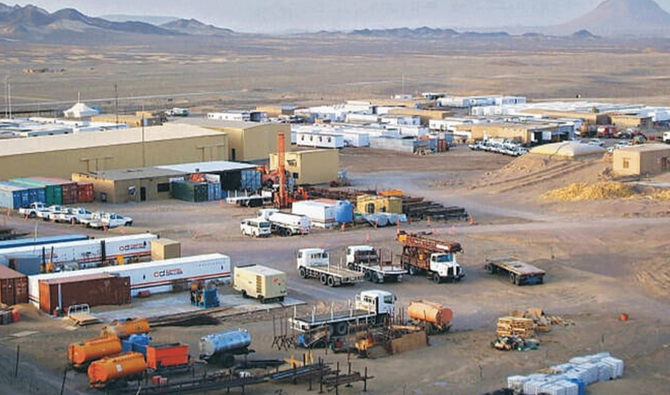
A file photo of the site of the gold and copper mine exploration project of Tethyan Copper Company (TCC) in Reko Diq, in Balochistan, Pakistan. (Photo courtesy: TCC)
Short Url
Updated 10 December 2025
Follow

US commits $1.25 billion EXIM financing for Pakistan’s Reko Diq mine — envoy

  • Financing could unlock up to $2 billion in US mining equipment exports, create 13,500 jobs across Pakistan and US
  • Move aligns with Pakistan’s push to close $3.5 billion debt package for world-class copper-gold mine in Balochistan

KARACHI: Washington has approved $1.25 billion in US Export-Import Bank financing for Pakistan’s Reko Diq copper-gold mine, Acting US ambassador Natalie Baker said in a video message on Wednesday, adding that the package could unlock up to $2 billion in US equipment and service exports for the project.

The facility, one of the largest US financing decisions in Pakistan’s minerals sector, is expected to help pave the way for US-sourced mining technology, drilling machinery and operations support, while creating jobs in both countries and accelerating development of one of the world’s largest untapped copper deposits.

The $7 billion Reko Diq project, located in the mineral-rich southwestern province of Balochistan, is being developed by Canadian mining giant Barrick Gold in partnership with Pakistan’s federal and provincial governments. The mine is central to Pakistan’s effort to expand exports, attract foreign investment and open the country’s largely untapped critical minerals reserves, a segment where copper plays a key role in electric vehicles, renewable energy, AI hardware and global supply chains. Saudi Arabia’s Manara Minerals, a Public Investment Fund and Ma’aden joint venture, has also expressed intent to acquire a 15 percent stake.

“I am pleased to highlight the US Export-Import Bank recently approved financing of $1.25 billion to support the mining of critical minerals at Riko Diq in Pakistan,” Baker said.

“In the coming years, EXIM’s project financing will bring in up to $2 billion in high-quality US mining equipment and services needed to build and operate the Riko Diq mine, along with creating an estimated 6,000 jobs in the US and 7,500 jobs in Balochistan, Pakistan.”

The envoy added that the deal reflects the strategic direction of US commercial diplomacy.

“The Riko Diq project serves as the model for mining projects that will benefit US exporters as well as local Pakistani communities and partners by bringing employment and prosperity to both our nations,” Baker added. “The Trump administration has made the forging of deals exactly like this one central to American diplomacy.”

SECURITY CHALLENGES

Speaking to Arab News last month, Pakistan’s Finance Minister Muhammad Aurangzeb said the broader debt package for Reko Diq was nearly complete, anchored by the International Finance Corporation (IFC) and expected to total about $3.5 billion.

“The financial close, from my perspective, is around the corner,” he said, adding that EXIM participation had been delayed only due to a temporary US government shutdown restrictions, now lifted.

If financing closes on schedule, Reko Diq is projected to generate $2.8 billion in export potential in its first year of shipment, nearly 10 percent of Pakistan’s existing export volume, and could embed the US as a long-term strategic investor alongside Canadian and Saudi partners. The project added 13 million ounces to Barrick’s gold reserves in 2024 and is expected to produce 200,000 metric tons of copper a year in its first phase, doubling after expansion, with projected free cash flow of more than $70 billion over 37 years.

Lenders including the International Finance Corporation and the Asian Development Bank among others are assembling a financing package exceeding $2.6 billion.

Balochistan suffers frequent attacks by separatists and other militants, making security a major concern for the mining scheme. The project also requires a railway line upgrade to transport copper concentrate to Karachi for processing abroad.

Barrick returned to Pakistan in 2022 after a years-long legal dispute was settled, and the mine has since become a flagship investment for the country as it seeks to draw more capital into its minerals sector.


IMF warns against policy slippage amid weak recovery as it clears $1.2 billion for Pakistan

Updated 11 December 2025
Follow

IMF warns against policy slippage amid weak recovery as it clears $1.2 billion for Pakistan

  • Pakistan rebuilt reserves, cut its deficit and slowed inflation sharply over the past one year
  • Fund says climate shocks, energy debt, stalled reforms threaten stability despite recent gains

ISLAMABAD: Pakistan’s economic recovery remains fragile despite a year of painful stabilization measures that helped pull the country back from the brink of default, the International Monetary Fund (IMF) warned on Thursday, after it approved a fresh $1.2 billion disbursement under its ongoing loan program.

The approval covers the second review of Pakistan’s Extended Fund Facility (EFF) and the first review of its climate-focused Resilience and Sustainability Facility (RSF), bringing total disbursements since last year to about $3.3 billion.

Pakistan entered the IMF program in September 2024 after years of weak revenues, soaring fiscal deficits, import controls, currency depletion and repeated climate shocks left the economy close to external default. A smaller stopgap arrangement earlier that year helped avert immediate default, but the current 37-month program was designed to restore macroeconomic stability through strict monetary tightening, currency adjustments, subsidy rationalization and aggressive revenue measures.

The IMF’s new review shows that Pakistan has delivered significant gains since then. Growth recovered to 3 percent last year after shrinking the year before. Inflation fell from over 23 percent to low single digits before rising again after this year’s floods. The current account posted its first surplus in 14 years, helped by stronger remittances and a sharp reduction in imports. And the government delivered a primary budget surplus of 1.3 percent of GDP, a key program requirement. Foreign exchange reserves, which had dropped dangerously low in 2023, rose from US$9.4 billion to US$14.5 billion by June.

“Pakistan’s reform implementation under the EFF arrangement has helped preserve macroeconomic stability in the face of several recent shocks,” IMF Deputy Managing Director Nigel Clarke said in a statement after the Board meeting.

But he warned that Islamabad must “maintain prudent policies” and accelerate reforms needed for private-sector-led and sustainable growth.

The Fund noted that the 2025 monsoon floods, affecting nearly seven million people, damaging housing, livestock and key crops, and displacing more than four million, have set back the recovery. The IMF now expects GDP growth in FY26 to be slightly lower and forecasts inflation to rise to 8–10 percent in the coming months as food prices adjust.

The review warns Pakistan against relaxing monetary or fiscal discipline prematurely. It urges the State Bank to keep policy “appropriately tight,” allow exchange-rate flexibility and improve communication. Islamabad must also continue raising revenues, broadening the tax base and protecting social spending, the Fund said.

Despite the progress, Pakistan’s structural weaknesses remain severe.

Power-sector circular debt stands at about $5.7 billion, and gas-sector arrears have climbed to $11.3 billion despite tariff adjustments. Reform of state-owned enterprises has slowed, including delays in privatizing loss-making electricity distributors and Pakistan International Airlines. Key governance and anti-corruption reforms have also been pushed back.

The IMF welcomed Pakistan’s expansion of its flagship Benazir Income Support Program, which raises cash transfers for low-income families and expands coverage, saying social protection is essential as climate shocks intensify. But it warned that high public debt, about 72 percent of GDP, thin external buffers and climate exposure leave the country vulnerable if reform momentum weakens.

The Fund said Pakistan’s challenge now is to convert short-term stabilization into sustained recovery after years of economic volatility, with its ability to maintain discipline, rather than the size of external financing alone, determining the durability of its gains.