

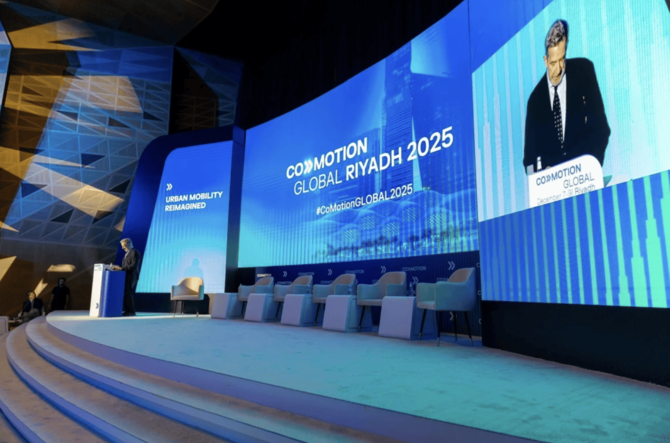
CoMotion Global 2025 in Riyadh discusses trends in electric vehicles

CoMotion Global 2025 commenced on Dec. 7 in Riyadh. Al-Eqtisadiah
Short Url
Updated 08 December 2025
Follow

CoMotion Global 2025 in Riyadh discusses trends in electric vehicles

RIYADH: The Global CoMotion Summit, CoMotion Global 2025, in Riyadh, is examining the latest trends in electric vehicles, autonomous mobility, artificial intelligence in transportation, smart city solutions, and future supply chains.

The summit, hosted by the Saudi Conventions and Exhibitions General Authority, commenced on Dec. 7 in the Saudi capital, highlighting the major transformations witnessed in global cities due to the rapid growth of urban technologies and Saudi Arabia’s role in this sector, according to Al-Eqtisadiah.

This specialized international summit focuses on the future of urban mobility and smart cities, bringing together an elite group of decision-makers, leaders from the public and private sectors, experts, investors, and innovators from around the world.

What are the main objectives of the Global CoMotion Summit?

The summit is being held from Dec. 7 to 9 in Riyadh, further cementing its position as a global center for urban innovation and future technologies.

This is thanks to the extensive transformations it is witnessing, integrating the efforts of the summit’s strategic partners, including multiple ministries and government entities.

Together, they are establishing a national system to push forward the development and on-the-ground application of advanced mobility solutions.

The summit’s work began with an opening session attended by Fahd Al-Rasheed, the chairman of the Board of Directors of SCEGA and the Saudi lead for the Urban 20 initiative, and Rumaih Al-Rumaih, the deputy minister of Transport and Logistic Services, and acting president of Transport General Authority.

They reviewed the features of new transformations in urban transport systems and the future of innovation in the sector.

The founder and CEO of CoMotion, John Rossant, said: “Riyadh hosting this edition of the Global CoMotion Summit makes it an exceptional edition, due to the high-level participation it witnesses, including ministers, city leaders, and prominent creative technologists. This sends a clear message that the next decade of transformation in the mobility sector will be shaped on an unprecedented level to redefine the concept of future cities.”

The summit also features the participation of a number of leading global companies in the mobility sector, including Uber, Door to Door, Budget Saudi Arabia, and Changan Almajdouie. They will showcase the latest technologies and solutions in electric vehicles and smart services, reflecting the Kingdom’s rapid adoption of clean, advanced technologies.

The event’s program also includes a series of interactive mobility labs, the launch of the first edition of the “CoMotion City Pioneers Award,” and the inauguration of the “Mayors in Motion” initiative, aimed at enhancing international cooperation in urban innovation, advanced infrastructure, and sustainable mobility.

Showcasing major development projects in Saudi Arabia

In addition, the gathering will highlight the most prominent development projects in Saudi Arabia, including the Riyadh Metro project, models for developing local electric vehicle manufacturing, and the Kingdom’s preparations to host Expo 2030 and the FIFA World Cup 2034, and their role in enhancing future transport infrastructure. 

It will also showcase global experiences from Africa, China, and North America, with discussions on the future of conscious cities and the use of smart technologies in managing urban mobility.

Hosting the Global CoMotion Summit 2025 is part of Saudi Arabia’s ongoing efforts to enhance its position in building smarter and more sustainable future cities and driving innovation in the urban transport sector, in line with the objectives of Saudi Vision 2030.


Saudi non-oil sector continues to expand, latest PMI report shows

Updated 5 sec ago
Follow

Saudi non-oil sector continues to expand, latest PMI report shows

RIYADH: Saudi Arabia’s non-oil private sector remained firmly in expansion territory in February, supported by strong domestic demand and steady project approvals, according to the latest Riyad Bank Purchasing Managers’ Index.

The report, compiled by S&P Global, stood at 56.1 in February, slightly down from 56.3 in January in what was a nine-month low.

A PMI reading above 50 signals expansion, while a figure below 50 indicates contraction.

Developing a robust non-oil ecosystem remains central to Saudi Arabia’s Vision 2030 strategy, as the Kingdom continues efforts to diversify its economy and reduce reliance on crude revenues.

Iran’s retaliatory strikes across the Gulf since Feb. 28 have caused the biggest business disruption in the region since the COVID-19 pandemic, leading to airport closures, halted port operations, and sharp swings in financial markets.

Naif Al-Ghaith, chief economist at Riyad Bank, said: “Saudi Arabia’s non-oil private sector sustained its expansionary trajectory with a PMI reading of 56.1 in February, though the pace of output growth eased to its lowest level since last August.”  

He added: “This performance was driven by robust domestic demand and a steady flow of new project approvals. Despite the moderation in momentum, the sector remains firmly in growth territory, supported by seven months of rising international sales and an improving volume of new orders.” 

In February, the General Authority for Statistics reported that Saudi Arabia’s real gross domestic product expanded by 4.5 percent year on year in 2025, driven by strong growth in both oil and non-oil activities. 

It added that non-oil activities in the Kingdom grew by 4.9 percent in 2025 compared with the previous year. 

Although output growth slowed to a six-month low, it remained substantial. Survey respondents frequently cited improved customer demand and new project approvals as key drivers. However, some noted that competitive pressures across markets weighed on growth. 

Order books expanded during the month, largely reflecting stronger domestic sales. 

Panelists also attributed higher new work volumes to supportive government policies, improved customer spending, increased sales and marketing efforts, digital business development, and collaborative projects with clients. 

“A key highlight of the February results was the sizeable increase in employment, as firms expanded their workforce to manage higher workloads and new business inflows,” said Al-Ghaith. 

He added that the acceleration in hiring signals confidence in near-term demand, even as overall output growth moderated. 

Supply chain performance also improved, with delivery times shortening amid better coordination and operational efficiencies. 

“Overall, February’s results point to an economy that remains strong but is moving onto a more sustainable balance. Growth has moderated, yet demand and hiring activity continue to anchor the expansion,” said Al-Ghaith. 

He added: “The broader trend remains positive, with businesses actively adjusting their capacity while maintaining a high degree of confidence in underlying market conditions.” 

Looking ahead, survey participants expressed optimism for the next 12 months, citing new client projects, stronger demand and improving domestic economic conditions as key supporting factors. 

However, JPMorgan on March 2 cut its 2026 non-oil growth forecast for the Gulf by 0.3 percentage points and lowered its projection for Saudi Arabia by 0.2 percentage points, cautioning that the estimates are preliminary and subject to high uncertainty.