PIF-owned Lucid’s Q2 deliveries jump 38% as EV maker narrows operational loss

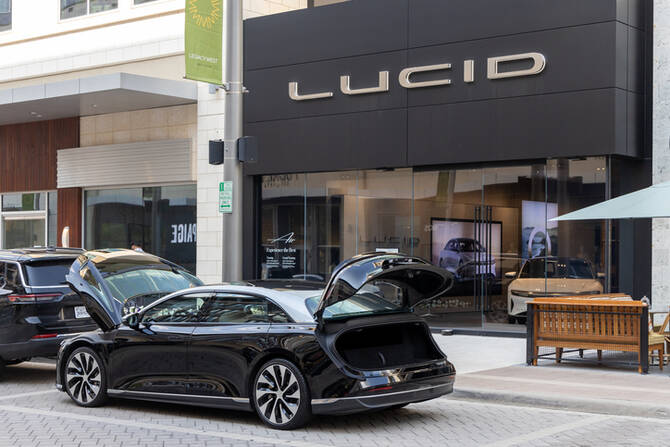
Lucid’s production surged 83 percent year on year to 3,863 units. Getty
Short Url
Updated 06 August 2025
Follow

PIF-owned Lucid’s Q2 deliveries jump 38% as EV maker narrows operational loss

RIYADH: Electric vehicle manufacturer Lucid Group, majority-owned by Saudi Arabia’s Public Investment Fund, boosted deliveries by 38 percent in the second quarter as it narrowed its operational net loss and adjusted its production forecast for the year. 

The California-based company handed over 3,309 vehicles in the three months ending June 30, up from 2,394 a year earlier, while it reported a second-quarter operational net loss of $539.4 million, down from $643.4 million a year ago.

Production surged 83 percent year on year to 3,863 units, reflecting stronger demand for premium EVs in North America, according to a press release. 

This comes as the company expanded charging access for Lucid Air owners through a partnership with Tesla, enabling use of over 23,500 superchargers across North America. 

Marc Winterhoff, interim CEO at Lucid, said: “We had our sixth consecutive quarter of record deliveries in the second quarter and expect to continue this trend as we ramp up Lucid Gravity production in the second half of the year.” 

The company revised its full-year production guidance to a range of 18,000 to 20,000 vehicles, trimming expectations slightly from its earlier target of around 20,000 units. 

In line with its strategy to diversify revenue streams, Lucid recently announced a partnership with Uber Technologies and autonomous driving firm Nuro. The deal will see Uber deploy at least 20,000 Lucid Gravity vehicles equipped with Nuro Driver, a Level 4 autonomous system. 

“In the first quarter, we mentioned our ongoing partnership discussions to develop new revenue streams for our EV technology and beyond. The robotaxi partnership we announced with Uber and Nuro is a perfect example aligned with that strategy,” he added. 

“We delivered solid performance despite a challenging macroeconomic backdrop, thanks to the adaptability and focus of our team in navigating a dynamic environment,” said Taoufiq Boussaid, chief financial officer at Lucid. 

Boussaid added that the company is currently focussed on business fundamentals to achieve its near-term goals which include disciplined cost management and brand building. 

“We remain committed to strengthening our balance sheet and maintaining long-term alignment with partners and shareholders,” he said. 

The company ended the second quarter with approximately $4.86 billion in total liquidity, the statement added. 

When factoring in preferred stock accretion — an accounting adjustment that reflects the increasing redemption value of convertible preferred shares held by certain investors, along with other items — the net loss attributable to common stockholders widened to $855.3 million in the second quarter of 2025, compared to $790.3 million in the same period a year earlier.

Preferred stock accretion does not involve an immediate cash outflow, but it reduces the earnings available to common shareholders and is therefore included in GAAP earnings per share calculations.

In April, Lucid had closed a $1.1 billion offering of convertible senior notes due in 2030.

At the time, the company said in a statement that $935.6 million of the net proceeds would be used to repurchase approximately $1.05 billion in aggregate principal of its outstanding 1.25 percent convertible senior notes due 2026. 

Lucid’s offering of convertible senior notes is a way for the company to raise cash by borrowing money that can later be converted into shares, while protecting existing investors from dilution. 


G7 countries to release oil reserves as IEA agrees to largest ever market intervention

Updated 11 March 2026
Follow

G7 countries to release oil reserves as IEA agrees to largest ever market intervention

  • IEA recommends release of 400 million barrels

RIYADH: Germany, Japan and Austria will release part of their oil reserves after the International Energy Agency recommended the release of 400 million barrels of oil ‌from stockpiles, the largest ‌such move in IEA ​history.

In a statement, IEA Executive Director Fatih Birol said the flow of oil, gas and other commodities through the Strait of Hormuz have all but stopped, leading global energy supply to fall by around 20 percent.

Ahead of the confirmation of the move — a larger intervention than the 182.7 million barrels that were released in 2022 by in response to Russia’s invasion of Ukraine — several countries began setting out plans to bring their reserves into play as countries grapple with ​soaring crude prices amid ​the US-Israeli war with Iran. 

Birol said: “I can now announce that IEA countries have decided to launch the largest ever release of emergency oil stocks in our agency's history. 

“IEA countries will be making 400 million barrels of oil available to the market to offset the supply lost through the effective closure of the strait.

“This is a major action aiming to alleviate the immediate impacts of the disruption in markets.”

Germany’s Economy ⁠Minister ​Katherina Reiche ⁠confirmed on Wednesday her government plans to limit petrol price increases at filling stations to once a day and to introduce more stringent antitrust regulation of the sector.

She did not ⁠give an exact timing for ‌those measures, but added that ‌the US and ​Japan would be the ‌largest contributors to the release of the ‌oil reserves.

The US has not confirmed it would do so, but its Interior Secretary Doug Burgum told Fox News on Wednesday that “these are the kinds of moments that these reserves are used for.”

The announcements did not stop oil prices rising, with Brent crude up 3.26 percent to $90.66 a barrel at 4:29 p.m Saudi time, and West Texas Intermediate up 3.12 percent to $86.05. Both were some way below the $119 a barrel seen earlier in the week.

“The situation regarding oil supplies is tense, as the Strait of Hormuz is currently virtually impassable,” Germany’s Reiche said.

“We will comply with this request and ‌contribute our share, because Germany stands behind the IEA’s most important principle: mutual ⁠solidarity,” Reiche ⁠said about the IEA’s request.

According to a statement by Reiche’s ministry, Germany will contribute 2.64 million tonnes of oil. This corresponds to 19.51 million barrels.

Reiche stressed there was no supply shortage in the country, which has a legally mandated reserve of oil and oil products intended to cover 90 days’ demand.

South Korea will release 22.46 million ​barrels of oil, which represents 5.6 percent of the total IEA ask, the ⁠country's industry ministry said.

“The government will consult with the IEA ⁠secretariat on details, such ‌as ‌the ​timing ‌and amount, from ‌the perspective of national interests in accordance with domestic conditions,” ‌the ministry said in a statement.

The ⁠ministry ⁠said it would continue to coordinate closely with major countries in responding to high oil prices to minimise any domestic ​impact.

Austrian Economy Minister Wolfgang Hattmannsdorfer said his country was releasing part of the emergency oil reserve and extending the national strategic gas reserve, adding: “One thing is clear: in a crisis, there must be no crisis winners at the expense of commuters and businesses.”

Acting ahead of the IEA move, G7 ​member Japan announced plans to release 15 days' worth of ‌private-sector oil reserves and one month's worth of state oil reserves.

“Rather than wait for formal IEA approval ‌of a coordinated international reserve release, Japan will act first to ease global energy market supply and demand, releasing reserves as early as the 16th of this month,” Prime Minister Sanae Takaichi said in a broadcast statement.

Following a meeting with the IEA on Wednesday, G7 energy ministers said: “In principle, we support the implementation of proactive measures to address the situation, including the use of strategic reserves.”

All IEA member countries are required to keep 90 days’ worth of their nation’s oil use in reserve in case of global disruption.