

Benin’s President Talon says mutineers ‘fleeing’ as ECOWAS forces help crush coup attempt

1 / 2
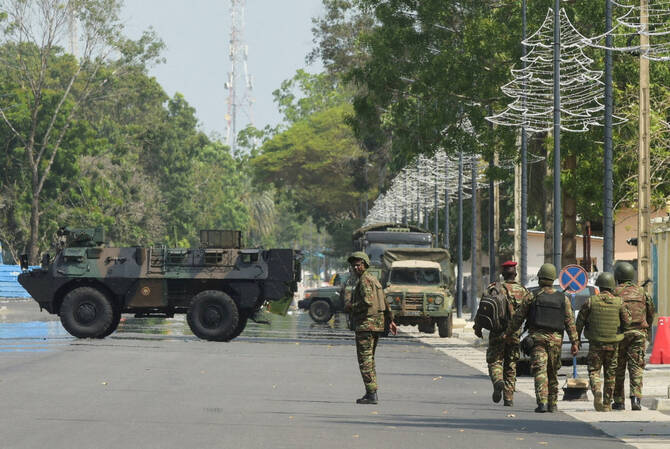
Soldiers patrol in front of the headquarters of Benin's radio and television station in Cotonou on December 7, 2025, after the country's armed forces, aided by ECOWAS forces, thwarted an attempted coup against the government of President Patrice Talon. (Reuters)
2 / 2
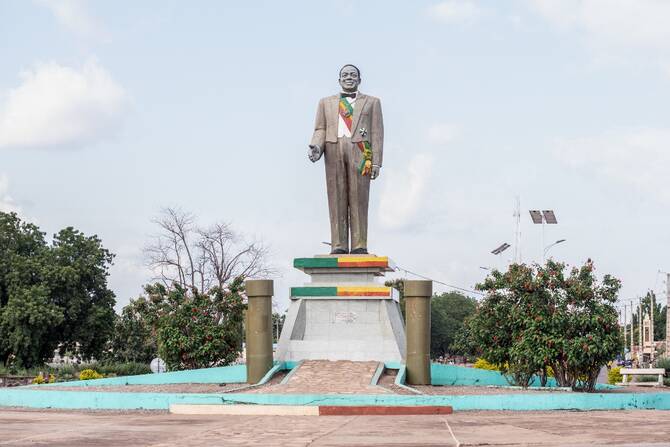
A general view of a statue of Benin’s first President Hubert Maga in Parakou, Benin. (AFP)
Short Url
Updated 08 December 2025
Follow

Benin’s President Talon says mutineers ‘fleeing’ as ECOWAS forces help crush coup attempt

  • Group calling itself the Military Committee for Refoundation earlier announced the formation of a junta led by one Lt. Col. Pascal Tigri 
  • Nigeria’s President Tinubu later confirmed that Nigerian troops joined ECOWAS forces in helping crush the coup attempt

COTONOU, Benin: Benin President Patrice Talon on Sunday condemned an attempted coup that was foiled by the country’s army in his first public comments since sporadic gunfire was heard in parts of the administrative capital, Cotonou.
A group of soldiers appeared on Benin ‘s state TV earlier Sunday to announce the dissolution of the government in an apparent coup, which would have been the latest of many in West Africa. The group called itself the Military Committee for Refoundation.
Later, Interior Minister Alassane Seidou announced in a video on Facebook that the attempted coup had been “foiled,” but Talon, whose location was unclear, did not comment.
“I would also like to take this opportunity to express my condolences to the victims of this senseless adventure, as well as to those still being held by the fleeing mutineers,” the president said in a televised address to the nation that ended his silence. “I assure them that we will do everything in our power to find them safe and sound.”

The coup attempt is the latest in a string of military takeovers and attempted takeovers that have rocked West Africa. Last month, a military coup in Guinea-Bissau removed former President Umaro Embalo after a contested election in which both he and the opposition candidate declared themselves winners.


Benin President Patrice Talon addresses the nation on state broadcaster after coup attempt, in Cotonou, Benin, on December 7, 2025. (Benin TV/Reuters TV via REUTERS)

Talon did not provide figures on casualties or hostages in Sunday’s attempted coup.
“In the early morning of Sunday, Dec. 7, 2025, a small group of soldiers launched a mutiny to destabilize the state and its institutions,” Seidou said. “Faced with this situation, the Beninese Armed Forces and their leadership, true to their oath, remained committed to the republic.”
The regional bloc, the Economic Community of West African States, or ECOWAS, said it ordered the deployment of troops from Nigeria, Sierra Leone, Ivory Coast and Ghana to support Benin’s army to “preserve constitutional order and the territorial integrity of the Republic of Benin.”
ECOWAS earlier called the attempted coup “a subversion of the will of the people of Benin.”
Nigeria’s President Bola Tinubu praised the Nigerian armed forces for their involvement in restoring the government in Benin. In a statement by the Nigerian government’s spokesperson, Bayo Onanuga said Benin’s government made two separate requests for air and ground forces.
“It took some hours before the government’s loyal forces, assisted by Nigeria, took control and flushed out the coup plotters from the National TV,” Onanuga said in the statement.
Local media reported the arrest of 13 soldiers who took part in the coup earlier on Sunday, citing sources close to the presidency. It remained unclear if Lt. Col. Pascal Tigri, the coup leader, had been apprehended. Gunfire was heard and soldiers were seen patrolling in some locations in Cotonou, but the city has been relatively calm since the coup attempt was announced.


Illustration courtesy of Gemini

The Military Committee for Refoundation earlier said that Tigri was appointed president of the military committee.
Following its independence from France in 1960, the West African nation witnessed multiple coups. Since 1991, the country has been politically stable following the two-decade rule of Marxist-Leninist Mathieu Kérékou.
The signal to the state television and public radio, which was cut off, was later restored.
Talon has been in power since 2016 and is due to step down next April after a presidential election.
Talon’s party pick, former Finance Minister Romuald Wadagni, is the favorite to win the election. Opposition candidate Renaud Agbodjo was rejected by the electoral commission on the grounds that he did not have sufficient sponsors.
In January, two associates of Talon were sentenced to 20 years in prison for an alleged 2024 coup plot.
Last month, the country’s legislature extended the presidential term of office from five to seven years, keeping the term limit at two.


WHO chief says reasons US gave for withdrawing ‘untrue’

Updated 25 January 2026
Follow

WHO chief says reasons US gave for withdrawing ‘untrue’

  • US Secretary of State Marco Rubio and US Health Secretary Robert F. Kennedy Jr. announced in a joint statement Thursday that Washington had formally withdrawn from the WHO
  • And in a post on X, Tedros added: “Unfortunately, the reasons cited for the US decision to withdraw from WHO are untrue”

GENEVA: The head of the UN’s health agency on Saturday pushed back against Washington’s stated reasons for withdrawing from the World Health Organization, dismissing US criticism of the WHO as “untrue.”
Tedros Adhanom Ghebreyesus warned that US announcement this week that it had formally withdrawn from the WHO “makes both the US and the world less safe.”
And in a post on X, he added: “Unfortunately, the reasons cited for the US decision to withdraw from WHO are untrue.”
He insisted: “WHO has always engaged with the US, and all Member States, with full respect for their sovereignty.”
US Secretary of State Marco Rubio and US Health Secretary Robert F. Kennedy Jr. announced in a joint statement Thursday that Washington had formally withdrawn from the WHO.
They accused the agency, of numerous “failures during the Covid-19 pandemic” and of acting “repeatedly against the interests of the United States.”
The WHO has not yet confirmed that the US withdrawal has taken effect.

- ‘Trashed and tarnished’ -

The two US officials said the WHO had “trashed and tarnished” the United States, and had compromised its independence.
“The reverse is true,” the WHO said in a statement.
“As we do with every Member State, WHO has always sought to engage with the United States in good faith.”
The agency strenuously rejected the accusation from Rubio and Kennedy that its Covid response had “obstructed the timely and accurate sharing of critical information that could have saved American lives and then concealed those failures.”
Kennedy also suggested in a video posted to X Friday that the WHO was responsible for “the Americans who died alone in nursing homes (and) the small businesses that were destroyed by reckless mandates” to wear masks and get vaccinated.
The US withdrawal, he insisted, was about “protecting American sovereignty, and putting US public health back in the hands of the American people.”
Tedros warned on X that the statement “contains inaccurate information.”
“Throughout the pandemic, WHO acted quickly, shared all information it had rapidly and transparently with the world, and advised Member States on the basis of the best available evidence,” the agency said.
“WHO recommended the use of masks, vaccines and physical distancing, but at no stage recommended mask mandates, vaccine mandates or lockdowns,” it added.
“We supported sovereign governments to make decisions they believed were in the best interests of their people, but the decisions were theirs.”

- Withdrawal ‘raises issues’ -

The row came as Washington struggled to dislodge itself from the WHO, a year after US President Donald Trump signed an executive order to that effect.
The one-year withdrawal process reached completion on Thursday, but Kennedy and Rubio regretted in their statement that the UN health agency had “not approved our withdrawal and, in fact, claims that we owe it compensation.”
WHO has highlighted that when Washington joined the organization in 1948, it reserved the right to withdraw, as long as it gave one year’s notice and had met “its financial obligations to the organization in full for the current fiscal year.”
But Washington has not paid its 2024 or 2025 dues, and is behind around $260 million.
“The notification of withdrawal raises issues,” WHO said Saturday, adding that the topic would be examined during WHO’s Executive Board meeting next month and by the annual World Health Assembly meeting in May.
“We hope the US will return to active participation in WHO in the future,” Tedros said Saturday.
“Meanwhile, WHO remains steadfastly committed to working with all countries in pursuit of its core mission and constitutional mandate: the highest attainable standard of health as a fundamental right for all people.”