Zionist activists deface Palestinian Embassy in London as envoy calls for security upgrades

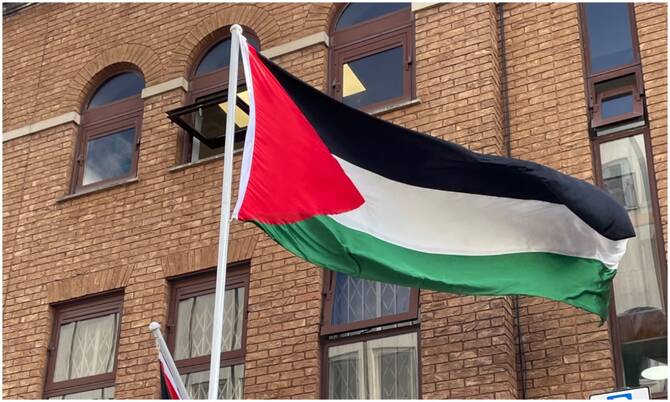
On Sept. 22, the embassy hosted a flag-raising ceremony after the UK formally recognized the Palestinian state. (AN Photo/Mustafa Abu Sneineh)
Short Url
Updated 06 December 2025
Follow

Zionist activists deface Palestinian Embassy in London as envoy calls for security upgrades

  • Masked group waved Israeli flags outside the building and plastered facade with stickers
  • The embassy was upgraded from a mission this year after UK’s recognition of Palestinian state

LONDON: Palestine’s ambassador to the UK, Husam Zomlot, has appealed for “comprehensive protection” after a group of Zionist activists attacked his embassy last Saturday, The Guardian has reported.

Masked activists were seen waving Israeli flags while posing at the entrance to the embassy in Hammersmith, west London. The building was also plastered with stickers bearing phrases including “I love the IDF.”

On Sept. 22, the embassy hosted a flag-raising ceremony after the UK formally recognized the Palestinian state, upgrading the diplomatic status of what had previously been the Palestinian mission to Britain.

Despite the upgrade, no changes to security arrangements have been made, and fears are now mounting over the safety of its staff.

A post on Facebook called for another demonstration outside the building on Friday, Dec. 5.

It said: “A hardcore group of Zionists have decided it’s time for direct action to challenge the haters and give them a taste of their own medicine. Bring your union jack and Israeli flags and your megaphones.

“We’re calling for an end to Hamas and PIJ (Palestinian Islamic Jihad) terrorism once and for all.”

The embassy has no affiliation with either militant group, and is part of the Palestinian Authority.

Zomlot said: “To those responsible, we clearly say your actions will not deter us. We will continue to advance Palestine-UK relations and defend the rights and lives of the Palestinian people.

“We have formally requested the British authorities to provide immediate and comprehensive protection for the embassy and our personnel from such attacks. We call on them to investigate this incident fully and hold those responsible accountable.”

In 2023, when the embassy was still the Palestinian mission, its staff reported four attacks in the space of a few weeks. They also received death threats.

Officials said that the lack of diplomatic protection provided to embassy staff had been “inexplicable and unacceptable.”

Other stickers posted on the building last week included one with a star of David placed over the union flag with the slogan: “We are not Jews trembling at the knees.”

Host states of missions and embassies are required to undertake a “special duty” to protect premises from damage or surveillance, according to the Vienna Convention on Diplomatic Relations.

In a statement, the Palestinian Embassy described the events of last Saturday as a “flagrant breach of diplomatic laws and customs and the rules of international law.”

Palestinian missions outside of the UK, including in France, often receive permanent security and their ambassadors are sometimes given close protection.

A spokesperson for London’s Metropolitan Police told The Guardian: “We take the security and safety of the diplomatic community extremely seriously. Security arrangements at diplomatic premises, overseen by the Met’s parliamentary and diplomatic protection command, are based on an assessment of risk and are constantly reviewed.”


Only 4% women on ballot as Bangladesh prepares for post-Hasina vote

Updated 26 January 2026
Follow

Only 4% women on ballot as Bangladesh prepares for post-Hasina vote

  • Women PMs have ruled Bangladesh for over half of its independent history
  • For 2026 vote, only 20 out of 51 political parties nominated female candidates

DHAKA: As Bangladesh prepares for the first election since the ouster of its long-serving ex-prime minister Sheikh Hasina, only 4 percent of the registered candidates are women, as more than half of the political parties did not field female candidates.

The vote on Feb. 12 will bring in new leadership after an 18-month rule of the caretaker administration that took control following the student-led uprising that ended 15 years in power of Hasina’s Awami League party.

Nearly 128 million Bangladeshis will head to the polls, but while more than 62 million of them are women, the percentage of female candidates in the race is incomparably lower, despite last year’s consensus reached by political parties to have at least 5 percent women on their lists.

According to the Election Commission, among 1,981 candidates only 81 are women, in a country that in its 54 years of independence had for 32 years been led by women prime ministers — Hasina and her late rival Khaleda Zia.

According to Dr. Rasheda Rawnak Khan from the Department of Anthropology at Dhaka University, women’s political participation was neither reflected by the rule of Hasina nor Zia.

“Bangladesh has had women rulers, not women’s rule,” Khan told Arab News. “The structure of party politics in Bangladesh is deeply patriarchal.”

Only 20 out of 51 political parties nominated female candidates for the 2026 vote. Percentage-wise, the Bangladesh Socialist Party was leading with nine women, or 34 percent of its candidates.

The election’s main contender, the Bangladesh Nationalist Party, whose former leader Zia in 1991 became the second woman prime minister of a predominantly Muslim nation — after Pakistan’s Benazir Bhutto — was the party that last year put forward the 5 percent quota for women.

For the upcoming vote, however, it ended up nominating only 10 women, or 3.5 percent of its 288 candidates.

The second-largest party, Jamaat-e-Islami, has not nominated a single woman.

The 4 percent participation is lower than in the previous election in 2024, when it was slightly above 5 percent, but there was no decreasing trend. In 2019, the rate was 5.9 percent, and 4 percent in 2014.

“We have not seen any independent women’s political movement or institutional activities earlier, from where women could now participate in the election independently,” Khan said.

“Real political participation is different and difficult as well in this patriarchal society, where we need to establish internal party democracy, protection from political violence, ensure direct election, and cultural shifts around female leadership.”

While the 2024 student-led uprising featured a prominent presence of women activists, Election Commission data shows that this has not translated into their political participation, with very few women contesting the upcoming polls.

“In the student movement, women were recruited because they were useful, presentable for rallies and protests both on campus and in the field of political legitimacy. Women were kept at the forefront for exhibiting some sort of ‘inclusive’ images to the media and the people,” Khan said.

“To become a candidate in the general election, one needs to have a powerful mentor, money, muscle power, control over party people, activists, and locals. Within the male-dominated networks, it’s very difficult for women to get all these things.”