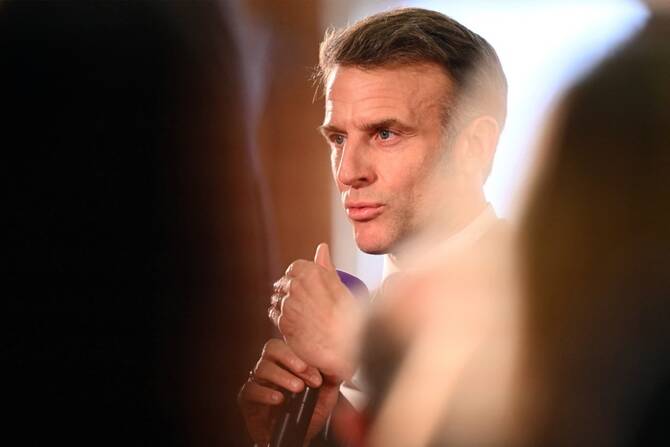
PARIS: Emmanuel Macron heads to China on Wednesday for a three-day state visit focusing on trade and diplomatic talks as the French president seeks to enlist Beijing in pressuring Russia toward a ceasefire with Ukraine.
Macron will advocate for an agenda of cooperation in economic and trade matters aimed at achieving a balance that ensures “sustainable, solid growth that benefits everyone,” his office said.
France is aiming to attract more investment from Chinese companies and facilitate market access for French exports. During the visit, officials from both nations are expected to sign several agreements in the energy, food industry, and aviation sectors.
Macron is committed to defend “fair and reciprocal market access,” his office said.
France will host the Group of Seven summit in 2026 involving the world’s most advanced economies, while China will chair the 21-member Asia-Pacific Economic Cooperation forum, which includes the United States, South Korea, Japan, Australia, and Russia.
The 27-nation bloc runs a massive trade deficit with China — over 300 billion euros last year. China alone represents 46 percent of France’s total trade deficit.
France and the European Union have described China as a partner, competitor and systemic rival. Recent years have been marked by multiple trade disputes across a range of industries after the EU undertook a probe into Chinese electric vehicles subsidies. China responded with investigations into imports of European brandy, pork and dairy products.
In July, Macron welcomed exemptions for most cognac producers as a positive step. France is China’s first supplier of wine and spirits.
Macron’s talks with President Xi Jinping will also address Russia’s war in Ukraine, particularly following a meeting Monday in Paris with Ukrainian President Volodymyr Zelensky to discuss potential terms for a ceasefire.
“What we want ... is that China can convince and influence Russia to move toward a ceasefire as quickly as possible and consolidate that ceasefire through negotiations which, in our view, should lead to solid security guarantees for Ukraine,” a French top diplomatic official said.
Paris expects Beijing to “refrain from providing Russia with any means whatsoever to continue the war,” the official said, speaking anonymously in line with the French presidency customary practices.
China’s Foreign Ministry spokesperson Mao Ning said last week that Beijing believes in “dialogue and negotiation” to resolve Ukraine war and supports “all efforts” leading to peace. Since the beginning of the Ukraine conflict, China “has played a constructive role in promoting a political resolution of the crisis,” she said.
Macron, who will be accompanied by his wife, Brigitte, is scheduled to arrive in Beijing on Wednesday evening, with plans to visit the 18th-century Qianlong Garden complex in the Forbidden City, which has been recently reopened to the public after a major renovation.
On Thursday, Macron will meet with Xi at the Great Hall of the People. Both leaders will then participate in a Franco-Chinese business forum. In the afternoon, Macron’s agenda includes talks with Zhao Leji, chairman of the National People’s Congress, and Chinese Premier Li Qiang.
The French presidential couple will then travel to Chengdu in China’s Sichuan province.
On Friday, Macron and Xi will have talks in Dujiangyan, on the site of one of the world’s oldest irrigation system. Macron will later meet with students from the Sichuan University.
Chengdu is also home to the Conservation and Research Center for the Giant Panda, where Yuan Meng, the first giant panda born in France who got his name by first lady Brigitte Macron, is now staying. France last month sent back to China a couple of star giant pandas who lived in the country for 13 years and gave birth to three cubs.


![]()

Macron heads to China for talks with Xi on trade ties and Russia’s war in Ukraine
Short Url
https://arab.news/9q8pn
Macron heads to China for talks with Xi on trade ties and Russia’s war in Ukraine
- France and the European Union have described China as a partner, competitor and systemic rival
Latest updates






© 2026 SAUDI RESEARCH & PUBLISHING COMPANY, All Rights Reserved And subject to Terms of Use Agreement.