


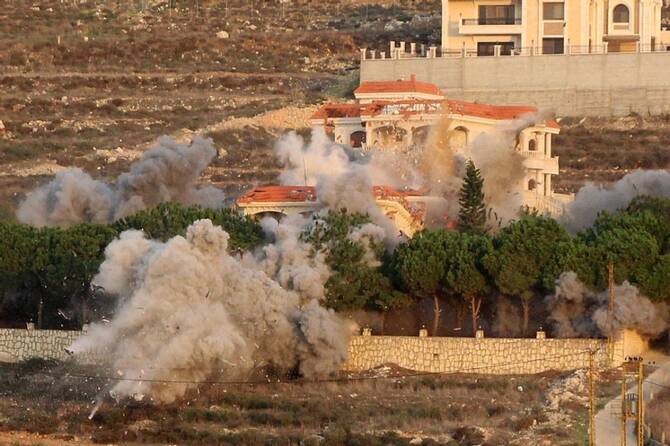

BEIRUT: Lebanese President Joseph Aoun told a visiting UN Security Council delegation on Friday that Lebanon has chosen the path of negotiations, not war, with Israel, as tensions continue to rise along the southern border between the countries.
Former ambassador Simon Karam has been appointed to lead the Lebanese delegation in ceasefire discussions with Israel, he added, in an effort “to spare the country another round of violence.”
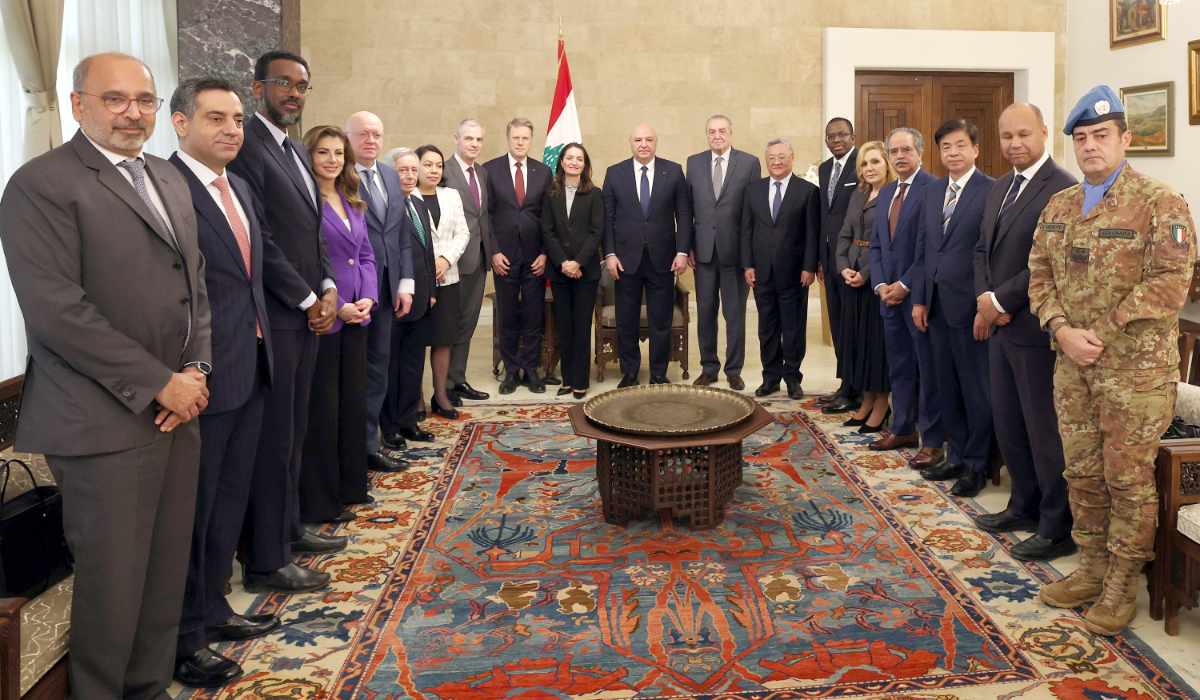
Lebanese President Joseph Aoun poses for a group photo with members of the visiting UN Security Council delegation in Beirut. (Supplied)
Aoun’s comments came during talks in Beirut with the 15-member UN delegation, which was led by Ambassador Samuel Zbogar from Slovenia, which holds the presidency of the Security Council this month.
On Wednesday, Lebanese and Israeli civilian representatives held their first direct talks in decades in Ras Al-Naqoura, beginning what Aoun described as “a new phase of negotiations.”
He continued: “Wars have never brought lasting solutions. Only negotiations can create the conditions for stability, resolve outstanding issues and reduce the suffering of civilians.”
The Security Council delegates traveled to Beirut from Damascus, where they had met Syrian officials on Thursday to reaffirm international support for Syria in the aftermath of the fall of the Assad regime a year ago.
In Lebanon, their meetings focused on implementation of UN Security Council Resolution 1701, particularly efforts to place all weapons under the control of the Lebanese state. The resolution was adopted by the council in 2006 with the aim of resolving the conflict that year between Israel and Hezbollah. It calls for an end to hostilities, the withdrawal of all Israeli forces from Lebanon, the withdrawal of Hezbollah and other armed groups from parts of the country south of the Litani River, and the disarmament of Hezbollah and other armed groups.
Zbogar said the delegation sought clarity on the process for disarmament on nonstate armed groups, and specifically the continued armed presence of Hezbollah. Aoun affirmed the government’s commitment to the disarmament process. He vowed that the Lebanese army would fulfill its role in protecting citizens across the country, especially in the south, and stressed that there was a national consensus that no weapons should exist outside of state control.
“We have asked all parties to cooperate in implementing this decision, even if it takes time,” he said. “There will be no turning back.”
Zbogar reiterated the UN’s “full support for the diplomatic efforts required to resolve the dispute or reach a settlement regarding the international border with Israel.” The Security Council also backs the start of a negotiation process with Syria, he added.
He also affirmed the delegation’s commitment to stability in Lebanon, and the wider region, and its full support for the work of the UN Interim Force in Lebanon, the mandate for which is due to expire at the end of 2026. With this in mind, he asked for Lebanon’s assessment of the future role of international forces.
Aoun told the delegation that Lebanon’s peace talks with Israel were shaped by national interest, not international pressure.
“Lebanon’s approach to the Joint Mechanism negotiations is not about appeasing the international community; it is driven by Lebanon’s own best interests,” he said.
“Our decision is final. I have communicated this to Arab and international officials, including US Secretary of State Marco Rubio, and we are committed to taking this path.”
The peace talks aim to enable the full implementation of the November 2024 ceasefire agreement between Lebanon and Israel, end Israeli hostilities against Lebanon, secure the release of prisoners, establish a timetable for a complete Israeli withdrawal from occupied areas, and resolve remaining points of contention along the Blue Line, the demarcation line between the countries set by the UN in June 2000.
“We hope they will produce positive results,” Aoun said. “Ultimately, their success depends on Israel’s position.”
He highlighted the Lebanese army’s successes so far in its efforts to clear the region south of the Litani River of armed groups and their weapons, but reiterated that the continuing Israeli occupation of some areas along the border was hindering full deployment.
“This, however, did not prevent the army from carrying out its mission in geographically vast regions, filled with valleys, where access is not always easy,” Aoun said.
He called on the international community to support the army’s mission, stressing the interconnected nature of regional stability, and adding that enhancement of “Lebanon’s stability contributes to the safety of other brotherly and friendly countries.”
Regarding Lebanon’s relationship with the UN’s Interim Force, Aoun confirmed that the Lebanese army will continue to coordinate with the peacekeepers in southern Lebanon until their “final day” in the country.
He added: “We had hoped UNIFIL would remain until the army completes its full deployment along the internationally recognized border.
“We welcome any country that is willing to keep its forces, partially or fully, in place to assist the army after UNIFIL’s withdrawal at the end of 2026.”
The speaker of the Lebanese parliament, Nabih Berri, who also met the Security Council delegation, said stability in southern Lebanon requires commitments by Israel to the implementation of Resolution 1701 and the 2024 ceasefire agreement.
“Negotiating under fire is impermissible and unacceptable,” he added, warning that “Israel’s ongoing aggression could reignite the war.”
During his meeting with the delegates, Prime Minister Nawaf Salam stressed the need for an international force to provide support for the army when the UNIFIL mandate ends, to avoid a vacuum in southern Lebanon.
He suggested that a new international force could operate within the framework of the UN Truce Supervision Organization, or as a limited peacekeeping force similar to UN Disengagement Observer Force in the Golan Heights, in terms of its tasks, the nature of deployment and border control.
Meanwhile, UNIFIL said on Friday that peacekeepers on patrol near Bint Jbeil had been approached by six men on three mopeds, one of whom fired approximately three shots into the back of their vehicle. No casualties were reported.
The force said attacks on peacekeepers “are unacceptable” and represent grave violations of Resolution 1701. It reminded Lebanese authorities “of their obligations to ensure the safety and security of peacekeepers, and demand a full and immediate investigation to bring the perpetrators to justice.”
UNIFIL also reported Israeli airstrikes in its area of operations on Thursday, while the Lebanese army continued its operations to clear unauthorized weapons and related infrastructure in southern Lebanon. The force encouraged the Israeli army to “benefit from the available mechanisms for liaison and coordination.”
In a statement on Friday during a Hezbollah gathering in the southern suburbs of Beirut, the Iran-backed organization’s secretary-general, Naim Qassem, commented on the negotiation process with Israel.
“All of our dealings, as a Lebanese State, with the Israeli enemy are limited to the ceasefire agreement,” he said.
Hezbollah supports the state’s choice to pursue a diplomatic path to end hostilities with Israel and “we stand by its decision to continue in this direction,” he added.
However, he argued that the participation of a civilian delegation in peace talks was a violation, because this was supposed to be contingent on the cessation of hostilities by Israel.
“You offered a free concession, which won’t change the enemy’s stance or aggression,” Qassem told the Lebanese government.
He also reiterated that Hezbollah refuses to give up its weapons in areas north of the Litani, stating that “this is an internal Lebanese matter and we reject any attempt to erase our existence.”


