

Nigeria’s defense minister resigns amid security crisis

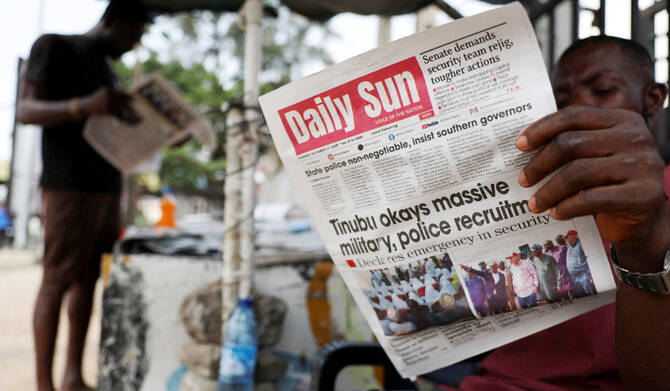
People read newspapers at a roadside newspaper stand in Ikoyi Lagos, Nigeria, November 27, 2025. (REUTERS)
Short Url
Updated 02 December 2025
Follow

Nigeria’s defense minister resigns amid security crisis

  • Africa’s most populous country has long experienced insecurity but the spate of abductions recently has left it scrambling

ABUJA: Nigeria’s defense minister has resigned, the presidency said, as the country reeled from a security crisis including mass kidnappings of schoolchildren.
The departure of Mohammed Badaru Abubakar came after President Bola Tinubu declared a “nationwide security emergency” last week as the country scrambled to respond to a wave of mass kidnappings that have seen hundreds of people, mostly schoolchildren, captured within days last month.
Tinubu’s spokesman, Bayo Onanuga, said in a statement that Abubakar, 63, was quitting with immediate effect, on health grounds.
“His resignation comes amid President Tinubu’s declaration of a national security emergency, with plans to elaborate on its scope in due course,” the spokesman said.
Africa’s most populous country has long experienced insecurity but the spate of abductions recently has left it scrambling.
US President Donald Trump in late October named Nigeria a Country of Particular Concern — a State Department designation for religious freedom violations — over what he called killing of Christians. He subsequently threatened to intervene militarily.
Washington’s rhetoric — rejected by the Nigerian government and independent security analysts — has placed the country’s security crisis under the spotlight.
Armed gangs seized more than 300 teachers and staff at St. Mary’s co-education school in north-central Nigeria on November 21. Fifty escaped but the rest are still in captivity.
“The children are fine and will be back soon,” national security adviser Nuhu Ribadu, was quoted as saying during a high-profile visit with school officials in the town of Kontagora, in central Niger state.
Since Boko Haram militants kidnapped nearly 300 schoolgirls from the northeastern town of Chibok in an infamous raid more than a decade ago, Nigeria has struggled to contain mass kidnappings.
In addition to kidnappings, which are frequent in Nigeria and are mostly carried out by criminal gangs seeking quick ransom payments, Africa’s most populous country has been battling a deadly militant insurgency in its northwestern regions, since 2009.
In the wake of the kidnappings, the country’s president declared emergency, and ordered mass recruitment of police and military personnel.
Recent raids have resulted in kidnappings of schoolchildren and teachers, worshippers and priests, a bride and her bridemaids, farmers, women and children as well as farmers across various parts of the country.


Indonesia eyes investment boost from UAE after leaders’ meeting 

Updated 20 min 10 sec ago
Follow

Indonesia eyes investment boost from UAE after leaders’ meeting 

  • Indonesia-UAE trade was worth $6.4b in 2025, up from $5b in 2024
  • President Prabowo Subianto, MBZ also discussed increasing cooperation in renewable energy, tech, AI

JAKARTA: Indonesia is expecting more investments from the UAE, the Indonesian government said on Friday following talks between President Prabowo Subianto and his Emirati counterpart Sheikh Mohamed bin Zayed Al-Nahyan.

Indonesia’s relations with the UAE grew under former President Joko Widodo, who in 2021 secured more than $46 billion investment commitment from the Gulf state.

Subianto visited Abu Dhabi earlier this week accompanied by Foreign Minister Sugiono, and Energy and Mineral Resources Minister Bahlil Lahadalia on a trip aimed at strengthening cooperation under the Indonesia-UAE Comprehensive Economic Partnership Agreement. 

“The meeting discussed cooperation to increase investment (and) strengthen bilateral cooperation. The UAE wants to increase its investment in Indonesia,” Cabinet Secretary Teddy Indra Wijaya said in a statement, without disclosing any amount. 

Indonesia and the UAE signed the free trade deal in 2022, which came into force a year later. It was Jakarta’s first with a Gulf country and Abu Dhabi’s first with a Southeast Asian nation.

The Indonesia-UAE CEPA erases about 99 percent of existing tariffs and includes commitments to increase Indonesia’s services exports to the UAE by 6 percent while mutually recognizing each country’s halal certification.

Commerce between the two countries has seen a boost since then, with bilateral trade reaching more than $6.4 billion in 2025, according to Indonesian Trade Ministry data, showcasing an increase of nearly 27 percent from the previous year, when it was worth around $5 billion.

The Emirati state news agency WAM said the talks in Abu Dhabi also covered ways to increase cooperation in other sectors, including renewable energy, technology, artificial intelligence, sustainability, food security and culture.

“The (UAE) president noted the continuing progress of long-standing UAE-Indonesia relations, which are founded on mutual trust, respect and shared interests,” WAM said.

“He reaffirmed the UAE’s commitment to advancing its development and economic partnership with Indonesia for the benefit of both countries and their peoples.”

This year marks the 50th anniversary of diplomatic relations between Indonesia and the UAE.

The UAE was Subianto’s last stop on a multi-nation trip, which included the US, the UK and Jordan.