

Pakistan’s fragile economic recovery faces risk as Iran conflict raises escalation fears

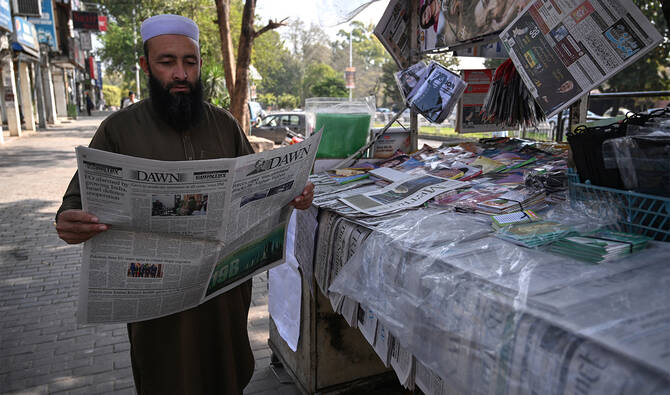
A man reads a newspaper reporting at a roadside stall in Islamabad on February 27, 2026. (AFP/File)
Short Url
Updated 01 March 2026
Follow

Pakistan’s fragile economic recovery faces risk as Iran conflict raises escalation fears

  • KP finance advisor says wider Gulf conflict could undermine $41 billion remittance target, push up energy prices
  • Economists warn oil surge would widen import bill as Iran targets neighboring countries in regional flare-up

KARACHI: Pakistan’s fragile economic recovery could come under pressure if Israel-US strikes on Iran escalate into a wider regional conflict, threatening oil supplies and remittance flows vital to the country’s balance of payments, officials and independent economists said on Saturday.

The United States and Israel struck Iran following weeks of rising tensions, while Pakistan has also faced renewed border clashes with Afghanistan in recent weeks.

Economists warn that a wider Middle East conflict could quickly destabilize Pakistan’s hard-won macroeconomic gains under a $7 billion International Monetary Fund program since the country relies heavily on Gulf states for imported fuel and worker remittances, which are projected at $41 billion this fiscal year.

Iran has already targeted several neighboring countries in an attempt to strike US military bases in the region, raising fears of a broader escalation and drawing condemnation from regional governments, including Pakistan.

“Pakistan’s western borders are in a state of war,” Muzzammil Aslam, finance minister of the country’s northwestern Khyber Pakhtunkhwa province bordering Afghanistan, told Arab News over the phone. “Given the limited trade with western borders, Pakistan exports are unlikely to be affected. However, if the war expands across the Middle East, it will definitely impact the remittances.”

Aslam warned that energy prices could also spike due to potential supply disruptions.
Pakistan’s finance adviser Khurram Schehzad and finance ministry’s spokesperson Qamar Sarwar Abbasi did not respond to questions seeking their comments on the issue.

However, the country, which is a net oil importer, has only recently posted a modest current account surplus after years of deficits, helped by import compression and higher remittances. Inflation, which peaked at 38 percent in May 2023, has eased to single digits.

Experts said a sustained surge in crude prices could reverse those gains.

“If the Iran-US conflict escalates and oil moves sharply higher, Pakistan is likely to feel it immediately,” Farrukh Saleem, an economist, said. “An increase in crude materially widens the import bill, pressures the current account and weakens the rupee.”

He said such a situation would feed inflation and limit the State Bank of Pakistan’s room to ease the policy rate which it kept unchanged at 10.5 percent in January.

“The Pakistan-Afghanistan tensions are more about security,” he continued. “They don’t move oil, but they raise country risk, delay investment, and strain fiscal space.”

In response to a question, Saleem said he did not see an immediate balance-of-payments crisis.

“Most Middle East conflicts since 2006 have followed a pattern: sharp opening strikes, controlled retaliation, backchannel de-escalation,” he said.

Former state minister for investment Haroon Sharif warned that prolonged instability would weigh on investor confidence.

“A prolonged conflict will lead to capital outflows,” he said.

Regional tensions are also affecting aviation, with Pakistan International Airlines suspending flights to the United Arab Emirates, Bahrain, Doha and Kuwait, while services to Saudi Arabia have been rerouted.

“The monetary impact of these flight suspensions can run in millions of rupees because one flight costs us as much as Rs2 million,” PIA spokesperson Abdullah Hafeez Khan told Arab News.

“Right now, we can safely say domestic carriers are expected to lose millions of rupees in view of the prevailing situation,” he added.

KP’s finance advisor Aslam said Pakistan should remain diplomatically careful while dealing with the ongoing conflicts.

“Given the remittances and oil prices are correlated to the balance of payments, one can say the risk of that crisis remains,” he added.


Curfew extended in Gilgit-Baltistan, probe ordered after deadly Khamenei protests

Updated 03 March 2026
Follow

Curfew extended in Gilgit-Baltistan, probe ordered after deadly Khamenei protests

  • At least 15 people were killed in clashes with law enforcement agencies over the weekend in Gilgit-Baltistan
  • Government also announces a de-weaponization campaign, crackdown on hate speech and cybercrime in region

ISLAMABAD: The government in Pakistan’s Gilgit-Baltistan (GB) region on Tuesday extended a curfew in Gilgit district and ordered a judicial probe into violent protests over the killing of Iranian Supreme Leader Ali Khamenei in US-Israeli strikes last week, an official said.

At least 15 people were killed in clashes with law enforcement agencies over the weekend in GB, where protesters torched and vandalized several buildings, including United Nations regional offices, an army-run school, software technology park and a local charity building.

The violence prompted regional authorities to impose curfew in Gilgit and Skardu districts on March 2-4 as officials urged people to stay indoors and cooperate with law enforcers, amid widespread anger in Pakistan, particularly among members of the Shiite minority, over Khamenei’s killing.

On Tuesday, the GB government convened to review the situation and announced the extension of curfew in Gilgit among a number of security measures as well as ordered the establishment of a judicial commission to investigate the weekend violence in the region.

“The government has made it clear that the law will strictly take its course against elements involved in vandalism at government institutions, private properties and incidents of vandalism in Gilgit and Skardu and no kind of mischief will be tolerated,” Shabbir Mir, a GB government spokesperson, said in a statement.

“In view of the security situation, curfew will remain in force in Gilgit, while the decision to extend the curfew in Skardu will be taken keeping the ground realities and the changing situation in view.”

The statement did not specify how long the curfew will remain in place in Gilgit.

Besides the formation of the judicial commission to investigate the violent clashes, the government also decided to launch a large-scale de-weaponization campaign in the entire Gilgit district, for which relevant institutions have been directed to immediately complete all necessary arrangements, according to Mir.

In addition, a crackdown has been ordered on hate speech, spread of fake news and cybercrime.

“The aim of these decisions is to ensure the rule of law, protect the lives and property of citizens and crack down on miscreants,” he said. “Approval has also been given to immediately survey the affected infrastructure and start their restoration work on priority basis.”

Demonstrators in Pakistan’s southern port city of Karachi also stormed the US Consulate on Sunday, smashing windows and attempting to burn the building. Police responded with batons, tear gas, and gunfire, leaving 10 people dead and more than 50 injured.

Pakistani authorities have since beefed up security at US diplomatic missions across the country, including around the US consulate building in Peshawar, to avoid any further violence.