

French musician joins Saudi talents for creative residency in historic Al-Balad

1 / 3
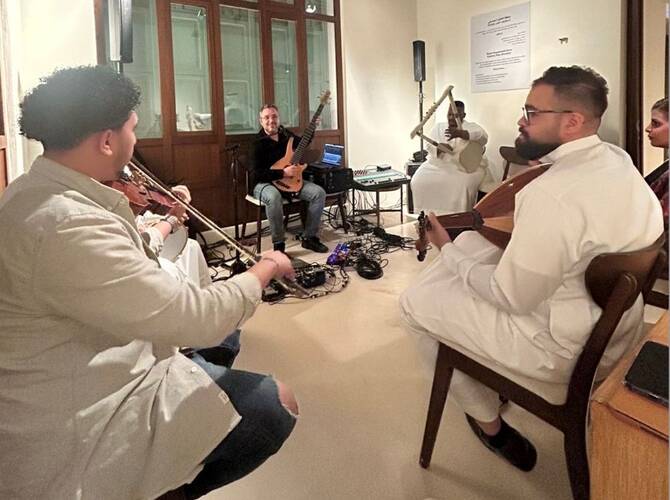
Stracho Temelkovski joined five Saudi artists for the residency. (AN Photo)
2 / 3
Stracho Temelkovski joined five Saudi artists for the residency. (AN Photo)
3 / 3
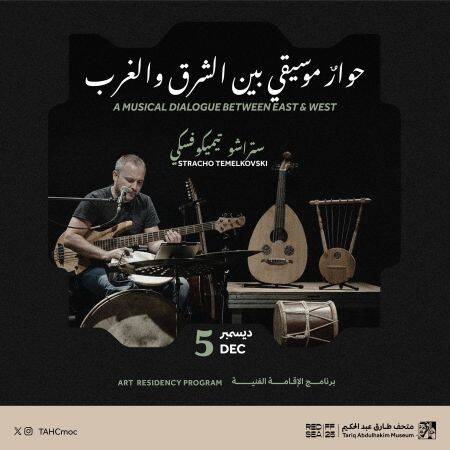
Stracho Temelkovski joined five Saudi artists for the residency. (Supplied/@TAHCmoc)
Short Url
Updated 04 December 2025
Follow

French musician joins Saudi talents for creative residency in historic Al-Balad

  • Collaboration ‘fosters dialogue through music’ ahead of Jeddah concert
  • Stracho Temelkovski: ‘Maybe it’s humility, maybe it’s the respect I feel in this area. I know it’s a very important place, and I feel good energy’

JEDDAH: A creative residency encouraging musical collaboration between Saudi and French artists was held in Jeddah’s Al-Balad this week. 

The French Consulate General in Jeddah, in partnership with the Tariq Abdulhakim Museum, the French Embassy, and Alliance Francaise, brought together French musician Stracho Temelkovski and five Saudi artists for the residency. 

Held from Nov. 27 to Dec. 5, the program featured multi-instrumentalist Temelkovski along with Saudi talents Sultan Al-Qurashi on oud, Ziyad Ayman Saeed on violin, Amin Mohammed Abu Harb on semsemiya, Abadi Abdulrahim Al-Qurashi on drums, and singer Mada Ali Al-Ghamdi. 

Over several afternoons of musical exchange, they worked on a collaborative repertoire that will culminate in a public performance on Friday night, Dec. 5, at Festival Garden in Al-Balad’s Cultural Square. 

Temelkovski described the residency as a natural extension of his lifelong artistic mission. “I really like to make bridges in my music,” he said. “That’s one of the aims. Music has to be something deep, and I try every time to make a real meeting with another culture.” 

He added that the chance to collaborate with Saudi musicians resonated with his own background. “I have oriental roots from Macedonia. Even though I’m French, this inspired me to make this bridge happen with Saudi culture because it’s something different from what I’m used to, and it was really exciting.” 

During his time in Jeddah’s Old Town, Temelkovski said Al-Balad became a source of quiet creative energy. 

“I feel really welcomed at Al-Balad. It’s something you cannot explain. Maybe it’s humility, maybe it’s the respect I feel in this area. I know it’s a very important place, and I feel good energy. I feel I’m welcome. Every person, every musician I met and all the staff have been so kind to me. 

“That’s not a small detail because I feel everyone is really involved, and it helps me be in a creative process. 

“Being in this museum feels like meeting between my music and Saudi Arabia. Tariq Abdulhakim was one of the greatest musicians in this land, and I have the impression that I’m meeting his sons. It’s something very deep for me.” 

Studying the late maestro’s compositions further shaped Temelkovski’s experience. 

“I have listened to his music, and it really inspires me because I like this music. It’s so rich in the melodic interpretation and in the rhythm. I even feel a link with my Macedonian roots in the rhythmic way,” he said. 

Mohammed Nehad, consul general of France in Jeddah, highlighted the significance of the collaboration, saying: “This artistic residency illustrates the ambition shared by France and Saudi Arabia to foster dialogue between traditions, open up new spaces for creativity, and support today’s talents. 

Nehad said that meeting between Temelkovski and the Saudi musicians, made possible thanks to the commitment of the Tariq Abdulhakim Museum, “demonstrates the strength of Saudi Arabia’s musical heritage and the creativity that arises from the intersection of cultures.” 

Larry Lamartiniere, managing director of Alliance Française, added: “This event perfectly embodies the mission of the Alliance Française Saudi Arabia which is building cultural bridges through dialogue, creativity and shared experiences.” 

Saudi drummer Al-Qurashi said that the residency expanded his creative perspective. 

“Working with Stracho mixed Arabic, French and Saudi styles, and it really changed how I listen, perform and connect with musicians. It was a big step for me personally, and it helps show the world the beauty of Saudi music when it blends with new cultures.” 

Referring to the upcoming concert, he said: “I’m excited for the audience to feel the unique mix of Saudi and French styles and the new energy we created together.” 

Singer Al-Ghamdi described the residency as an artistic turning point. “Working with him made everything feel easier, and he always made sure the work came from passion and authenticity, not from pressure or abdication. 

“That really aligns with who I am as an artist,” she said. “I often struggle with rigidity and lack of creativity when collaborating with some musicians. 

“In the past, I worked with artists who made me feel like art was exhausting and heavy. But Mr. Stracho brought me back to my core. He reminded me that art has no limits, no fixed rules, no single language or style. It’s a space full of freedom and humanity.” 

Al-Ghamdi, whose style is a blend of Oriental, Arabic, English, and predominantly Western influences, said that the residency supported her global artistic ambitions. 

“My goal is for my art to reach global audiences, not just the Gulf or Middle East. As a Saudi woman, I have a vision, feelings, and ideas I want to share proudly. 

“I want to show the world the real Saudi culture — its beauty, strength, wisdom and pride.” 

Preparing for the concert on Friday, Al-Ghamdi said she looked forward to bringing her authentic self to the stage. “I want the audience to feel the message that being true to yourself is powerful. There is no need to complicate things or fear judgment. 

“The more authentic and open-minded we are, the faster we connect. Difference is the essence of beauty, and love is the foundation that brings us together. Clean, honest music is the best way to elevate the soul.” 

Temelkovski expressed similar hopes for the final performance. “It’s the bridge. I want to share not just entertainment but a ritual together, a meeting between my identity and Saudi music and all these wonderful musicians. 

“When music has no lyrics, sometimes it’s easier to be universal. I want to give something unique, something new. I want the experience to be a kind of meditation, but also to dance and express happiness.”


Jameel Prize winner Khandakar Ohida: ‘Personal stories open universal memories’ 

Updated 27 November 2025
Follow

Jameel Prize winner Khandakar Ohida: ‘Personal stories open universal memories’ 

  • The winner of the Jameel Prize 2024 discusses her winning work ‘Dream Your Museum,’ now on display in Jeddah

JEDDAH: “Jameel Prize: Moving Images,” an exhibition of works from the finalists of last year’s Jameel Prize — an international award for contemporary art and design inspired by Islamic tradition established by the UK’s Victoria and Albert Museum — opened at Hayy Jameel in Jeddah on Nov. 19.  

The works explore themes of environment, faith and community and were produced by seven artists or collectives: Sadik Kwaish Alfraji; Jawa El-Khash; Alia Farid; Zahra Malkani; Marrim Akashi Sani; the collective of Ramin Haerizadeh, Rokni Haerizadeh and Hesam Rahmanian; and this year’s winner, Indian filmmaker Khandakar Ohida, who was awarded the prize for her work “Dream Your Museum.” 

The 18-minute film is a portrait of her uncle Khandakar Selim. (Supplied)

The 18-minute film is a portrait of her uncle Khandakar Selim and the extraordinary collection of objects and memorabilia that he has built up over the last 50 years. Her uncle was a longtime ally, she explains. “I wanted to go to art school, and being a woman from a village, that was difficult. People said I should study a little and then get married. But my grandfather and uncle supported me, they said my painting was good and I should study art.” 

Ohida documented the collection as it was displayed in her uncle’s traditional mud home, which no longer stands. The work invites visitors to find value in everyday objects and reflect on cultural representations and belonging. 

“When someone sees my film or this installation for the first time, I hope they immediately feel a sense of connection,” Ohida tells Arab News. “The objects in the work are everyday things: stamps, train tickets, coins, gramophone parts… Many people will have seen similar items in their grandparents’ trunks. Personal stories open universal memories.” 

Ohida documented the collection as it was displayed in her uncle’s traditional mud home. (Supplied)

“Dream Your Museum” emerged from Ohida’s return to her home village of Kelepara during the COVID-19 pandemic.  

“Since childhood, I knew my uncle collected objects. But because he collected mundane things, people called him a junk collector,” she says. “He worked as a doctor’s assistant in an eye department and used to visit many homes in Calcutta,” she says. “In every household, he asked if they were throwing anything interesting, and he collected from them. Over time, he built an entire empire of objects. He never built a concrete house because he spent everything on collecting objects. That mud house became chaotic with thousands of items, and it created family conflict,” she says. 

Returning home with a new camera, she discovered that her cousin intended to discard her uncle’s collection. “In the beginning, it was like I was rescuing the objects digitally,” she explains. “My uncle spent his life being dismissed and hated for collecting, and I feel a responsibility to honor him, especially now that he is ill and has a pacemaker.” 

Some of the original objects now travel with her for exhibitions; she brought a variety of them to Jeddah too. And so, the habit of collecting has been moved to another generation. 

“I’m doing my residency in the Netherlands, and I find myself going to second-hand stores, buying things,” says Ohida. “So now about 10 to 15 percent of the objects are ones I collected, but 85 percent belong to my uncle. People normally throw away old objects, but uncle taught me how to rescue them.” 

The scale of the archive is staggering. “I tried counting, but it’s difficult because he even collects tiny stamps, (which he counts as a single object). Roughly, it could be around 10,000 to 12,000 objects.”  

The work invites visitors to find value in everyday objects and reflect on cultural representations and belonging. (Supplied)

Hardly any of the collection has ever been displayed publicly, but winning the Jameel Prize means that could soon change.  

“Before, making a museum felt like a privileged, capitalist dream,” Ohida says. After the award, she told her uncle: “We will make a small space on the rooftop.” Construction is underway, and she plans to film its progress. Her uncle, she notes, has become a natural performer. “In the beginning, he was shy, but now he doesn’t care at all.” 

The film has been described as “meditative.” Ohida agrees. “I think that comes from my miniature painting background,” she says. Mughal miniatures, she notes, contain “multiple stories within one frame,” and reject strict perspective. 

Aside from enabling the construction of a rooftop museum, Ohida’s Jameel Prize win carried huge significance personally. “I come from a Muslim family, and it was very difficult to go to art school as a Muslim woman from a rural village,” she says. “For me, pursuing art was an act of protest. Many rural and marginalized women never get a chance to study art or culture.” 

Her ambition is for the museum to become an inspiration for the children of the village. “There is no museum, no gallery, no cultural space in rural India. If even one child dreams differently, that’s enough,” she says.  

She has similar ambitions for her film. “It’s not just one film; it’s an idea, a journey, a struggle, and a dream,” she says. “Others might see it and think, ‘If she did it, I can do it too.’”