Sweden seizes false-flagged ship with suspected stolen Ukrainian grain

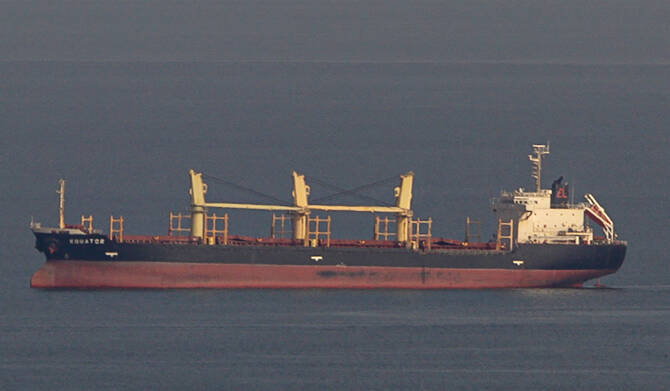
The bulk carrier Equator, under the flag of Marshall Islands, floats to collect grain from one of the ports of Odesa region on October 3, 2023, amid the Russian invasion of Ukraine. (AFP file photo)
Short Url
Updated 08 March 2026
Follow

Sweden seizes false-flagged ship with suspected stolen Ukrainian grain

  • The Russian embassy in Stockholm said it had been informed by the Swedish coast guard that 10 of the crew were Russian citizens

STOCKHOLM: Police in Sweden have seized a false-flagged cargo ship off its southern coast believed to belong to Russia’s shadow fleet and suspected of transporting stolen Ukrainian grain, authorities said Saturday.
The 96-meter (315-foot) Caffa left Casablanca in Morocco on February 24 and was headed for Saint Petersburg, Russia when armed Swedish police boarded it on Friday off the southern town of Trelleborg.
“The vessel is on the Ukraine sanctions list. Information indicates that it has essentially been used to transport grain that is stolen, as we understand it, from Ukraine,” the coast guard’s acting head of operations, Daniel Stenling, told a press conference.
“We have been able to establish that the vessel is sailing under a false flag. She is registered in Guinea, but that registration is in fact false,” he added.
“A majority” of the 11 crew members were Russian, Stenling said.
The Russian embassy in Stockholm said it had been informed by the Swedish coast guard that 10 of the crew were Russian citizens.
“The Russian embassy in Sweden is in contact with the competent Swedish authorities and is ready, if necessary, to provide consular assistance to the Russian nationals among the crew,” it wrote on Telegram.
One crew member was under investigation for violation of the maritime code on seaworthiness and on ship safety, Stenling said, refusing to disclose the suspect’s identity or crew role.
“The investigative measures we have taken so far reinforce our suspicions and our view that there are extensive maritime safety deficiencies on this vessel,” he said.
The Swedish Transport Agency was to inspect the ship and determine whether it was seaworthy and authorized to continue its journey.

- ‘Risk of accidents’ -

Moscow’s “shadow fleet” consists of vessels with opaque ownership used to skirt Western sanctions.
“It’s a problem for us that we are seeing more ships that don’t respect the law of the sea,” Stenling said, noting that “the risk of accidents increases when ships are not certified.”
“We might not even know what kind of crew is on board, what kind of skills they have, what certifications they hold, and they often lack insurance if something were to happen,” he added.
Ukrainian Foreign Minister Andriy Sybiga on Saturday thanked Sweden.
“Collective action against such vessels is gaining momentum. This is a welcome development,” he wrote on X.
“Sanctions work when they are strictly enforced. Together, we must stop the activities of Russia’s shadow fleet to protect Europe’s security and environment.”


Indonesia sets rules limiting use of AI for schoolchildren

Updated 4 sec ago
Follow

Indonesia sets rules limiting use of AI for schoolchildren

  • Indonesian children spend about 7.5 hours daily on tablets, smartphones
  • Gen Zs make up the majority of AI users in the country of 280m people

JAKARTA: The Indonesian government introduced on Thursday a new policy regulating the use of digital technology in education, limiting access to artificial intelligence for students.

Generation Alphas and Gen Zs make up almost half of Indonesia’s online population, which reached nearly 230 million people in 2025, according to a survey conducted by the Association of Indonesian Internet Service Providers.

As Indonesian children clock around 7.5 hours of daily screen time, the joint ministerial decree seeks to boost the benefits of digital technology and AI in formal and informal educational institutions, while also protecting the youth from risks in digital spaces.

“There are a lot of factors but the number of teenagers with mental health issues are high and continue to increase, and one of the suspected triggers — that have been proven academically — is the uncontrolled, unmitigated use of digital technology,” said Pratikno, Indonesia’s Coordinating Minister for Human Development and Cultural Affairs.

“The effects on education are also concerning, such as how it weakens brain activity due to dependence on digital technology tools and reduces critical thinking and cognitive and reflective abilities. This is what we have to regulate.”

Among Indonesia’s 280 million population, around a quarter of internet users are already using AI, with Gen Zs making up about 43 percent of that segment.

The joint decree, which Pratikno described as “comprehensive” and encompasses early childhood education to higher education, was signed in Jakarta by seven ministers, including Higher Education, Science and Technology Minister Brian Yuliarto and Primary and Secondary Education Minister Abdul Mu’ti.

“This decree seeks to ensure that our children are not controlled by technology but become the masters of technology for good, that is our goal. (It prioritizes) digital wellness, (for tech to be used) wisely and intelligently,” Pratikno said.

The policy is important to support young Indonesians, many of whom are internet users from adolescence, said Communication and Digital Affairs Minister Meutya Hafid, who also signed the ministerial decree.

“Indonesia has a significant number of children using the internet. Therefore, we must ensure that they are not only a target market for the technology industry, but also able to utilize technology according to their readiness,” she said.

“Every kind of technological advance has to consider the readiness of its users, especially children.”