

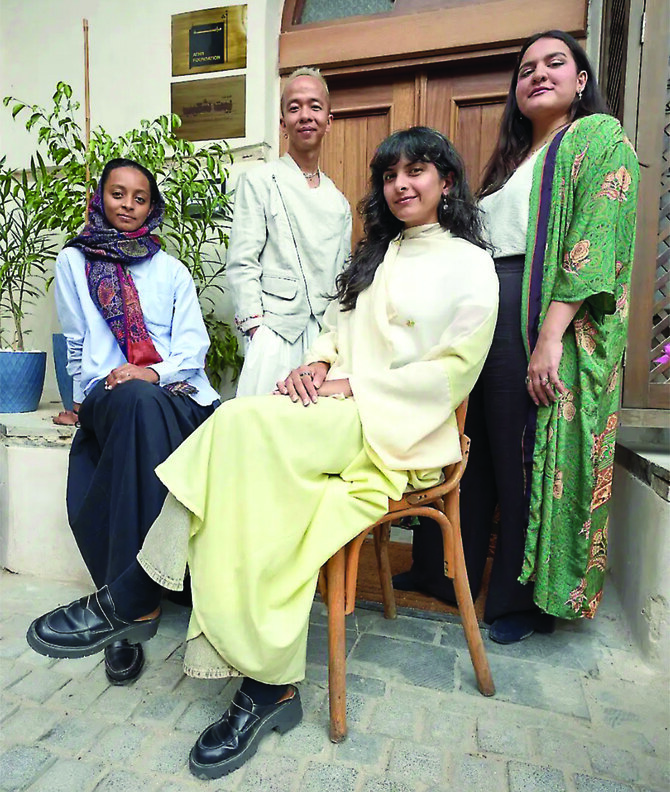

JEDDAH: Athr Foundation’s Bait Shouaib Arts Residency in Al-Balad district brought together a filmmaker, curator and two artists, fostering interdisciplinary collaboration over an eight-week program.
The Moving Narratives cycle explored the theme of movement through diverse lenses and transformed the historic Bait Shouaib into an active participant in the creative process.
The exhibition, which was open last month as part of this year’s Islamic Arts Biennale, welcomed visitors to witness interpretations of Jeddah’s cultural and historical essence through contemporary art.

Hayfa Algwaiz created a site-specific mobile installation in Bait Shouaib’s stairwell, or minwar. (Supplied)
Residency director and senior program manager at Athr Foundation, Ibrahim Romman, highlighted the program’s impact and told Arab News: “Each resident’s exploration of ‘movement’ became an invitation to reflect on how stories, spaces and identities shift and intersect.
“Together, their work offered a richly layered response to the theme, presenting interdisciplinary perspectives that bridged the historical with the contemporary.”
Sudanese artist Rund Alarabi has created a poetic video installation bridging the cultural and architectural legacies of the port cities of Jeddah and Suakin, Sudan.

Vietnamese curator Nhat Q. Vo centered his project around Al-Shafi’i Mosque. (Supplied)
Her project delves into the undocumented and intangible aspects of collective memory. She told Arab News: “Living between Frankfurt, Khartoum and Jeddah has fed my practice with various materials and unraveled new ways of misunderstanding. This has led me to question what I consider to be given and rethink my understanding of global and local consensus.”
Featuring sensory elements such as soundscapes composed of everyday cooking utensils, her installation forges an intimate connection to cultural memory. “Sound and moving images act as vessels that challenge our understanding of reality. They highlight overlooked aspects of our existence by infiltrating beyond our preconceived assumptions,” she said.
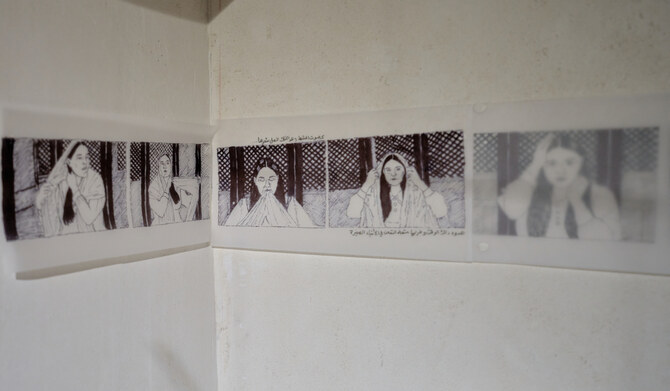
Filmmaker Nada Al-Mojadedi drew inspiration from Hejazi folklore to craft an immersive narrative that seamlessly blends performance, textiles and moving images. Her dual-room installation transformed her studio into a theatrical set, inviting visitors to journey through time.

Sudanese artist Rund Alarabi’s video installation bridged the architectural legacies of the port cities of Jeddah and Suakin, Sudan. (Supplied)
Al-Mojadedi explained: “I wanted to blur the lines between performer and observer, offering an intimate reflection on identity and memory.”
Speaking about her approach to the theme, she added: “For me, movement transcends the physical; it embodies the unseen — a constant, evolving force of imagination, a ‘quantum dance’ through time and space. This concept guided my exploration of Hejazi folklore, where I intertwined heritage with newly crafted urban legends.
“Immersing myself in Al-Balad’s vibrant life and stories, and inspired by my connection to Bait Shouaib and a visiting butterfly, I created Haleema, a Hejazi urban legend inspired by the untold stories of women who once lived in these spaces.”
Reflecting on her creative process, Al-Mojadedi said: “My work layers the personal with the performative, reimagining space as both a site of storytelling and an active participant in the narrative. Being part of this residency was an enriching experience that allowed us to delve into the dynamic cultural tapestry of Al-Balad and contribute our individual narratives to its enduring story.”
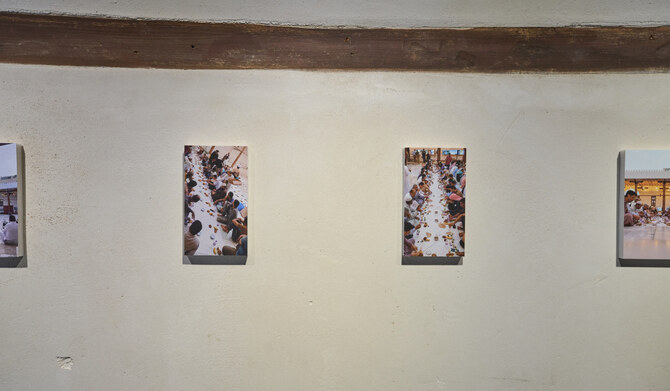
Similarly, another artist, Nhat Q. Vo, a Vietnamese curator and cultural worker, explored the transient histories of Jeddah’s migrant worker communities, centering his project around Al-Shafi’i Mosque, a hub of cultural exchange.
“When I arrived in Al-Balad, I was drawn to its physical environment and the untold stories of the laborers who sustain Historic Jeddah. At first, the language barrier made it difficult to connect, but my discovery of Al-Shafi’i Mosque changed everything.
“The sight of people gathering for iftar, united by faith despite their differences, inspired me to represent their stories through their shared rituals rather than words.”
Speaking about how architecture informed his creative approach, he said: “Architecture became a vessel for these narratives, a place where diverse communities converge. Using over 70 meters of fabric to replace the plastic sufra at the mosque, I allowed the material to absorb the traces of shared meals and human connection.
“The fabric, marked by food crumbs, oil stains and creases, became a tangible record of collective memory. For me, the real inspiration comes from the people whose lives and routines shape the rich tapestry of these spaces.”
Riyadh-based artist and architect, Hayfa Algwaiz, has created a site-specific mobile installation in Bait Shouaib’s stairwell, or minwar, exploring the interplay between movement, space and architectural elements.
Activating the stairwell as a dynamic participant in her narrative, she said: “The subtle movement of the mobile mirrored the ephemeral qualities of light, air and transition experienced in Al-Balad. By focusing on a single element, I was able to honor the historic significance of the space while introducing contemporary artistic interpretations.”
Elaborating on her approach, she said: “As an artist and architect, I strive to bridge the past and the present by focusing on elements that connect them, such as the framed openings in historic structures like Bait Shouaib. These openings, adorned with intricate ornamentation, are constants that I deconstruct and reconstruct to reflect our contemporary times.
“In Saudi Arabia’s rapidly changing urban landscape, I aim to spark a dialogue around what should be preserved and what can evolve. By reinterpreting traditional materials, spatial layouts and ornamentation into modern expressions, I hope to honor our cultural identity while embracing the future.”
Animated by natural airflow, her installation reflects the residency’s ethos of bridging tradition with innovation.
“Architecture has the potential to transform into a living, breathing entity, and I sought to capture that essence,” she said.


