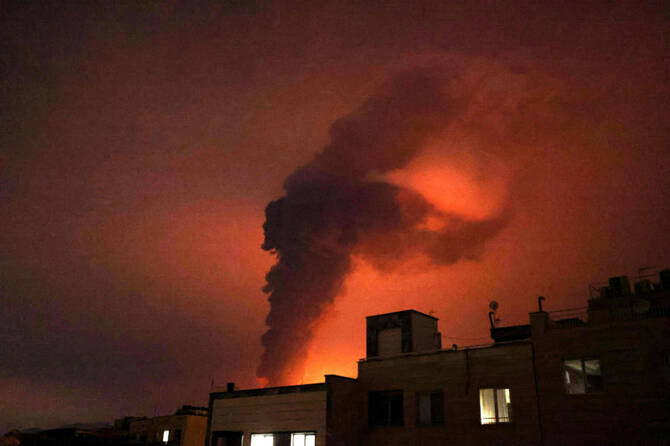

TEHRAN: The United States and Israel hit five oil facilities with overnight strikes in and near the Iranian capital that killed six people, an official told state TV on Sunday.
“Last night, four oil depots and a petroleum products transport center in Tehran and the Alborz were attacked by enemy aircraft,” the CEO of the National Iranian Oil Products Distribution Company, Keramat Veyskarami, told state TV.
“Four of our personnel, including two oil tanker drivers, were killed in the incident,” he added, saying facilities “were damaged” but the “fire was brought under control.”
Smoke from fires overnight hung over the capital, casting a dark haze across the city as morning broke.
Residents reported the smell of burning lingered in the air.
Veyskarami said Iran’s oil depots have “sufficient gasoline reserves.”
Israel’s military confirmed that it hit the fuel storage facilities in Tehran.
Associated Press video showed the horizon glowing against the night sky above Tehran. It appeared to be the first time a civil industrial facility has been targeted in the war.
State media blamed “an attack from the US and the Zionist regime” at the facility that supplies the capital and neighboring provinces in the north.
Apology
On Saturday, Iranian President Masoud Pezeshkian apologized for attacks on “neighboring countries,” even as his country’s missiles and drones flew toward Gulf Arab states and hardliners asserted that Tehran’s war strategy would not change.
A rift between politicians looking to de-escalate the war and others committed to battling the United States and Israel could complicate any diplomatic efforts. Conflicting Iranian statements came from two of the three members of the leadership council overseeing Iran since Supreme Leader Ayatollah Ali Khamenei was killed in the war’s opening airstrikes.
Pezeshkian, who is a member of the council, also dismissed US President Donald Trump’s call for Tehran to surrender unconditionally, saying: “That’s a dream that they should take to their grave.”
Trump threatened that Iran would be “hit very hard” and more “areas and groups of people” would become targets, without elaborating. Already, the conflict has rattled global markets and left Iran’s leadership weakened by hundreds of Israeli and American airstrikes.
“We’re not looking to settle,” Trump told reporters Saturday aboard Air Force One. “They’d like to settle. We’re not looking to settle.”
He described the ongoing US operations in Iran as an “excursion” and said issues such as rising gas prices and the safety of Americans would improve once the conflict ends.
Iran makes varying statements on attacks
Pezeshkian’s message, seemingly recorded in a hurry, underlined the limited powers exercised by the theocracy’s leaders over the paramilitary Revolutionary Guard, which controls the hundreds of ballistic missiles targeting Israel and other countries. It answered only to Khamenei and appears to be picking its own targets.
Pezeshkian’s statement said Iran’s leadership council had been in touch with the armed forces and “from now on, they should not attack neighboring countries or fire missiles at them, unless we are attacked by those countries. I think we should solve this through diplomacy.”
The US strikes have not come from the Gulf Arab governments under attack, but from US bases and vessels in the region.
But hardline judiciary chief Gholam Hossein Mohseni-Ejei, another member of the three-man leadership council, suggested that war strategy will not change.
“The geography of some countries in the region — both overtly and covertly — is in the hands of the enemy, and those points are used against our country in acts of aggression. Intense attacks on these targets will continue,” he posted on X.
As long as US bases are present in the region, “the countries will not enjoy peace,” Iran’s Parliament speaker and a former Revolutionary Guard general, Mohammad Bagher Ghalibaf, said on X.
Iran’s UN mission later suggested, without offering evidence, that strikes on nonmilitary sites “may have resulted from interception by US electronic defense systems.”
Late Saturday, top Iranian security official Ali Larijani asserted in an address carried by state media that “our leaders are united on this issue and have no disagreements with one another.”
He also said the leadership council has requested that “arrangements be made” to convene the Assembly of Experts to choose the next supreme leader, but did not say when.