

Pakistan to allow UN aid cargo into Afghanistan after 50-day border freeze

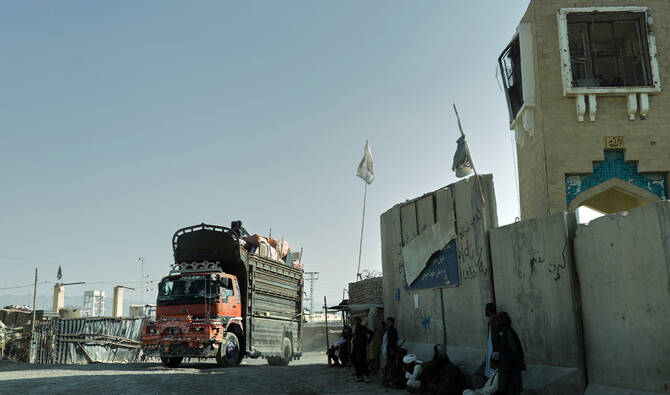
People wait near the closed gate at the Spin Boldak border crossing with Pakistan, after the border was closed following clashes between Afghan and Pakistani forces, in Kandahar province, Afghanistan, on October 23, 2025. (AP/File)
Short Url
Updated 04 December 2025
Follow

Pakistan to allow UN aid cargo into Afghanistan after 50-day border freeze

  • Phased clearance approved for WFP, UNICEF and UNFPA consignments
  • Food, medicines and school kits to move first under revised transit plan

ISLAMABAD: Pakistan has authorized the movement of United Nations humanitarian cargo into Afghanistan through the Torkham and Chaman border crossings after nearly 50 days of disruption, according to an official notification issued by the Ministry of Commerce this week. 

The clearance will apply to consignments from the World Food Programme (WFP), UNICEF and the UN Population Fund (UNFPA) under a phased plan agreed between Pakistani authorities and the UN Resident Coordinator’s Office.

The reopening follows the suspension of cross-border access after armed clashes between Pakistani and Afghan forces in October, which stalled the movement of people and goods, including relief shipments, at a time when aid agencies warn of worsening food insecurity and shortages of medicines inside Afghanistan. 

The notification represents Islamabad’s first structured authorization for humanitarian transit since the freeze began, with the government saying clearance will start immediately.

“Principal decision is taken to allow phased movement of WFP, UNICEF and UNFPA containers initially as follows,” the commerce ministry letter dated Dec. 1 said.

The order instructs the Federal Board of Revenue and the Directorate General of Transit Trade to facilitate the onward movement of approved containers, with the first consignments to consist of food supplies, followed by pharmaceutical products and medical equipment, then other essential goods such as student and teacher kits.

Pakistan has said cargo will move through the border crossings at Chaman and Torkham, which serve as the primary land routes for Afghanistan’s imports and relief operations. 

The decision comes amid a humanitarian crisis in Afghanistan, where the UN estimates that more than half the population requires assistance following economic collapse, sanctions and the withdrawal of foreign funding after the Taliban takeover in 2021. Aid agencies had warned in recent weeks that extended trade disruption at Pakistan-Afghanistan crossings risked deepening shortages for communities already facing winter and rising malnutrition.

Islamabad says the reopening applies only to UN humanitarian consignments and further expansion will depend on security conditions, compliance procedures and coordination with the UN and Afghan authorities.

In October, dozens of people were killed in air strikes and ground fighting between the South Asian neighbors, their deadliest confrontation since the Afghan Taliban seized power in Kabul in 2021.

Islamabad says Pakistani militants are based in Afghanistan, from where they send attackers into Pakistan. The Taliban administration in Afghanistan denies the presence on Pakistani militants there and says it does not allow Afghan soil to be used against other countries.


Pakistan, global crypto exchange discuss modernizing digital payments, creating job prospects 

Updated 8 sec ago
Follow

Pakistan, global crypto exchange discuss modernizing digital payments, creating job prospects 

  • Pakistani officials, Binance team discuss coordination between Islamabad, local banks and global exchanges
  • Pakistan has attempted to tap into growing crypto market to curb illicit transactions, improve oversight

ISLAMABAD: Pakistan’s finance officials and the team of a global cryptocurrency exchange on Friday held discussions aimed at modernizing the country’s digital payments system and building local talent pipelines to meet rising demand for blockchain and Web3 skills, the finance ministry said.

The development took place during a high-level meeting between Finance Minister Muhammad Aurangzeb, Pakistan Virtual Assets Regulatory Authority (PVARA) Chairman Bilal bin Saqib, domestic bank presidents and a Binance team led by Global CEO Richard Teng. The meeting was held to advance work on Pakistan’s National Digital Asset Framework, a regulatory setup to govern Pakistan’s digital assets.

Pakistan has been moving to regulate its fast-growing crypto and digital assets market by bringing virtual asset service providers (VASPs) under a formal licensing regime. Officials say the push is aimed at curbing illicit transactions, improving oversight, and encouraging innovation in blockchain-based financial services.

“Participants reviewed opportunities to modernize Pakistan’s digital payments landscape, noting that blockchain-based systems could significantly reduce costs from the country’s $38 billion annual remittance flows,” the finance ministry said in a statement. 

“Discussions also emphasized building local talent pipelines to meet rising global demand for blockchain and Web3 skills, creating high-value employment prospects for Pakistani youth.”

Blockchain is a type of digital database that is shared, transparent and tamper-resistant. Instead of being stored on one computer, the data is kept on a distributed network of computers, making it very hard to alter or hack.

Web3 refers to the next generation of the Internet built using blockchain, focusing on giving users more control over their data, identity and digital assets rather than big tech companies controlling it.

Participants of the meeting also discussed sovereign debt tokenization, which is the process of converting a country’s debt such as government bonds, into digital tokens on a blockchain, the ministry said. 

Aurangzeb called for close coordination between the government, domestic banks and global exchanges to modernize Pakistan’s payment landscape.

Participants of the meeting also discussed considering a “time-bound amnesty” to encourage users to move assets onto regulated platforms, stressing the need for stronger verifications and a risk-mitigation system.

Pakistan has attempted in recent months to tap into the country’s growing crypto market, crack down on money laundering and terror financing, and promote responsible innovation — a move analysts say could bring an estimated $25 billion in virtual assets into the tax net.

In September, Islamabad invited international crypto exchanges and other VASPs to apply for licenses to operate in the country, a step aimed at formalizing and regulating its fast-growing digital market.