WEST PALM BEACH, Florida: Top Trump administration officials are meeting Ukrainian negotiators in Florida this weekend, pushing to broker an end to Russia’s war in Ukraine and setting the stage for key talks planned this week in Moscow with Russian leader Vladimir Putin.
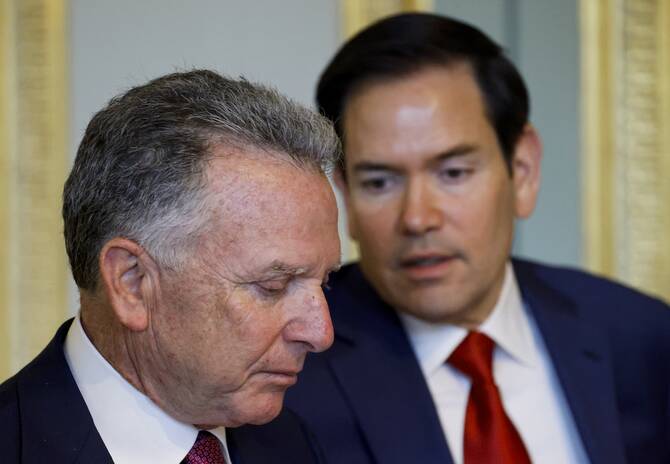
Secretary of State Marco Rubio, Special Envoy Steve Witkoff and Jared Kushner, the son-in-law of President Donald Trump, were expected to sit down with a Ukrainian delegation to further hash out the details of a proposed peace framework – talks that come at a sensitive moment for Ukraine as it continues to push back against Russian forces that invaded the country in 2022.
On Friday just before the Florida sit-down, Ukrainian President Volodymyr Zelensky announced the resignation of his powerful chief of staff, Andrii Yermak, who up until that point had been the country’s lead negotiator in talks with the US.
The announcement came after Yermak’s home was searched by anti-corruption investigators. Zelensky’s government has been roiled by fallout from a scandal over $100 million embezzled from the energy sector through kickbacks paid by contractors, causing newfound domestic pressures for Zelensky.
It was only a week ago that Rubio had met with Yermak in Geneva, with each side saying the talks had been positive in putting together a revised peace plan.
Now, the Ukrainian delegation includes Andrii Hnatov, the head of Ukraine’s armed forces; Andrii Sybiha, Ukraine’s foreign minister; and Rustem Umerov, head of Ukraine’s security council, Zelensky has said.
Diplomats have been focused on revisions to Trump’s proposed 28-point plan developed in negotiations between Washington and Moscow. That plan was criticized as being too weighted toward Russian demands. It had initially envisioned Ukraine ceding the entire eastern region of the Donbas to Russia – a sticking point for Kyiv.
The plan – which Trump has since downplayed as a “concept” or a “map” to be “fine-tuned” – would also impose limits on the size of Ukraine’s military, block the country from joining NATO, and require Ukraine to hold elections in 100 days. Negotiators have indicated the framework has changed, but it’s not clear how its provisions have been altered.
Trump said on Tuesday that he would send Witkoff and perhaps Kushner to Moscow this week to meet with Putin about the plan. Both Witkoff and Kushner, like Trump, hail from the world of real estate that values dealmaking over the conventions of diplomacy. The pair also were behind a 20-point proposal that led to a ceasefire in Gaza.
On Saturday, Russian drone and missile attacks in and around Ukraine’s capital of Kyiv killed at least three people and dozens more were wounded, officials said.
Zelensky wrote on X that the Ukrainian delegation would “swiftly and substantively work out the steps needed to end the war.”

Rubio, Witkoff to meet with Ukraine’s negotiators as Trump pushes to broker a deal
Short Url
https://arab.news/bybwa
Rubio, Witkoff to meet with Ukraine’s negotiators as Trump pushes to broker a deal
- Diplomats have been focused on revisions to Trump’s proposed 28-point plan developed in negotiations between Washington and Moscow
Georgia’s street dogs stir affection, fear, national debate
TBILISI: At a bus stop in central Tbilisi, two tagged dogs dozed on a bench as some commuters smiled at them and others cast angry glances.
In the streets of the Georgian capital, such scenes are part of daily life: community-fed “yard dogs,” yellow municipal tags on their ears, lounge outside bakeries, metro entrances and school gates.
The free-roaming canines stir both affection and fear. What to do with their swelling numbers — in the tens of thousands in Tbilisi alone — has become a nationwide dilemma.
Stray animals tied the top spot for public concerns in a poll by the National Democratic Institute, with 22 percent of respondents naming it the most pressing issue.
Many welcome the dogs as a symbol of Tbilisi, a showcase of Georgian hospitality and the warm street life that draws tourists to the capital.
“Street dogs in Georgia have made a more positive impact on tourism and the image of Georgia than people and culture alone,” said journalist Elena Nikoleisvili, 51, who helps street dogs.
“If anything, these adorable creatures should be the symbol of the capital — like the cats of Istanbul.”
On cafe terraces, regulars slip bones under tables as mongrels curl up between patrons’ feet, while each neighborhood and cul-de-sac has its own local canine mascot.
- ‘Drop in the ocean’ -
Others worry about safety.
“They bark and scare folks,” said plumber Oleg Berlovi, 43.
“Two weeks ago, a dog bit my kid and we needed shots. Animals are great, but they need looking after.”
According to the World Health Organization, dogs are the main vectors in human rabies cases globally.
Georgia still records a handful of human deaths from the disease each year and administers tens of thousands of post-exposure treatments, according to the Global Alliance for Rabies Control.
City officials say the answer is steady, humane population control.
“The state’s policy is to manage these animals by the most humane methods possible and to reduce to a minimum the number of stray dogs on the streets,” Nicoloz Aragveli, who heads Tbilisi city hall’s animal monitoring agency, told AFP.
A recent count put the capital’s stray dog population at about 29,000, and around 74 percent have been neutered, Aragveli said.
“We plan to do more so that we reach 100 percent,” he said.
The city runs weekly school lessons and a door-to-door registration drive to raise awareness and track owned pets.
Legislative changes have also tightened penalties for abandoning animals and for violating care and ownership rules — steps officials say will help halt the flow of pets to the streets.
But journalist Nikoleisvili said the authorities only responded after a public backlash, and “could do much more.”
The number of dogs that have been neutered in Tbilisi — around 50,000 over the last decade — is “a drop in the ocean,” she said.
- ‘Guilty party’ -
Volunteers, like theater director Zacharia Dolidze, who builds kennels, also play a big role in caring for the dogs.
“There are days I make 20 kennels. I’ve built about 2,500 in seven years,” the 40-year-old said.
He collects regular donations to help pay for materials.
Shelter operators say there are big gaps in addressing what they call one of Georgia’s biggest issues.
“You can make regulations, but if you cannot enforce them, that’s not going to help,” said Sara Anna Modzmanashvili Kemecsei, who runs a shelter that houses about 50 dogs.
In many regions, “there are absolutely no neutering campaigns.”
“I can’t really see that the government is on top of the issue, so there are lots of volunteers,” she said. “They are really good at managing these animals.”
Politics has also injected fresh uncertainty.
Last year, the government pushed a “foreign influence” law that complicates NGOs’ access to funding from foreign donors such as UK animal welfare charity Mayhew, which runs a program to vaccinate and neuter strays in Tbilisi.
Volunteers meanwhile continue to juggle feeding, sheltering and basic care.
Nino Adeishvili, 50, is a geologist and university lecturer who looks after around 10 dogs.
Her group organizes rabies shots and fundraises on Facebook for deworming, flea treatment and food.
“On the street, a dog is still unprotected,” she said.
“The guilty party is the human.”
In the streets of the Georgian capital, such scenes are part of daily life: community-fed “yard dogs,” yellow municipal tags on their ears, lounge outside bakeries, metro entrances and school gates.
The free-roaming canines stir both affection and fear. What to do with their swelling numbers — in the tens of thousands in Tbilisi alone — has become a nationwide dilemma.
Stray animals tied the top spot for public concerns in a poll by the National Democratic Institute, with 22 percent of respondents naming it the most pressing issue.
Many welcome the dogs as a symbol of Tbilisi, a showcase of Georgian hospitality and the warm street life that draws tourists to the capital.
“Street dogs in Georgia have made a more positive impact on tourism and the image of Georgia than people and culture alone,” said journalist Elena Nikoleisvili, 51, who helps street dogs.
“If anything, these adorable creatures should be the symbol of the capital — like the cats of Istanbul.”
On cafe terraces, regulars slip bones under tables as mongrels curl up between patrons’ feet, while each neighborhood and cul-de-sac has its own local canine mascot.
- ‘Drop in the ocean’ -
Others worry about safety.
“They bark and scare folks,” said plumber Oleg Berlovi, 43.
“Two weeks ago, a dog bit my kid and we needed shots. Animals are great, but they need looking after.”
According to the World Health Organization, dogs are the main vectors in human rabies cases globally.
Georgia still records a handful of human deaths from the disease each year and administers tens of thousands of post-exposure treatments, according to the Global Alliance for Rabies Control.
City officials say the answer is steady, humane population control.
“The state’s policy is to manage these animals by the most humane methods possible and to reduce to a minimum the number of stray dogs on the streets,” Nicoloz Aragveli, who heads Tbilisi city hall’s animal monitoring agency, told AFP.
A recent count put the capital’s stray dog population at about 29,000, and around 74 percent have been neutered, Aragveli said.
“We plan to do more so that we reach 100 percent,” he said.
The city runs weekly school lessons and a door-to-door registration drive to raise awareness and track owned pets.
Legislative changes have also tightened penalties for abandoning animals and for violating care and ownership rules — steps officials say will help halt the flow of pets to the streets.
But journalist Nikoleisvili said the authorities only responded after a public backlash, and “could do much more.”
The number of dogs that have been neutered in Tbilisi — around 50,000 over the last decade — is “a drop in the ocean,” she said.
- ‘Guilty party’ -
Volunteers, like theater director Zacharia Dolidze, who builds kennels, also play a big role in caring for the dogs.
“There are days I make 20 kennels. I’ve built about 2,500 in seven years,” the 40-year-old said.
He collects regular donations to help pay for materials.
Shelter operators say there are big gaps in addressing what they call one of Georgia’s biggest issues.
“You can make regulations, but if you cannot enforce them, that’s not going to help,” said Sara Anna Modzmanashvili Kemecsei, who runs a shelter that houses about 50 dogs.
In many regions, “there are absolutely no neutering campaigns.”
“I can’t really see that the government is on top of the issue, so there are lots of volunteers,” she said. “They are really good at managing these animals.”
Politics has also injected fresh uncertainty.
Last year, the government pushed a “foreign influence” law that complicates NGOs’ access to funding from foreign donors such as UK animal welfare charity Mayhew, which runs a program to vaccinate and neuter strays in Tbilisi.
Volunteers meanwhile continue to juggle feeding, sheltering and basic care.
Nino Adeishvili, 50, is a geologist and university lecturer who looks after around 10 dogs.
Her group organizes rabies shots and fundraises on Facebook for deworming, flea treatment and food.
“On the street, a dog is still unprotected,” she said.
“The guilty party is the human.”
© 2025 SAUDI RESEARCH & PUBLISHING COMPANY, All Rights Reserved And subject to Terms of Use Agreement.


