

Jordan urges sustained peace in Gaza, two-state solution at Mediterranean forum

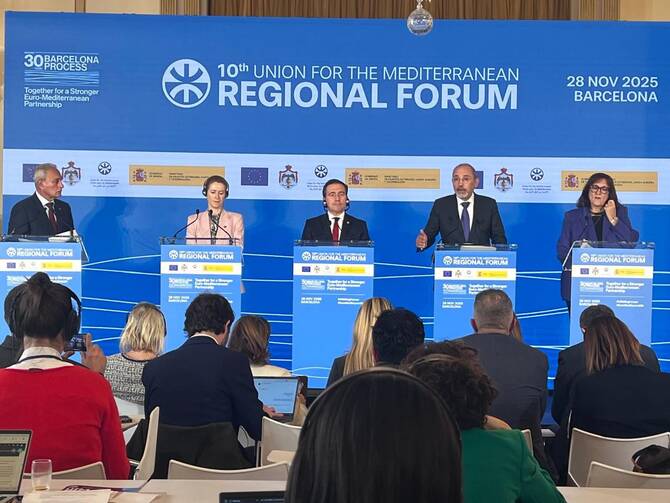
Jordanian Foreign Minister Ayman Safadi called for a sustained peace in Gaza and reaffirmed support for the two-state solution during the 10th Regional Forum of Foreign Ministers of the Union for the Mediterranean, which ended Friday. (Jordan News Agency)
Short Url
Updated 28 November 2025
Follow

Jordan urges sustained peace in Gaza, two-state solution at Mediterranean forum

  • Co-chaired with European Commission Vice President Kaja Kallas, the forum was hosted by Spanish Foreign Minister Jose Manuel Albares

BARCELONA: Jordanian Foreign Minister Ayman Safadi called for a sustained peace in Gaza and reaffirmed support for the two-state solution during the 10th Regional Forum of Foreign Ministers of the Union for the Mediterranean, which ended Friday.

Co-chaired with European Commission Vice President Kaja Kallas, the forum was hosted by Spanish Foreign Minister Jose Manuel Albares and attended by foreign ministers and heads of delegations from UfM member states, alongside representatives of European and regional institutions.

Speaking at the forum, Safadi warned that “the promise of peace, prosperity and cooperation has been shattered by a brutal occupation whose inhumane nature has been exposed in the most horrific ways during two years of genocide in Gaza.”

He highlighted escalations and violations in the occupied West Bank, noting that 32,000 Palestinians had been displaced recently, alongside settlement expansion, land confiscation and the strangulation of the Palestinian economy.

“The two-state solution remains the only path to a just and comprehensive peace,” he said, stressing alignment with international law and the Arab Peace Initiative.

Safadi also welcomed Syria’s restoration of its UfM membership, highlighting the need to support reconstruction while protecting the country’s unity, sovereignty and territorial integrity.

The foreign minister took part in the ministerial meeting launching the Mediterranean Charter, describing it as “an important operational framework to deepen cooperation across the Mediterranean.”

He also noted that a forthcoming action plan, to which Jordan will contribute, will ensure the charter translates into tangible results for the region’s peoples, the Jordan News Agency reported.

At a joint press conference with Kallas, Albares, UfM Secretary-General Nasser Kamel and European Commissioner for the Mediterranean Dubravka Suica, Safadi reiterated the urgency of sustaining the Gaza ceasefire, enabling humanitarian aid, granting UN agencies full access and preventing forced displacement.

He condemned recent Israeli attacks in the West Bank, including the killing of two Palestinians who had surrendered, calling it a “cold-blooded execution” and a war crime.

He highlighted ongoing settler attacks, home demolitions, arson and the destruction of olive trees, describing them as actions that deprive the region of peace.

Safadi also denounced Israel’s strike on the Syrian village of Beit Jinn as a violation of international law and stressed the importance of supporting Lebanon’s sovereignty and reconstruction.

He reaffirmed Jordan’s readiness to resume delivering humanitarian aid to Gaza via the Jordanian corridor, with a capacity of 250 trucks per day once restrictions are lifted.

On the sidelines of the forum, Safadi held meetings with ministers from Egypt, Lebanon, Slovenia, Montenegro and Spain, as well as Kallas and Suica, to discuss regional developments and strengthen Jordan–EU strategic cooperation.


The UN says Al-Hol camp population has dropped sharply as Syria moves to relocate remaining families

Updated 3 sec ago
Follow

The UN says Al-Hol camp population has dropped sharply as Syria moves to relocate remaining families

  • Forces of Syria’s central government captured the Al-Hol camp on Jan. 21 during a weekslong offensive against the SDF, which had been running the camp near the border with Iraq for a decade

DAMASCUS: The UN refugee agency said Sunday that a large number of residents of a camp housing family members of suspected Daesh group militants have left and the Syrian government plans to relocate those who remain.
Gonzalo Vargas Llosa, UNHCR’s representative in Syria, said in a statement that the agency “has observed a significant decrease in the number of residents in Al-Hol camp in recent weeks.”
“Syrian authorities have informed UNHCR of their plan to relocate the remaining families to Akhtarin camp in Aleppo Governorate (province) and have requested UNHCR’s support to assist the population in the new camp, which we stand ready to provide,” he said.
He added that UNHCR “will continue to support the return and reintegration of Syrians who have departed Al-Hol, as well as those who remain.”
The statement did not say how residents had left the camp or how many remain. Many families are believed to have escaped either during the chaos when government forces captured the camp from the Kurdish-led Syrian Democratic Forces last month or afterward.
There was no immediate statement from the Syrian government and a government spokesperson did not respond to a request for comment.
At its peak after the defeat of IS in Syria in 2019, around 73,000 people were living at Al-Hol. Since then, the number has declined with some countries repatriating their citizens. The camp’s residents are mostly children and women, including many wives or widows of IS members.
The camp’s residents are not technically prisoners and most have not been accused of crimes, but they have been held in de facto detention at the heavily guarded facility.
Forces of Syria’s central government captured the Al-Hol camp on Jan. 21 during a weekslong offensive against the SDF, which had been running the camp near the border with Iraq for a decade. A ceasefire deal has since ended the fighting.
Separately, thousands of accused IS militants who were held in detention centers in northeastern Syria have been transferred to Iraq to stand trial under an agreement with the US
The US military said Friday that it had completed the transfer of more than 5,700 adult male IS suspects from detention facilities in Syria to Iraqi custody.
Iraq’s National Center for International Judicial Cooperation said a total of 5,704 suspects from 61 countries who were affiliated with IS — most of them Syrian and Iraqi — were transferred from prisons in Syria. They are now being interrogated in Iraq.