

Black Sea tanker that sustained blast hit again: Turkiye

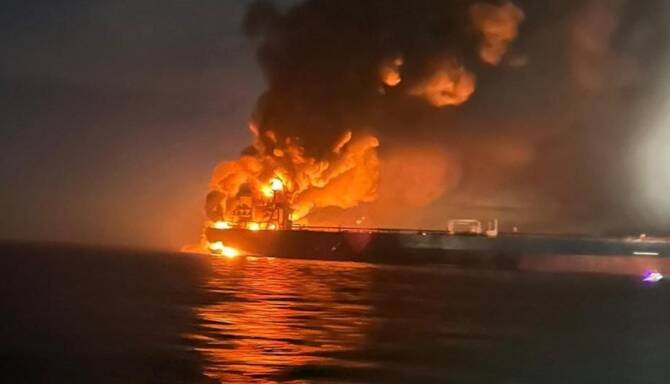
Two tankers were struck and caught fire in the Black Sea, prompting rescue operations, Turkish authorities reported Friday. (X/@RWApodcast)
Short Url
Updated 29 November 2025
Follow

Black Sea tanker that sustained blast hit again: Turkiye

  • The Virat oil tanker was attacked again by unmanned maritime vehicles early Saturday morning
  • The ministry’s post was the first official confirmation that the Virat was attacked by drones

ISTANBUL: Turkiye’s transport ministry said one of two empty oil tankers hit by blasts in the Black Sea late Friday had been struck again early on Saturday, blaming an unmanned sea vehicle.

“The Virat, which was previously said to have been attacked by unmanned maritime vehicles approximately 35 nautical miles off the Black Sea coastline, was attacked again by unmanned maritime vehicles early this morning,” the ministry said on X.

It said the tanker sustained only “minor damage” on the starboard side and that none of the 20-strong crew were hurt.

On Friday evening, Turkiye’s transport ministry said two empty oil tankers, the Virat and the Kairos, had reported explosions but sustained no casualties, suggesting they had been struck but without saying what had caused the blasts.

The ministry’s post was the first official confirmation that the Virat was attacked by drones.

The Kairos incident took place around 1500 GMT, with rescuers evacuating its 25 crew members after a fire broke out. At the time, it was about 100 kilometers (60 miles) east of the point where the Bosphorus Strait enters the Black Sea, officials said.

The Virat was struck later; at the time, it was about 400 kilometers further east, according to the VesselFinder tracking site.

Transport Minister Abdulkadir Uraloglu said both vessels had been hit by “explosions,” telling Turkiye’s private NTV television they tankers might have been hit a mine, or been struck by a rocket or a drone.

“An external impact means the vessel was hit by a mine, a rocket, or a similar projectile, or perhaps by a drone, or by an unmanned underwater vehicle. These are the first things that come to mind,” he said.

Gambian-flagged, under sanctions

In a post on X, the maritime affairs directorate said the Kairos was “en route to Russia’s Novorossiysk” when it reported an “external impact causing a fire 28 nautical miles off” the Turkish coast.

Novorossiysk is a key Russian port city on the northeastern shores of the Black Sea near the entrance to the Sea of Azov.

It posted dramatic images of flames and thick black smoke pouring out of the vessel, with the blaze still raging some five hours later.

The directorate later said the Virat had reported “being hit approximately 35 nautical miles offshore,” saying that all 20 crew were unharmed but there was “heavy smoke detected in the engine room,” saying those on board had not requested evacuation.

Both tankers – which are flying a Gambian flag, according to the VesselFinder website – are subject to Western sanctions for transporting oil from Russian ports in defiance of an embargo imposed after Russia’s 2022 invasion of Ukraine.

Since Russia’s invasion of Ukraine, both sides have planted sea mines to protect their coastlines. Many have since been located and destroyed in the Black Sea, but others have drifted, notably due to storms, endangering shipping.

In response, NATO members Turkiye, Bulgaria, and Romania – all of whom border the Black Sea – set up the Mine Countermeasures Naval Group (MCM Black Sea) in 2024 to oversee de-mining operations.


Israeli attacks on Lebanon kill four, including security officer and child

Updated 7 sec ago
Follow

Israeli attacks on Lebanon kill four, including security officer and child

  • Lebanon’s health ministry says Israeli strike on village of Yanuh in the south killed three people
  • Israeli gunfire also killed one person in the border village of Aita Al-Shaab
BEIRUT: Israeli attacks on Lebanon killed four people on Monday including a Lebanese security forces member and his child, hours after the Israeli army seized a member of Islamist group Jamaa Islamiya.
Israel frequently strikes Lebanon despite a November 2024 ceasefire aimed at ending more than a year of hostilities with militant group Hezbollah.
On Monday, Lebanon’s health ministry said an Israeli strike on the village of Yanuh in the south killed three people.
The Israeli military said the strike targeted Ahmad Ali Salameh, who it alleged was Hezbollah’s head of artillery and had been working to restore the group’s capabilities.
In addition to Salameh, the strike killed a member of Lebanon’s security forces and his three-year-old child, who were passing by, according to Lebanon’s state-run National News Agency (NNA).
The Israeli military said the incident was “under review” after it was made “aware of the claim that uninvolved civilians were killed.”
Later on Monday, the health ministry reported that Israeli gunfire killed one person in the border village of Aita Al-Shaab, with the Israeli military saying it killed a Hezbollah member.
It alleged he was “gathering intelligence on (Israeli) troops and operated to rehabilitate Hezbollah’s terrorist infrastructure in southern Lebanon.”
In addition to recurring attacks, the Israeli army still has troops deployed on five border positions in Lebanon it deems strategic.
Monday’s incidents come hours after the Jamaa Islamiya group, an ally of Palestinian militants Hamas, accused Israel of seizing one of its officials, Atwi Atwi, from his home in the Hasbaya district, south Lebanon, and taking him to an unknown location.
The group, which has claimed responsibility for multiple attacks against Israel during the war with Hezbollah, condemned “the Israeli occupation forces’ infiltration.”
The Israeli military said that it “apprehended a senior terrorist” in the group who was then “transferred for further questioning in Israeli territory.”
Atwi’s capture came hours after Lebanese Prime Minister Nawaf Salam completed a two-day visit to the south, which suffered extensive damage during the conflict with Hezbollah, with thousands displaced.
Salam in a statement condemned Atwi’s “abduction,” calling it a “blatant attack on Lebanese sovereignty, a violation of the ceasefire agreement and “a breach of international law.”
Hezbollah meanwhile called on the state to “take deterrent measures and firm and clear positions, and to act immediately at all political, diplomatic and legal levels, and to work seriously to protect citizens.”
Lebanon accuses Israel of having abducted several other citizens since the start of the hostilities.
Hezbollah lawmaker Hussein Al-Hajj Hassan said last month that Israel was holding “20 Lebanese prisoners,” alleging 10 had been abducted “inside Lebanese territory after the ceasefire.”
Lebanon says Israel must release these detainees and withdraw from the border positions it retains, in addition to halting air strikes on Lebanon.