
RIYADH: During the fall and winter, parts of Saudi Arabia face bouts of heavy rainfall that can overwhelm drainage networks, particularly in older neighborhoods or areas with inadequate infrastructure.
Over the years, repeated flooding has caused fatalities and major damage to homes, businesses and public property. Jeddah is one of the clearest examples.
As reported by Arab News in 2015, past urban planning decisions allowed construction in natural flood valleys, creating structural vulnerabilities that surfaced whenever severe rain hit.
At the time, experts noted that infrastructure systems — from stormwater drainage and sanitation to roads, lighting, electrical grids and water services — had not been developed in tandem, leaving cities exposed. Ignoring the natural valley system further amplified the risk and led specialists to call for comprehensive flood strategies to correct earlier planning mistakes, according to Fares Al-Enzi, an academic affiliated with Prince Sultan bin Abdul Aziz University.
DID YOU KNOW?
• Bioswales not only channel stormwater and reduce flood risk — they also create valuable habitat that supports local biodiversity.
• Different types of bioswales are used depending on a region’s climate and terrain.
• These channels are generally linear in form and often take on natural parabolic, trapezoidal, or V-shaped profiles.
A 2019 King Saud University report echoed similar concerns, finding that rapid urbanization had expanded into natural waterways, blocking the movement of runoff and worsening flash flood incidents.
Since the launch of Vision 2030 in 2016, however, Saudi Arabia has been investing heavily in modern, resilient infrastructure to address these gaps. One nature-based solution increasingly being adopted is the use of bioswales.
Bioswales are vegetated channels that capture, filter and redirect stormwater, allowing it to gradually infiltrate the soil. Typically designed in linear, parabolic, trapezoidal or V-shaped forms, they slow the rush of runoff and help reduce surface flooding.
“Bioswales can be effective in Saudi Arabia when designed for the region’s rainfall behavior, which is infrequent but often intense,” said Abdulaziz Daghestani, area sales director of water utilities in MENA, and Saudi Arabia country director for Grundfos.

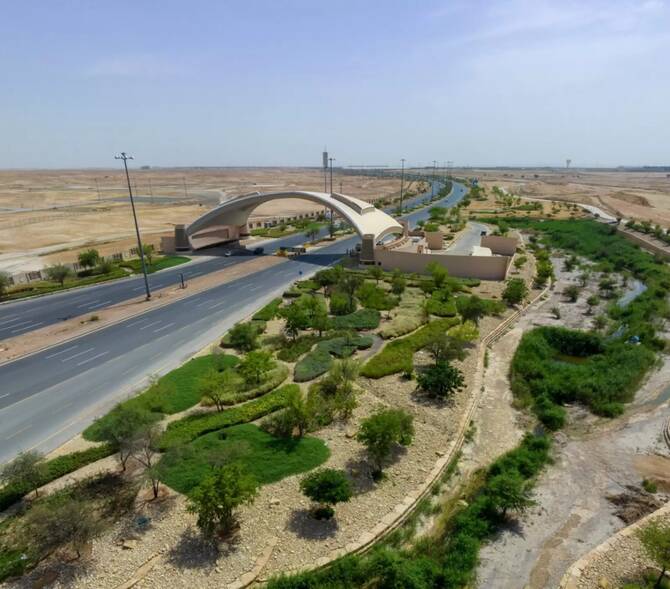
Bioswales are one of the measures adopted to address the problem of stormwater runoff, and experts are confident that they can help prevent flooding. (RCRC)
They help manage peak storm events by providing temporary storage and easing the load on drainage networks. “This reduces pressure on drainage networks and lowers the risk of sudden surges,” he told Arab News. “Their effectiveness increases when drought-tolerant vegetation and engineered soil mixes suited to arid conditions are used.”
Although often compared to rain gardens, bioswales handle larger quantities of water and are typically positioned along roads, parking lots or other impervious surfaces.
“At Grundfos, we see bioswales as an important part of decentralized stormwater management, complementing modern pumping and monitoring systems that help cities manage extreme rainfall more proactively,” Daghestani said.
Saudi soils vary widely, and many are low in permeability. To adapt, bioswales in the Kingdom often rely on engineered soil layers, gravel bases and underdrain systems that compensate for limited natural infiltration. Plant selection is equally critical.
“Native, heat-resistant vegetation maintains performance while minimizing irrigation needs,” he said. “These adaptations help bioswales function reliably despite clay-heavy soils and high temperatures.”

In urban centers, these systems can meaningfully reduce flood risks by directing and absorbing runoff. “In cities such as Jeddah and Riyadh, their benefits are most apparent when they operate alongside engineered infrastructure, like retention basins and controlled drainage systems,” Daghestani explained. “As part of an integrated approach, bioswales help manage peak storm events and support overall urban flood resilience.”
He added that Grundfos is collaborating with Saudi municipalities on hybrid stormwater solutions that pair nature-based designs with smart pumps and sensors for improved weather-response capabilities.
Beyond their flood-management role, bioswales also improve water quality. “Bioswales act as natural filtration systems, capturing sediments, oils, metals and other pollutants carried by stormwater,” Daghestani said. “Engineered soils and vegetation trap contaminants before the water enters drainage networks or natural ecosystems, reducing pollutant loads and lowering maintenance needs for hydraulic infrastructure. This is especially important in urban areas with higher impurity loads.”

Bioswales are eco-friendly channels of vegetation that capture and redirect stormwater, filter out pollutants and help absorb it into the ground. (RCRC)
Different types of bioswales are suited to different environments.
Grassed swales are simple, turf-covered channels suitable for parks and residential areas, capable of removing up to 71 percent of suspended solids with minimal maintenance.
Dry swales, built with engineered soil and gravel supported by perforated pipes, completely drain between storms and work well where natural infiltration is poor.
Wet swales are best for high-water-table areas; they retain a shallow water layer and function like narrow wetlands, offering habitat benefits in addition to stormwater control.
Opinion
This section contains relevant reference points, placed in (Opinion field)
Vegetated swales, planted with native species, offer greater pollutant removal and enhance local biodiversity while improving the aesthetic character of urban landscapes.
As Saudi Arabia continues to expand its cities and strengthen its infrastructure, bioswales provide a practical and environmentally friendly tool for managing stormwater sustainably. When paired with advanced engineering systems and tailored to the Kingdom’s climate and soil conditions, they can help prevent the recurrence of past weather-related disasters and contribute to safer, more resilient cities for generations to come.