

Militants attack police station in Pakistan’s northwest, ‘several’ fighters killed in clashes

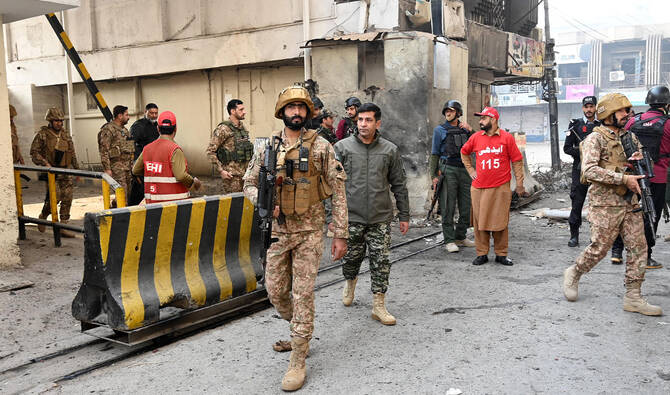
Army personnel inspect the suicide attack site outside the border force headquarters in Peshawar on November 24, 2025. (AFP/File)
Short Url
Updated 28 November 2025
Follow

Militants attack police station in Pakistan’s northwest, ‘several’ fighters killed in clashes

  • Police said militants opened fire overnight on Ahmedzai police station, prompting exchange of fire and search operation 
  • Such attacks are now a near-daily occurrence in KP province, Islamabad blames them on Afghan-based groups, which Kabul denies

KARACHI: Militants launched an overnight attack on a police station in northwest Pakistan’s Bannu district, triggering a major security operation in which “several” fighters were killed, authorities said on Friday, marking the latest in a string of assaults on security forces in Khyber Pakhtunkhwa province.

The attack comes a day after three policemen were killed in a drive-by shooting at a checkpoint in the Hangu district of KP province. It also follows a suicide bombing earlier this week on the headquarters of a paramilitary force in Peshawar, the provincial capital, with three personnel killed.

Police said militants opened fire overnight on the Ahmedzai police station, prompting an exchange of fire in which “several terrorists” were killed and injured. A second clash erupted in the Tarkha Oba area, where members of the Hathikhel tribe, a prominent local clan that has long resisted militant infiltration, confronted the fleeing fighters, triggering “heavy firing from both sides,” according to police.

“On the instructions of DIG Sajjad Khan, a large police contingent has been dispatched,” police said in a statement. “Search operation in the area is under way.”

“The peace of the area will be restored at all costs,” the statement quoted Khan as saying. “Security in the area is on high alert and the noose has been tightened around the terrorists.”

Such attacks are now a near-daily occurrence in KP, which has seen a sharp escalation in militant violence over the past two years. Islamabad accuses militant groups such as the Tehreek-e-Taliban Pakistan (TTP) of planning and executing such cross-border attacks from Afghan territory, a charge the administration in Kabul denies.


Pakistan, global crypto exchange discuss modernizing digital payments, creating job prospects 

Updated 05 December 2025
Follow

Pakistan, global crypto exchange discuss modernizing digital payments, creating job prospects 

  • Pakistani officials, Binance team discuss coordination between Islamabad, local banks and global exchanges
  • Pakistan has attempted to tap into growing crypto market to curb illicit transactions, improve oversight

ISLAMABAD: Pakistan’s finance officials and the team of a global cryptocurrency exchange on Friday held discussions aimed at modernizing the country’s digital payments system and building local talent pipelines to meet rising demand for blockchain and Web3 skills, the finance ministry said.

The development took place during a high-level meeting between Finance Minister Muhammad Aurangzeb, Pakistan Virtual Assets Regulatory Authority (PVARA) Chairman Bilal bin Saqib, domestic bank presidents and a Binance team led by Global CEO Richard Teng. The meeting was held to advance work on Pakistan’s National Digital Asset Framework, a regulatory setup to govern Pakistan’s digital assets.

Pakistan has been moving to regulate its fast-growing crypto and digital assets market by bringing virtual asset service providers (VASPs) under a formal licensing regime. Officials say the push is aimed at curbing illicit transactions, improving oversight, and encouraging innovation in blockchain-based financial services.

“Participants reviewed opportunities to modernize Pakistan’s digital payments landscape, noting that blockchain-based systems could significantly reduce costs from the country’s $38 billion annual remittance flows,” the finance ministry said in a statement. 

“Discussions also emphasized building local talent pipelines to meet rising global demand for blockchain and Web3 skills, creating high-value employment prospects for Pakistani youth.”

Blockchain is a type of digital database that is shared, transparent and tamper-resistant. Instead of being stored on one computer, the data is kept on a distributed network of computers, making it very hard to alter or hack.

Web3 refers to the next generation of the Internet built using blockchain, focusing on giving users more control over their data, identity and digital assets rather than big tech companies controlling it.

Participants of the meeting also discussed sovereign debt tokenization, which is the process of converting a country’s debt such as government bonds, into digital tokens on a blockchain, the ministry said. 

Aurangzeb called for close coordination between the government, domestic banks and global exchanges to modernize Pakistan’s payment landscape.

Participants of the meeting also discussed considering a “time-bound amnesty” to encourage users to move assets onto regulated platforms, stressing the need for stronger verifications and a risk-mitigation system.

Pakistan has attempted in recent months to tap into the country’s growing crypto market, crack down on money laundering and terror financing, and promote responsible innovation — a move analysts say could bring an estimated $25 billion in virtual assets into the tax net.

In September, Islamabad invited international crypto exchanges and other VASPs to apply for licenses to operate in the country, a step aimed at formalizing and regulating its fast-growing digital market.