Brazil prosecutors sue agencies over Haidar shipwreck, environmental risk

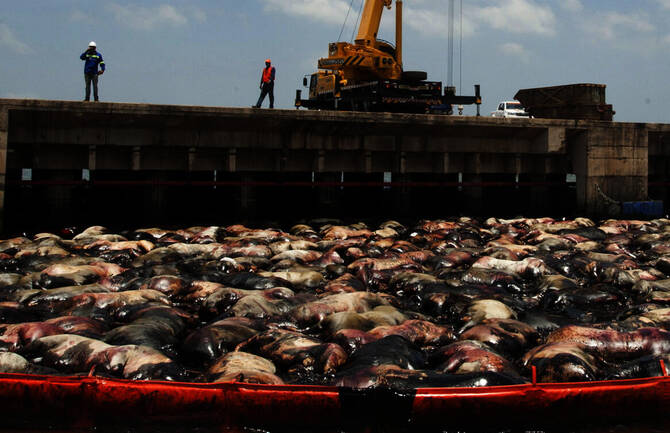
Dead cows are pictured on the side of livestock carrier Haidar, loaded with some 5,000 cows, after it capsized at the Vila do Conde port in Bacarena, Para state, Brazil, Oct. 10, 2015. (Reuters/File)
Short Url
Updated 27 November 2025
Follow

Brazil prosecutors sue agencies over Haidar shipwreck, environmental risk

  • Some 215,000 liters of oil, diesel, fuel, and lubricant could still be inside the ship, prosecutors said
  • Prosecutors are seeking at least $936,873 in compensation

SAO PAULO: Brazilian federal prosecutors in Para state have filed a lawsuit to demand the removal of the hull and oily residues from the Haidar ship, which sank 10 years ago near Vila do Conde port, Brazil’s biggest for live cattle shipments.
In a statement on Wednesday, Para federal prosecutors recalled the Haidar wreck caused the death of 5,000 cattle and a spill of 700,000 liters of oily residues.
A subsequent spill from the Haidar wreck was reported in 2018, prosecutors said, showing that remaining residues inside the hull represent “a constant threat.”
Some 215,000 liters of oil, diesel, fuel, and lubricant could still be inside the ship, prosecutors added, warning of potentially “catastrophic water pollution” if new spills occur.
The sunken vessel still contains carcasses and skeletal remains of the cattle drowned in 2015, they said.
Prosecutors are seeking at least 5 million reais ($936,873) in compensation, in addition to 91,400 reais for environmental damages related to the 2018 spill.
Defendants include the federal infrastructure department DNIT, Para’s environment agency SEMAS, the Para Port Authority CDP, and the companies that owned the ship.
They did not immediately comment on the lawsuit.
Para, Brazil’s biggest live cattle-exporting state, shipped 370,000 head of cattle worth $344 million mainly to Egypt, Morocco, and Algeria in the year through July, according to trade data compiled by state authorities.
Beefpacker Minerva owned the cattle ferried on the Haidar in 2015, but it is not a defendant, according to court filings.


Bangladesh begins exhuming mass grave from 2024 uprising

Updated 07 December 2025
Follow

Bangladesh begins exhuming mass grave from 2024 uprising

  • The United Nations says up to 1,400 people were killed in crackdowns as Hasina attempted to cling to power — deaths that formed part of her conviction last month for crimes against humanity

DHAKA: Bangladeshi police began exhuming on Sunday a mass grave believed to contain around 114 unidentified victims of a mass uprising that toppled autocratic former prime minister Sheikh Hasina last year.
The UN-supported effort is being advised by Argentine forensic anthropologist Luis Fondebrider, who has led recovery and identification missions at mass graves worldwide for decades.
The bodies were buried at the Rayerbazar Graveyard in Dhaka by the volunteer group Anjuman Mufidul Islam, which said it handled 80 unclaimed bodies in July and another 34 in August 2024 — all people reported to have been killed during weeks of deadly protests.
The United Nations says up to 1,400 people were killed in crackdowns as Hasina attempted to cling to power — deaths that formed part of her conviction last month for crimes against humanity.
Criminal Investigation Department (CID) chief Md Sibgat Ullah said investigators believed the mass grave held roughly 114 bodies, but the exact number would only be known once exhumations were complete.
“We can only confirm once we dig the graves and exhume the bodies,” Ullah told reporters.

- ‘Searched for him’ -

Among those hoping for answers is Mohammed Nabil, who is searching for the remains of his brother Sohel Rana, 28, who vanished in July 2024.
“We searched for him everywhere,” Nabil told AFP.
He said his family first suspected Rana’s death after seeing a Facebook video, then recognized his clothing — a blue T-shirt and black trousers — in a photograph taken by burial volunteers.
Exhumed bodies will be given post-mortem examinations and DNA testing. The process is expected to take several weeks to complete.
“It’s been more than a year, so it won’t be possible to extract DNA from the soft tissues,” senior police officer Abu Taleb told AFP. “Working with bones would be more time-consuming.”
Forensic experts from four Dhaka medical colleges are part of the team, with Fondebrider brought in to offer support as part of an agreement with the UN rights body the OHCHR.
“The process is complex and unique,” Fondebrider told reporters. “We will guarantee that international standards will be followed.”
Fondebrider previously headed the Argentine Forensic Anthropology Team, founded in 1984 to investigate the tens of thousands who disappeared during Argentina’s former military dictatorship.
Authorities say the exhumed bodies will be reburied in accordance with religious rites and their families’ wishes.
Hasina, convicted in absentia last month and sentenced to death, remains in self-imposed exile in India.