

Lebanese living abroad seek hope as they return for pope visit

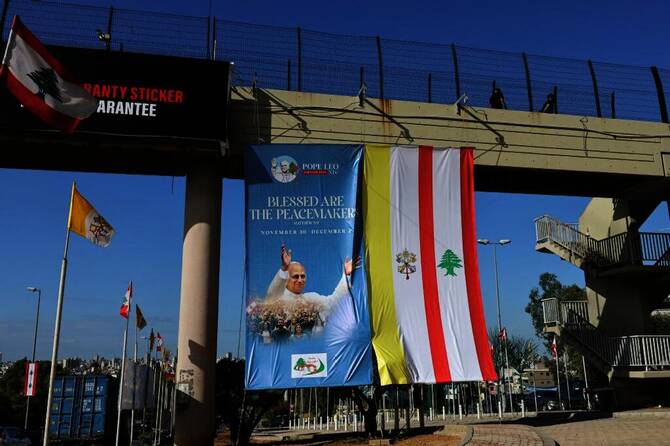
A portrait of Pope Leo XIV hangs in Hazmiyeh, east of Beirut ahead of his first trip abroad to Turkey and Lebanon. (AFP)
Short Url
Updated 26 November 2025
Follow

Lebanese living abroad seek hope as they return for pope visit

  • Members of Lebanon's Christian diaspora are traveling to their homeland to see Pope Leo XIV during his visit
  • Largest foreign delegation attending pope's youth meeting on Monday is from neighboring Syria

BEIRUT: Rachelle Mazraani is traveling from Sydney to Beirut for Pope Leo XIV’s visit this week, one of many Lebanese at home and abroad who hope the trip will revive their struggling country.
After visiting Turkiye, Leo is to arrive in Lebanon on Sunday for a three-day trip that includes an open-air mass at Beirut’s waterfront that organizers expect to draw 120,000 people.
He will also hold a special meeting with those aged 16 to 35 in Bkerke, north of Beirut, where the patriarchate of Lebanon’s Maronite Church is located.
“As a young Lebanese woman living abroad, this visit represents a deep reassurance that Lebanon is not forgotten,” the Australian-born Mazraani, 23, who works in sales and marketing, told AFP by telephone.
She is among some 500 young people from church delegations from several countries who will attend the pope’s youth meeting on Monday.
Leo’s visit “reminds us that Lebanon still has a mission in this region, a spiritual identity that cannot be erased by crisis or conflict,” she said, adding that it urges “us not to lose faith in who we are or in what Lebanon can still become.”
The small Mediterranean country has faced waves of crisis and conflict that have driven people to emigrate, with millions of Lebanese or their descendants now living abroad.
The number of Christians has plummeted, though no official figures are available as authorities have not held a recent census.
The community plays an important political role in multi-confessional Lebanon, the only Arab country with a Christian head of state.
Under the country’s power-sharing system, the post of president is reserved for a Maronite Christian.

‘Suffering deeply’

Billboards showing Leo with the slogan “Blessed are the peacemakers” have sprouted across the country.
It is a welcome message for a country still the target of regular Israeli strikes despite a November 2024 ceasefire that sought to end more than a year of hostilities between Israel and militant group Hezbollah.
But many fear a return to broader conflict.
“Lebanon has been suffering deeply, from ongoing crises to the most recent Israeli strikes, and our hearts are tired,” Mazraani said.
“While no single visit can solve everything overnight, I pray it inspires all of us... to come together to rebuild and to work for the Lebanon that we all dream of,” she said.
The pope is expected to emphasize interfaith dialogue and to call for peace during his visit to the Middle East, whose overall Christian community is diminishing.
The Lebanon visit “carries enormous significance,” said university student Gilbert Bakhos, 19, adding that it brings “unity and peace.”
He said he had traveled from Nigeria to be part of the youth meeting, which he called a “historic moment.”
“I hope to hear a message that motivates our country” to improve things “so my parents and family and our people can return,” he said, adding: “Nobody likes to live far from their country.”
Lebanon has declared a two-day official holiday to allow people to participate in Leo’s public events.
Some hotels are offering special deals, including discounts on bookings and transport to the mass.

‘Struggling’

Leo is visiting “at a time when even the Lebanese are afraid to come,” said Anthony Khadige, 33, a communications manager who was set to travel from Dubai.
“We live in a world in which we have lost hope... All we see is killing and bombing and blood,” he said, expressing optimism that the visit would “restore hope to people’s hearts.”
The largest foreign delegation attending the youth meeting is from neighboring Syria, which has emerged from a nearly 14-year civil war after the December ouster of longtime ruler Bashar Assad.
Syria’s Christian community has shrunk from around one million people before the war to fewer than 300,000 due to waves of displacement and emigration, experts say.
In Damascus, Father Makarios Qalouma from a Greek Catholic parish said he was keen for the visit to bring “hope and peace” to Lebanon and Syria.
Syrian Christians’ participation is an important message that “despite all the crises and difficulties that Syrian society has been through, and particularly the Christians... we are still here.”
A deadly suicide attack on a church in Damascus in June has further stoked fears among the country’s minority community.
Qalouma, who is heading a 300-strong delegation including some 190 young people, said Syrian Christians were “struggling and fighting through all these crises to stay in our country.”
Malik Jabra, head of a Catholic group, said the delegation sought support for a people “who have suffered greatly — particularly Christians who are thinking of emigrating.”


After wins abroad, Syria leader must gain trust at home

Updated 2 sec ago
Follow

After wins abroad, Syria leader must gain trust at home

BEIRUT: One year after ousting Bashar Assad, Ahmed Al-Sharaa has restored Syria’s international standing and won sanctions relief.
But analysts warn the former jihadist still needs to secure trust on the home front.
Sectarian bloodshed in the country’s Alawite and Druze minority heartlands — alongside ongoing Israeli military operations — have shaken Syria as President Sharaa tries to lead the country out of 14 years of war.
“Syria has opened a new chapter that many once thought impossible,” said Nanar Hawach, senior Syria analyst at the International Crisis Group, citing relaunched diplomatic ties and foreign investment.
But he added: “International rehabilitation means little if all Syrians don’t feel safe walking their own streets.”
US President Donald Trump has taken a particular shining to the 43-year-old, a surprise political victory for a former militant who once had a US bounty on his head due to his ties to Al-Qaeda.
Sharaa has toured capitals from the Gulf to Europe to Washington since his Islamist alliance toppled Assad on December 8 last year, ending more than half a century of the family’s iron-fisted rule.
Washington and the UN Security Council have removed him from their respective “terrorism” and sanctions lists, and a delegation from the world body visited Damascus for the first time this week.
The United States, the European Union and Britain have lifted major economic sanctions on Syria, and Damascus has announced investment deals for infrastructure, transport and energy.
Sharaa has even visited Russia, whose military pounded his forces during the war and which is now home to an exiled Assad.
“Sharaa won abroad, but the real verdict comes at home,” Hawach said.

- ‘Real accountability’ -

Critics say Syria’s temporary constitution fails to reflect the country’s ethnic and religious diversity and concentrates power in the hands of a president appointed for a five-year transition.
The new authorities have disbanded armed factions, including Islamist and militant fighters, but absorbed most into the new-look army and security forces, including some foreign fighters.
And some government forces or their allies have been implicated in outbreaks of sectarian violence.
The Alawite community massacres in March, killed more than 1,700 people, according to the Syrian Observatory for Human Rights.
And clashes in July in south Syria’s Druze-majority Sweida province left more than 2,000 dead, including hundreds of Druze civilians.
Authorities have announced investigations into the bloodshed and have arrested and put some suspects on trial.
Nicholas Heras, from the New Lines Institute, said Sharaa “has twice failed as a leader of national reconciliation” — during the violence against the Alawites and the Druze.
Heras told AFP questions remain over “the extent to which he personally wants to rein in the militant Islamist militias that played the strongest role in bringing him to power in Damascus.”
Sharaa’s position, he said, remains precarious “because he does not command a unified security apparatus that can enforce the rules made by his government.”

- ‘Terrifying’ -

Gamal Mansour, a researcher at the University of Toronto, said “factional leaders who are essentially warlords” have taken up official roles, contributing to a “crisis of trust” among minorities.
However, “most Syrians believe Sharaa is the only option that provides guarantees,” he said, calling the prospect of a power vacuum “terrifying.”
Just keeping the country together is a major task, with some on the coast and in Sweida urging succession and the Kurds seeking decentralization, which Damascus has rejected.
A Kurdish administration in the northeast has agreed to integrate its institutions into the central government by year-end but progress has stalled.
Adding to pressures is neighboring Israel, which has repeatedly bombed Syria and wants to impose a demilitarised zone in the south.
Israel’s forces remain in a UN-patrolled buffer zone on the occupied Golan Heights and conduct regular incursions deeper into Syria despite the two sides holding direct talks.
On Monday, Trump told Israel to avoid destabilising Syria and its new leadership.
In October, committees selected new members of parliament, but the process excluded areas outside government control and Sharaa is still to appoint 70 of the 210 representatives.
lar/lg/dc