

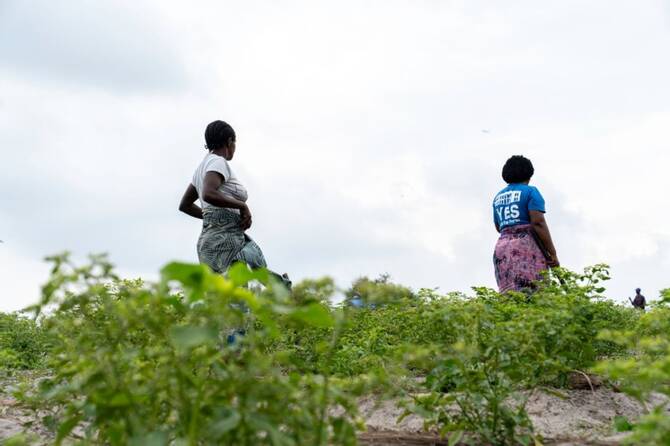

KINASHA: The Kimwenza Valley is a vital source of food for residents of Kinshasa, capital of the Democratic Republic of Congo, but its farmers need help to meet their ballooning needs.
They are constricted on the one hand by construction that is transforming fields into concrete jungles, and on the other, by impoverished soils and competition from cheap food imports that undermine their revenue.
The DRC has nearly 80 million hectares of arable land and four million hectares of irrigable land.
But only one percent is actually cultivated, according to a study published in 2022 by the United Nation’s Food and Agriculture Organization (FAO).
And more than 26 million Congolese people are at risk of severe food insecurity by early 2026, the UN said.
Coveted for its vast mineral resources, the central African country is seeing sectors of the economy other than mining being crowded out, the FAO said.
There are two very different flanks to Kimwenza Valley on the southern outskirts of Kinshasa, a megacity of around 17 million inhabitants which is constantly expanding and engulfing the surrounding countryside.
One flank is covered with tranquil forests and fields where typical local crops like spinach, sorrel and chives grow. Birds sing and the Lukaya River burbles along the valley floor.
The opposite flank has disappeared under concrete because real estate speculation is driving many landowners to convert agricultural land into building plots.
- Competition from imports -
Forner nursery schoolteacher Sylvia Nkelane left her poor, densely populated neighborhood of Kinshasa to work in Kimwenza.
She initially knew nothing about farming, but her school closed and she found herself forced to fend for herself, just like millions of other Kinshasa residents living in precarious conditions.
She had to pay a deposit for the right to farm her small plot of land, which measures about 10 meters (33 feet) by three, and pays rent to the landowner every month.
“But it’s temporary,” she sighed, standing barefoot in her freshly hoed soil.
“This is private land. We’re only here for a short time, and if we have to leave, we’ll have nowhere to go.”
Peasant farmers’ efforts to provide food for the nation — and their own families — is further hampered by difficulties of getting produce to market and by competition from cheap imports.
Local producers must contend with poor roads, dotted with checkpoints which illegally levy taxes to let them through.
By contrast, firms that import food products do not encounter such obstacles and also “often manage to circumvent tariff barriers” that they should face, Nkelane said.
Poultry from Brazil, widely criticized for its poor quality, and fruit and vegetables from South Africa or Europe all flood Kinshasa supermarkets, often at exorbitant prices.
- Natural fertilizers -
Despite abundant rainfall, the Kinshasa region is not particularly conducive to agriculture, which further complicates the farmers’ efforts.
Its sandy soils have a low capacity for retaining water and a poor level of organic matter, as does the rest of the Congo River basin, according to the FAO.
Small farmers like Nkelane rarely have the means to buy tools or the chemical fertilizers and insecticides they deem necessary to improve their soil.
“We have to make do with what little we have. It’s complicated,” her neighbor, Ruphin Kizonzi, told AFP.
Just under half of Congolese farming households have access to quality seeds and almost none to fertilizer, according to a study by the Integrated Food Security Phase Classification published in 2024.
To the northwest of Kinshasa, a pilot farm supported by the World Food Programme is working to transform sand into fertile land.
Carrots and papaya plants have already pushed up through a rectangle of dark soil, thanks to a technique based on organic fertilizers made from a mixture of compost and chicken manure.
It was developed by Oswald Symenouh, an agronomist who heads the company running the farm.
“It allows water retention because the texture of the soil has changed,” he explained.
The development is not an immediate panacea.
Small-scale farmers need training and support to introduce it, and it takes about “two years for the soil to be suitable for use in various vegetable crops.”
It nonetheless remains a positive, welcome development.


