

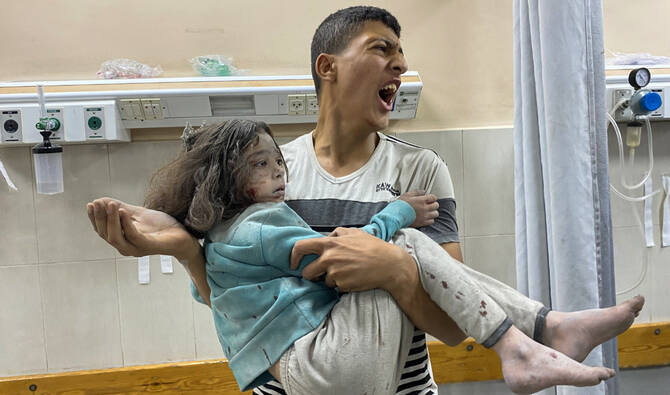

LONDON: For children trapped in the world’s conflict zones, 2024 was a year of unprecedented suffering. The UN verified 41,370 grave violations against children — a record-shattering 25 percent increase over the previous year — devastating countless young lives.
From Gaza to the Democratic Republic of the Congo, children are among the most vulnerable victims of war. The consequences go far beyond immediate physical danger, shaping the course of their lives for years to come.
According to the UN Security Council’s June 17 report on children and armed conflict, at least 22,495 were maimed, killed, recruited, or denied life-saving aid — robbed of the safety and innocence that should define childhood.
“The cries of 22,495 innocent children who should be learning to read or play ball, but instead have been forced to learn how to survive gunfire and bombings, should keep all of us awake at night,” Virginia Gamba, special representative of the UN secretary-general for children and armed conflict, said in the report.
“This must serve as a wake-up call. We are at the point of no return.”

According to the UN, at least 22,495 children were maimed, killed, recruited, or denied life-saving aid — robbed of the safety and innocence that should define childhood. (AFP)
The report, the most damning since the UN began collecting data in 1996, also noted a surge in children suffering multiple violations. In 2024, some 3,137 children were subjected to overlapping abuses such as abduction, forced recruitment, and sexual violence — up from 2,684 the year before.
Months before the report’s release, the UN children’s fund, UNICEF, warned of a crisis beyond precedent. In December, the agency declared 2024 the worst year in its history for children caught in war.
“By almost every measure, 2024 has been one of the worst years on record for children in conflict in UNICEF’s history — both in terms of the number of children affected and the level of impact on their lives,” Catherine Russell, the agency’s executive director, said in a statement.
These children are more likely to be malnourished, displaced, or out of school than those in peaceful regions — a reality she insisted “must not be the new normal.”
“We cannot allow a generation of children to become collateral damage to the world’s unchecked wars,” Russell added.

Palestinian men carry the bodies of children killed earlier in the day in an Israeli strike in Gaza City on July 2, 2025. (AFP)
Beyond the physical toll of conflict, psychological wounds are also profound and enduring, often outlasting conflicts themselves.
“What the recent UN report shows is that children caught in conflict zones are facing unimaginable levels of harm,” Dr. Jeeda Alhakim, a specialist counseling psychologist at City St George’s, University of London, told Arab News.
“This kind of violence doesn’t end when the event is over. It stays with them.”
Alhakim explained that prolonged exposure to danger alters a child’s perception of safety and can even reshape their biology. “When the body is constantly in survival mode, it becomes harder to sleep, concentrate, or feel calm,” she said.
Over time, this toxic stress can disrupt brain development, especially in neural regions responsible for memory, decision making, and emotional regulation. “Trauma doesn’t just live in the mind,” Alhakim said. “It becomes embedded in the nervous system.”
INNUMBERS
- 41,370 Violations against children.
- 11,967 Children maimed or killed.
(Source: UN, 2024)
There are “disruptions in the brain’s stress regulation systems,” she added, “especially in areas like the amygdala, hippocampus, and prefrontal cortex, which are central to managing emotions, remembering things, and making sense of what’s happening around them.”
She emphasized that trauma is not always visible. “Some children appear fine on the outside but are struggling internally. Others show signs of distress more openly. It depends on their experiences, the support they have, and what they’ve lost.
“When children struggle with focus, learning, or emotional outbursts, it’s not simply behavioral — it’s a sign that their brains are adapting to survive.”
Regardless of how it manifests, the consequences are deeply human. “Many children carry a profound sense of loss — of a parent, a home, or a future they once believed in,” she added.

Beyond the physical toll of conflict, psychological wounds are also profound and enduring, often outlasting conflicts themselves. (AFP)
Among the hardest-hit regions, the Palestinian territories ranked highest in the UN’s report, with 8,554 verified violations. More than 4,856 occurred in the Gaza Strip alone.
The UN confirmed the deaths of 1,259 Palestinian children in Gaza, while it continues to verify reports of another 4,470 killed in 2024. The report also documented 22 cases of Palestinian boys used as human shields in Gaza and five more in the West Bank.
Since Israel’s military operation in Gaza began in retaliation for the Oct. 7, 2023, Hamas-led attack on southern Israel, children in the Palestinian enclave have faced bombardment, deprivation, and the collapse of essential services.
Conditions further deteriorated in March when Israeli forces resumed bombing raids and tightened their blockade, triggering catastrophic levels of displacement and the near-total breakdown of healthcare and education.
“Under our watch, Gaza has become the graveyard of children (and) starving people,” Philippe Lazzarini, commissioner-general of the UN Relief and Works Agency for Palestine Refugees in the Near East, posted on X on July 11.
“Their choice is between two deaths: starvation or being shot at. The most cruel (and) machiavellian scheme to kill, in total impunity.”

Since Israel’s military operation in Gaza began in retaliation for the Oct. 7, 2023, Hamas-led attack on southern Israel, children in the Palestinian enclave have faced bombardment, deprivation, and the collapse of essential services. (AFP)
His remarks followed the killing of 15 people, including nine children and four women, who were waiting in line for nutritional supplements in Deir Al-Balah on July 10. The Israel Defense Forces have consistently denied targeting civilians.
The UN has nevertheless kept Israel on its blacklist of parties committing grave violations against children for a second consecutive year. Gaza’s ruling Hamas and Palestinian Islamic Jihad also remain on the list.
Outside the Palestinian territories, other regions also witnessed surging violence. In 2024, the UN recorded more than 4,000 violations in the DRC, some 2,500 in Somalia, nearly 2,500 in Nigeria, and more than 2,200 in Haiti.
Among the most alarming trends was a sharp rise in sexual violence. The UN documented a 35 percent increase in such cases last year, with a notable spike in gang rapes, underscoring the systematic use of sexual violence as a weapon of war.
“Sexual violence is especially devastating,” Alhakim said. “It harms children physically, but also emotionally and socially. It can leave them feeling ashamed, isolated, and deeply confused, especially when used deliberately as a weapon of war.”

In 2024, the UN recorded more than 4,000 violations in the DRC, some 2,500 in Somalia, nearly 2,500 in Nigeria, and more than 2,200 in Haiti. (AFP)
While the UN verified more than 2,000 cases in 2024, the real number is likely far higher. The report stressed that sexual violence remains vastly underreported due to stigma, fear of retaliation, social norms, lack of access to services, and impunity.
“Children are often too afraid or unable to speak out,” said Alhakim. “In some communities, the stigma surrounding sexual violence adds an extra layer of suffering and silence.”
Save the Children revealed in a June report that at least 1,938 children were subjected to catastrophic sexual violence in 2024 — the highest number of verified cases since records began. The figure marks a staggering 50 percent increase since 2020.
“To normalize this level of violence against children is to accept the dismantling of our collective humanity,” Helen Pattinson, CEO of War Child UK, said in a statement. “The level of alarm is unprecedented. Governments must act immediately to turn the tide of grief, trauma and loss borne by children.”
For millions of children growing up under siege, survival alone is no longer enough. What they need is safety, justice, and a chance to dream again.
“No child should have to carry the weight of mass violence,” said Alhakim. “And yet far too many are.”


