

Farhan’s maiden ton fires Pakistan into T20 World Cup Super Eight

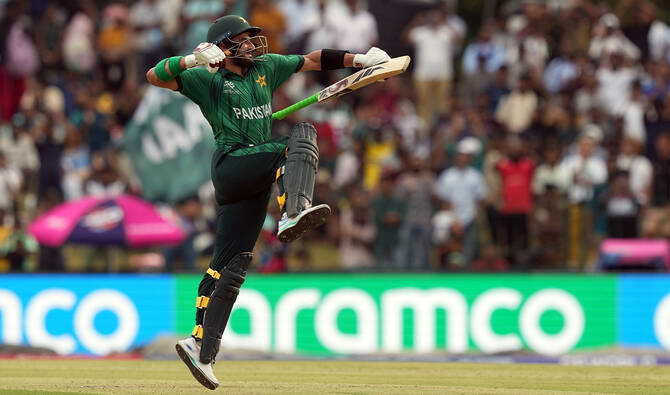
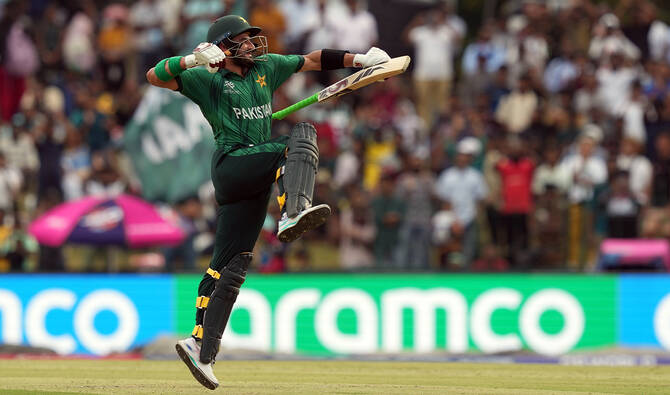
Pakistan’s Sahibzada Farhan celebrates his century during the T20 World Cup cricket match between Namibia and Pakistan in Colombo, Sri Lanka, on February 18, 2026. (AP)
Short Url
Updated 18 February 2026
Follow

Farhan’s maiden ton fires Pakistan into T20 World Cup Super Eight

  • Sahibzada Farhan remained unbeaten with 100 off 58 balls, guiding Pakistan to 199 in Group A clash
  • Pakistan’s Usman Tariq, Shadab Khan take four, three wickets, respectively, to dismiss Namibia for 97

Pakistan became the ‌final team to qualify for the Super Eight of the Twenty20 World Cup after Sahibzada ​Farhan’s maiden international century powered them to a thumping 102-run victory over Namibia in Colombo on Wednesday.

Farhan remained unbeaten on exactly 100 off 58 balls, reaching his landmark in the final over as Pakistan posted 199 in ‌their must-win ‌Group A encounter at ​the ‌Sinhalese ⁠Sports ​Club Ground.

The ⁠opener’s explosive knock featured 11 boundaries and four sixes, with skipper Salman Agha contributing a useful 38 and Shadab Khan adding an unbeaten 36 that included two sixes in the final ⁠over of the innings.

Namibia’s chase never ‌gained momentum despite ‌a promising start from ​opener Louren Steenkamp, ‌who raced to 23 before the African ‌side began losing wickets at regular intervals.

Shadab (3-19) proved instrumental with the ball as well, dismissing skipper Gerhard Erasmus before having Alexander ‌Busing-Volschenk stumped for 20 when the middle-order batter charged down the ⁠pitch ⁠as the required run rate mounted.

Spinner Usman Tariq cleaned up the tail and finished with career-best figures of 4-16 as Namibia were dismissed for 97, ending their World Cup campaign without a win to finish bottom of the group.


Pakistan’s Mahnoor Omer named among TIME’s ‘Women of the Year’ for 2026

Updated 01 March 2026
Follow

Pakistan’s Mahnoor Omer named among TIME’s ‘Women of the Year’ for 2026

  • Omer moved a Pakistani court against the so-called ‘period tax’ in Sept. 2025 which has since sparked a national debate
  • Taxes on sanitary pads in Pakistan can add up to 40 percent to retail price, UNICEF says only around 12 percent women use such products

ISLAMABAD: Pakistani women’s rights activist Mahnoor Omer, who fought against taxes on menstrual products, has been named among the TIME magazine’s ‘Women of the Year’ for 2026.

Omer’s efforts have been recognized alongside 16 activists, artists, athletes and businesswomen in the TIME’s Women of the Year 2026 list, including Olympic gold medalist Sydney McLaughlin-Levrone and Oscar-nominated filmmaker Chloe Zhao.

Dissatisfied with the efforts to educate Pakistani girls about sexual violence, Omer founded the Noor Foundation at the age of 14 and held her own workshops with village girls about everything from climate change to menstruation, according to the TIME magazine.

Two years later, a conversation with a domestic worker about the price of pads made her realize that not everyone could afford these essentials. She moved a court against the so-called “period tax” in Sept. 2025 and the case has sparked a national debate on the subject, considered a taboo by many in Pakistan, since its first hearing late last year.

“A decade and one law degree after her interest in activism was sparked, Omer, now 25, is putting her passion and expertise to work in the name of gender equity,” TIME wrote about Omer on its website.

Taxes imposed on sanitary products in Pakistan can add up to 40 percent to the retail price. UNICEF estimates just 12 percent of women in the country use commercially produced pads or tampons. The alternative, using cloth, risks health impacts including rashes and infections, and can make it impossible for girls to attend school while menstruating.

Omer’s suit, which awaits the government response, has sparked a national discussion. She says she spoke about menstruation to her father and male cousins, who thanked her for standing up for their daughters.
The 25-year-old, who is currently enrolled in a master’s degree in gender, peace, and security at the London School of Economics, sees this case as just the first of many.

“I’m not free until every woman is free,” she was quoted as saying by TIME. “I want to leave no stones unturned in terms of what I can do with the next few decades, as a lawyer for the women in my country and gender minorities in general.”