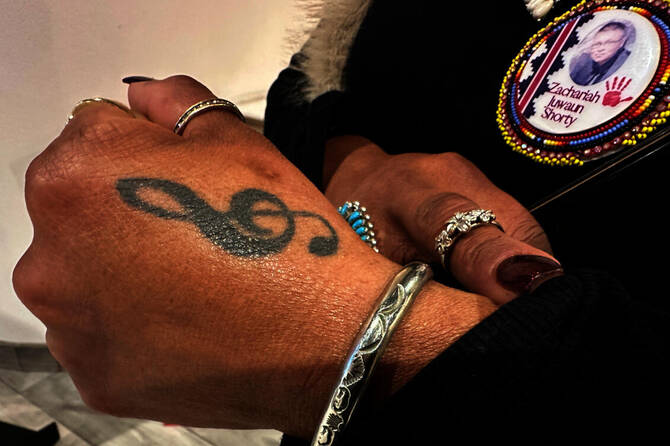
BERNALILLO: Unconditional love. That’s what Vangie Randall-Shorty felt the moment she first held her son. She still feels it — even though Zachariah Shorty is now gone.
“I carry him in my heart every day,” she said, while trying to find the words to describe the wave of emotions that washed over her Monday when she learned that federal authorities had charged three people in connection with her son’s killing on the Navajo Nation in 2020.
She had waited so long for answers, telling herself with each new year that she would finally see justice for her 23-year-old son. Her wait ended as the US Department of Justice announced the results of the latest deployment under Operation Not Forgotten.
Under the operation this year, more than 60 extra FBI agents, analysts and other personnel were temporarily assigned to field offices in 10 states, ranging from Albuquerque and Phoenix to Seattle, Salt Lake City, Detroit, Minneapolis and Jackson, Mississippi. Over six months, they investigated unsolved violent crimes in Indian Country with the goal of addressing a crisis of disappearances and killings that have left Native American communities frustrated and heartbroken.
Federal statistics show that Native Americans experience some of the highest per capita rates of violent victimization of any racial or ethnic group in the United States. At the beginning of the 2025 fiscal year, the FBI’s Indian Country program had about 4,300 open investigations, including over 900 death investigations, 1,000 child abuse investigations, and more than 500 domestic violence and adult sexual abuse investigations.
As part of its intensified operations this year, the FBI’s Indian Country initiatives netted 1,123 arrests, along with the recovery of over 300 weapons. More than 450 children who were victims of crimes were identified or located.
FBI Director Kash Patel acknowledged Monday that the challenge of covering such large jurisdictions is complicated by a lack of resources. He described Operation Not Forgotten as “a major step forward” in giving tribal communities the justice that they deserve.
Work to bring more attention to the crisis has spanned decades. President Donald Trump was the first president to formally recognize the issue when he signed an executive order during his first term, establishing a task force to tackle the high rate of killings and disappearances among Native Americans and Alaska Natives. Former US Interior Secretary Deb Haaland during her tenure created a national commission to explore ways to bridge jurisdictional gaps and other challenges to curbing crime in tribal communities.
Officials said this year’s operation marked the longest and most intense deployment of FBI resources to date to address Indian Country crime.
Advocates say the investment should be made permanent. They fear now that cases will continue to sit on the back burner with fewer federal resources in the field.
Randall-Shorty believes the extra resources helped in her son’s case.
She can’t help but wonder what her son could have accomplished had his life not been taken. A father himself, Zachariah Shorty loved art and music and aspired to be a tattoo artist. She showed off some of his work, pointing to the inked treble clef on her left hand.
Shorty was last seen at the Journey Inn Motel in the northwestern New Mexico city of Farmington, where he was out with friends to make music, his mom said. He was found days later in a field near the Navajo community of Nenahnezad. He had been shot multiple times.
The indictments provide no details about what might have let to the shooting or how Shorty was connected to the people charged in his death. Defense attorneys say they have yet to be provided with any discovery related to the case.
Austin Begay, 31, is charged with first-degree murder, while Jaymes Fage, 38, is accused of aiding and abetting. Both Navajo men and a third defendant, 40-year-old Joshua Watkins, also face charges for lying to investigators to conceal the killing.
Shorty’s mom has spent the last five years attending town halls, task force meetings, prayer circles and community marches to keep the case in the spotlight and to advocate for other families. While she’s pleased that charges have been brought, she knows the next step will stir more emotions because she still misses her son.
“My heart is heavy,” she said. “But I will continue advocating for Zach and continue being his voice.”


![]()

FBI surge leads to charges in 2020 killing in Native American community
Short Url
https://arab.news/ga6g2
FBI surge leads to charges in 2020 killing in Native American community
- The US Department of Justice announced the indictments this week in the shooting death of Zachariah Shorty as the agency shared results from Operation Not Forgotten
- The six-month surge involved dozens of FBI agents, analysts and others who boosted investigative resources to address violent crime across Indian Country


Latest updates





© 2026 SAUDI RESEARCH & PUBLISHING COMPANY, All Rights Reserved And subject to Terms of Use Agreement.