Pakistan encourages Azerbaijan to explore oil and gas opportunities amid investment push 

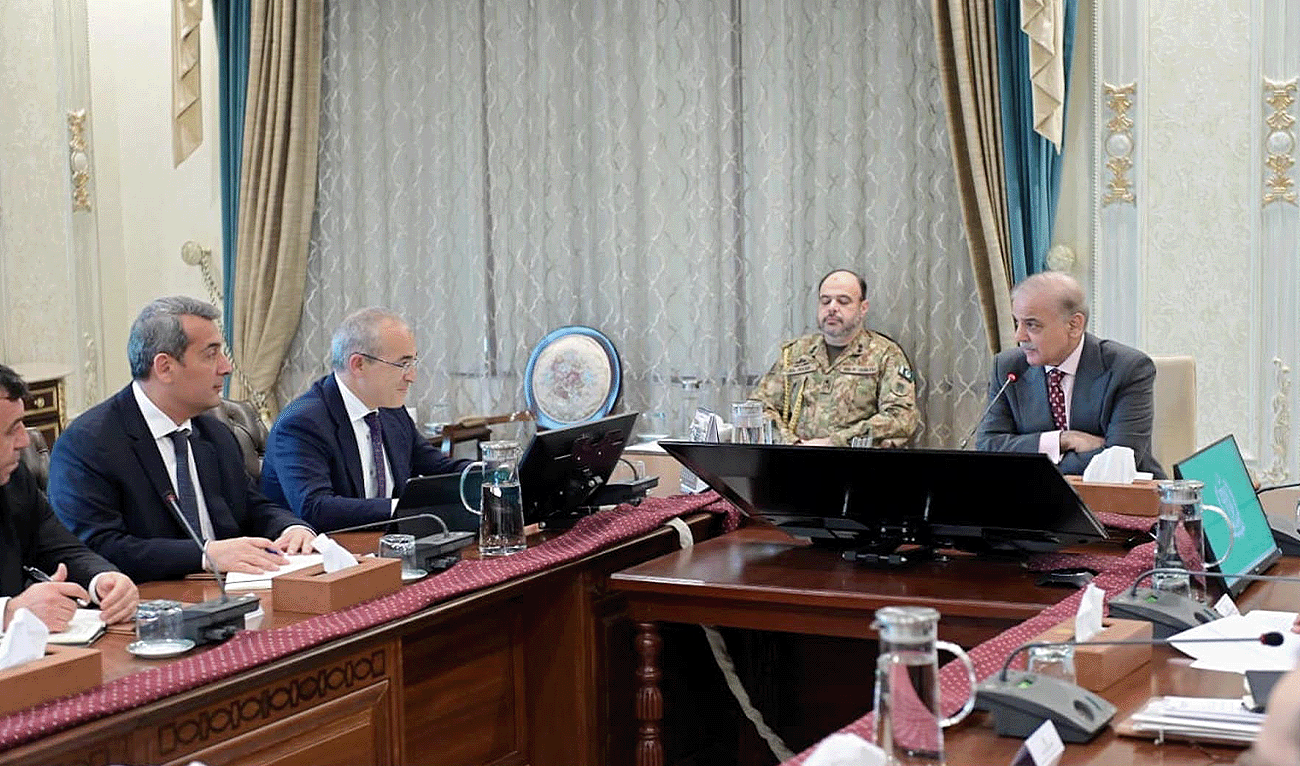
Azerbaijan’s Minister of Economy Mikayil Jabbarov (center) in conversation with Prime Minister of Pakistan Shehbaz Sharif in Islamabad, Pakistan on November 25, 2025. (PID)
Short Url
Updated 26 November 2025
Follow

Pakistan encourages Azerbaijan to explore oil and gas opportunities amid investment push 

  • Pakistan Prime Minister Shehbaz Sharif meets Azerbaijan’s Minister of Economy Mikayil Jabbarov in Islamabad
  • Both sides review trade ties, focusing on defense production, petroleum and minerals, IT sectors, says PM’s Office

ISLAMABAD: Prime Minister Shehbaz Sharif encouraged Azerbaijan to explore oil and gas investment opportunities in Pakistan, his office said this week, as Islamabad reviewed trade, economic and investment exchanges with its regional ally. 

The statement followed Sharif’s meeting with Azerbaijan’s Minister of Economy Mikayil Jabbarov on Tuesday, who is on a visit to Pakistan with a high-level delegation. The Pakistani prime minister visited Azerbaijan in November to discuss bilateral cooperation in trade, energy and defense sectors. 

During the talks, the two sides conducted an “extensive review” of bilateral trade and investment cooperation, the Prime Minister’s Office (PMO) said about Sharif’s meeting with Jabbarov. It also said the two agreed on the need to accelerate efforts to diversify and deepen economic exchanges, with discussions covering defense production, petroleum and minerals, infrastructure development, dairy and livestock, hospitality and the information technology sectors, the statement added. 

“Prime Minister Sharif reiterated Pakistan’s proposal to establish a Pakistan‑Azerbaijan Joint Investment Company with equal contributions from both countries,” the PMO said on Tuesday. “He also welcomed Azerbaijan’s interest in the White Oil Pipeline Project and encouraged SOCAR to explore upstream oil and gas opportunities in Pakistan.”

The White Oil Pipeline project, inaugurated in 2005, aims to facilitate the smooth transportation of oil between Karachi’s Keamari district and Mehmood Kot in Punjab, with the goal of reducing the traffic congestion caused by approximately 4,000 trucks and mitigating negative environmental impacts.

The project is managed by the Pak-Arab Pipeline Companies Limited (PAPCO) and is considered crucial for sustaining industrial growth and agricultural productivity, especially as energy demands in the country continue to rise.

Jabbarov thanked Pakistani government for hosting the Azeri delegation, hoping that ongoing engagements would culminate in the finalization of the Roadmap on Cooperation in Commerce, Economy, Industry and Investment (2025‑2028) between the two countries.

Pakistan seeks to position itself as a key trade and transit hub by connecting landlocked Central Asian states to the global market via the Arabian Sea. Islamabad has also eyed partnerships with various countries around the world, hoping they can tap into its natural oil, gas and critical mineral reserves as it seeks to escape a prolonged macroeconomic crisis. 



OIC’s COMSTECH stresses academic collaborations across Muslim world in Islamabad meeting

Updated 4 sec ago
Follow

OIC’s COMSTECH stresses academic collaborations across Muslim world in Islamabad meeting

  • COMSTECH holds annual meeting in Islamabad featuring 30 delegates from Iran, Somalia, Palestine, Indonesia and other OIC states
  • Limited pool of skilled professionals one of the foremost challenges facing Muslim world, notes COMSTECH secretary general 

ISLAMABAD: The OIC Standing Committee on Scientific and Technological Cooperation (COMSTECH) called for stronger academic collaboration across Islamic states to secure the future of higher education in the Muslim world, state-run media reported on Saturday. 

COMSTECH’s Coordinator General Prof. Dr. Muhammad Iqbal Choudhary was speaking at the Annual Meeting of the COMSTECH Consortium of Excellence at the organization’s Secretariat in Islamabad. The event brought together vice chancellors, rectors, and senior representatives from leading universities across OIC member and observer states. 

Nearly 30 international delegates representing universities from Iran, Somalia, Palestine, Indonesia, Malaysia, Thailand, Uganda, Bangladesh, Benin, Cameroon, Gabon, Côte d’Ivoire, and Senegal joined their counterparts from several Pakistani institutions at the meeting. Participants attempted to chart a collective path forward for tertiary education in OIC countries.

“Collaborations, knowledge sharing, best practices, exchange of scholars, technology transfer and joint academic programs are vital for overcoming the educational challenges faced across the OIC region,” Choudhary said, according to the state-run Associated Press of Pakistan (APP).

The COMSTECH secretary general noted that one of the foremost developmental challenges facing OIC nations remains the limited pool of skilled professionals and workforce. 

He said this gap can only be bridged through strengthened tertiary education systems and expanded opportunities for knowledge transfer.

Discussions at the event highlighted the urgent need for competency-driven education, modern pedagogical tools, university–industry partnerships and collaborative training programs designed to equip graduates with the skills necessary to address emerging global challenges.

“The Annual Meeting served as a vital platform for reviewing progress achieved over the past year, identifying future priorities, and deepening academic cooperation to promote scientific excellence and sustainable development across the OIC region,” the APP said.