

Diriyah Season highlights power of storytelling in Al-Bujairi

1 / 3
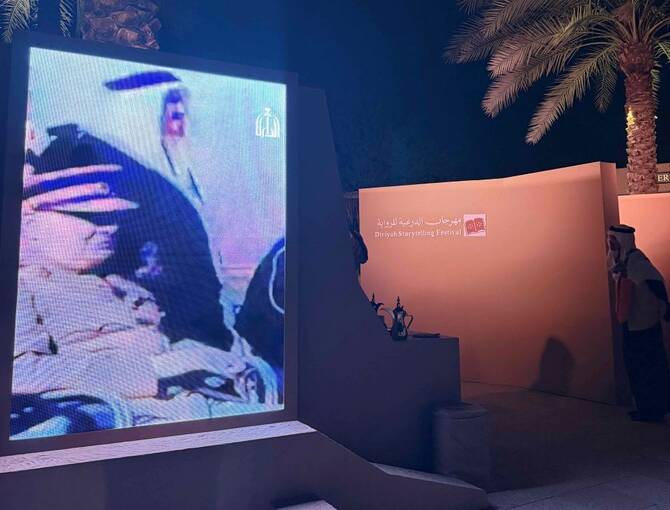
Traditional narrating experience at Diriyah. (AN Photo/Basmah Albasrawi)
2 / 3
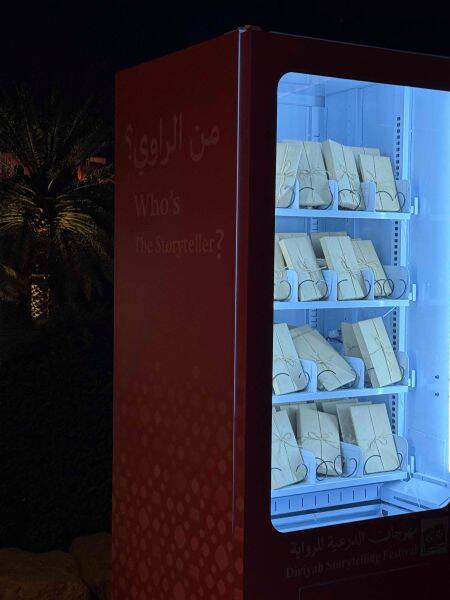
Untitled books vending machine at Diriyah. (AN Photo/Basmah Albasrawi)
3 / 3
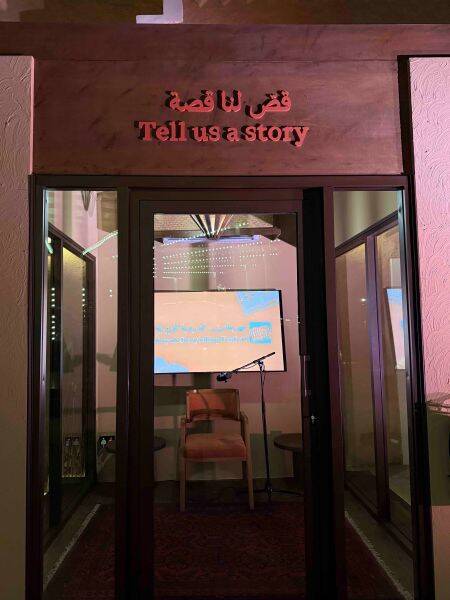
Tell Us A Story booth at Diriyah. (AN Photo/Basmah Albasrawi)
Short Url
Updated 25 November 2025
Follow

Diriyah Season highlights power of storytelling in Al-Bujairi

  • Festival’s author talks, immersive spaces and more celebrate region’s rich storytelling heritage
  • A discussion forum has featured interviews with authors such as Libyan writer Najwa Bin Shatwan

RIYADH: Al-Bujairi has been transformed into a lively hub of narratives, culture and creativity for the Diriyah Storytelling Festival, part of this year’s Diriyah Season.

Designed to create a direct connection between traditional storytelling and today’s modern, advanced narrative forms, the festival brings together a wide range of literary and cultural experiences in the heart of the UNESCO World Heritage Site. 

Diriyah Season, an annual celebration of art, culture and heritage, has once again embraced Riyadh’s winter crowds with programs, workshops and exhibitions highlighting local history.

But the Storytelling Festival stands out, bridging past and present forms of expression with a diverse range of activities in both Arabic and English, engaging locals and foreigners alike.

One of the first experiences, a storytelling venue, allows guests to choose their desired language before they enter a tent with traditional floor seating and decorated cultural handcrafts. After they are offered Saudi coffee, they listen to narrators tell a three-minute story.

Outside, visitors can explore traditional buildings and enjoy the winter atmosphere as they browse the various booths. Other interactive stations include “Diriyah Between the Lines,” where a literary gumball machine dispenses capsules containing prose.

A discussion forum has featured interviews with authors such as Libyan writer Najwa Bin Shatwan, the only woman to be shortlisted for the 2017 International Prize for Arabic Fiction.

She spoke about her writing experience to an eager audience, saying: “As Arabs, one of the first ways we used our language was in poetry.” She went on to discuss the industry, history of writing and trends in the Arab world.

Outside, the stone-carved “Giving Shelf” encourages visitors to donate books for others to take. Vending machines labeled “Who’s the Storyteller?” offer coverless, title-less books for guests to select blindly, encouraging engagement with Arab literature. “Tell Us a Story” inspires visitors to practice their own skills, as they narrate tales into a microphone.

The festival, which runs until Nov. 29 and is open daily from 5 p.m., connects visitors with history, culture and literature in one diverse experience. In total it features more than 40 workshops sessions and panels, along with around 20 inspiring talks with contributions from more than 30 storytellers.


How science is reshaping early years education 

Updated 27 December 2025
Follow

How science is reshaping early years education 

DUBAI: As early years education comes under renewed scrutiny worldwide, one UAE-based provider is making the case that nurseries must align more closely with science.

Blossom Nursery & Preschool, which operates 32 locations across the UAE, is championing a science-backed model designed to close what it sees as a long-standing gap between research and classroom practice.

“For decades, early years education has been undervalued globally — even though science shows the first five years are the most critical for brain development,” said Lama Bechara-Jakins, CEO for the Middle East at Babilou Family and a founding figure behind Blossom’s regional growth, in an interview with Arab News.

Lama Bechara-Jakins is the CEO for the Middle East at Babilou Family and a founding figure behind Blossom’s regional growth. (Supplied)

She explained that the Sustainable Education Approach was created to address “a fundamental gap between what we know from science and what actually happens in nurseries.”

Developed by Babilou Family, the approach draws on independent analysis of research in neuroscience, epigenetics, and cognitive and social sciences, alongside established educational philosophies and feedback from educators and families across 10 countries. The result is a framework built around six pillars; emotional and physical security, natural curiosity, nature-based learning, inclusion, child rhythms, and partnering with parents.

Two research insights, Bechara-Jakins says, were particularly transformative. “Neuroscience shows that young children cannot learn until they feel safe,” she said, adding that stress and inconsistent caregiving can “literally alter the architecture of the developing brain.” 

Equally significant was evidence around child rhythms, which confirmed that “pushing children academically too early is not just unhelpful — it can be counterproductive.”

Feedback from families and educators reinforced these findings. Across regions, common concerns emerged around pressure on young children, limited outdoor time and weak emotional connections in classrooms. What surprised her most was that “parents all sensed that something was missing, even if they couldn’t articulate the science behind it.”

At classroom level, the strongest body of evidence centres on secure relationships. Research shows that “secure attachments drive healthy brain development” and that children learn through trusted adults. At Blossom, this translates into practices such as assigning each child “one primary educator,” prioritising calm environments, and viewing behaviour through “a neuroscience lens — as stress signals, not misbehaviour.”

Bechara-Jakins believes curiosity and nature remain overlooked in many early years settings, despite strong evidence that both accelerate learning and reduce stress. In urban centres such as Dubai, she argues, nature-based learning is “not a luxury. It is a developmental need.” 

For Blossom, this means daily outdoor time, natural materials, gardening, and sensory play — intentional choices aimed at giving children what science says they need to thrive.