Diriyah Storytelling Festival finds fitting home in Al-Bujairi

1 / 3
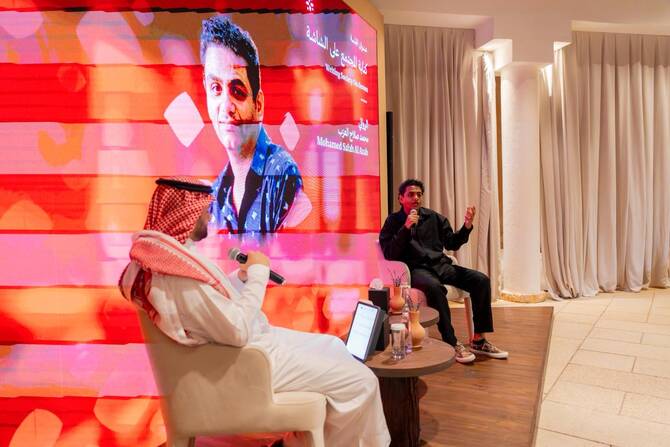
Diriyah Storytelling Festival transforms Al-Bujairi into a living epicenter of narrative arts. (Supplied)
2 / 3
Diriyah Storytelling Festival transforms Al-Bujairi into a living epicenter of narrative arts. (Supplied)
3 / 3
Diriyah Storytelling Festival transforms Al-Bujairi into a living epicenter of narrative arts. (Supplied)
Short Url
Updated 21 November 2025
Follow

Diriyah Storytelling Festival finds fitting home in Al-Bujairi

  • A district once famed for welcoming scholars and poets has found a natural extension of its intellectual spirit with the festival, attracting readers, authors, and other visitors eager to engage with storytelling

RIYADH: With the arrival of Diriyah Storytelling Festival on Nov. 16, Al-Bujairi District has emerged as a hub of knowledge and culture, “a place where storytelling blends with setting,” according to a press release from the festival organizers. 

A district once famed for welcoming scholars and poets has found a natural extension of its intellectual spirit with the festival, attracting readers, authors, and other visitors eager to engage with storytelling.

Over the past few days, the festival — the theme of which is “Where Stories Live On” — has included talks exploring how writers draw on history “to illuminate hidden meanings and human experiences. Through discussions on identity and memory, participants have uncovered new perspectives on truth as interpreted by experts through a contemporary lens,” the press release stated.

Local and international storytellers have examined how historical figures can be reintroduced into the present day, and how interpretation can balance narrative authenticity with creative freedom. 

Workshops and interactive sessions have offered audiences deeper insight into descriptive and visual storytelling techniques, revealing how image and text complement each other and how rhythm can open new pathways to meaning.

At The Storyteller’s Forum, one of the festival’s key features, visitors can browse exhibits on a range of literature. Meanwhile, Majlis Ar-Rawi presents narratives inspired by Saudi memory, and “reflecting the values that have shaped Diriyah’s identity and history through the ages.”

The Tell Us a Story experience has attracted participants eager to record their personal memories at the festival, while Who Is the Storyteller? and Diriyah Between the Lines both introduce innovative ways to engage with texts beyond traditional forms.

The festival runs until Nov. 29 and is open daily from 5 p.m. Over that time, more than 40 workshops sessions and panels — in both Arabic and English — will be held, in addition to around 20 inspiring talks with contributions from more than 30 storytellers.

Diriyah Storytelling Festival is part of Diriyah Season 25/26, which is being held this year under the theme “Your Pride, Your Place.” 

Diriyah Season includes a range of diverse interactive experiences, live performances, and art exhibitions, all shedding light on Diriyah’s rich cultural and economic heritage. 

The festival serves, according to its organizers, as “an open invitation to connect with Saudi Arabia’s celebrated past and discover the beauty of its present in an atmosphere filled with authenticity and tradition.”


Leading AI company to partner with Saudi Arabia, CEO tells Arab News

Updated 06 February 2026
Follow

Leading AI company to partner with Saudi Arabia, CEO tells Arab News

  • Argentum’s Andrew Sobko: ‘Very easy’ to build new infrastructure, data centers in Kingdom
  • In 2024, Saudi Arabia announced $100bn plan to establish AI hub

CHICAGO: The founder and CEO of Argentum AI, one of the world’s leading artificial intelligence companies, has told Arab News that he is looking forward to partnering with Saudi Arabia.

Ukrainian-born Andrew Sobko, based in Chicago, said Crown Prince Mohammed bin Salman has made a significant commitment to AI use.

In 2024, Saudi Arabia announced a $100 billion plan under Vision 2030 to build a hub to develop technology and data centers to handle a significant portion of the world’s AI workload.

The Kingdom reportedly expects AI to contribute more than $135.2 billion to its gross domestic product by 2030, representing roughly 12.4 percent of its economy.

“The US still is the kind of core leader of this AI innovation, development and infrastructure, but we quickly realized that Saudi Arabia sees this as an important asset class, not just as an innovation,” Sobko said.

“They’re deploying tons of capital. If you try to build some new infrastructure or data center, it’s very easy to do it in Saudi Arabia,” he added. “Saudi Arabia realizes and sees this compute as almost like a second asset class after oil.”

The term “compute” refers to the process of calculations that fuels AI development and applications in everyday use.

“The Middle East wants to be one of the largest exporters of compute. They realized that a couple of years ago and they’re aggressively expanding,” Sobko said, adding that AI is being used more and more in industries such as sports, in which Saudi Arabia has invested heavily.

Argentum AI recently added Majed Al-Sorour, CEO of the Saudi Golf Federation, to its board.

“Majed is also a huge believer in AI and AI infrastructure,” said Sobko. “With the help of Majed, we’re focusing on global expansion. He’s leading charge on that.”

Sobko said the challenge is not simply recognizing the importance of AI, but the ability to power data centers that it requires, and Saudi Arabia recognizes that need.

“If you secure a significant amount of power and you have data center capacity, you can actually control this kind of compute and AI,” he added.

“And the biggest bottleneck to continue expanding as we enter into this new age of robotics industry, it needs a lot more compute.”

Following meetings with US leadership, including President Donald Trump last November, Saudi Arabia secured agreements on AI technology transfers, aiming to avoid reliance on other nations’ systems.