

Kabul warns of response at ‘proper time’ after alleged Pakistan airstrikes 

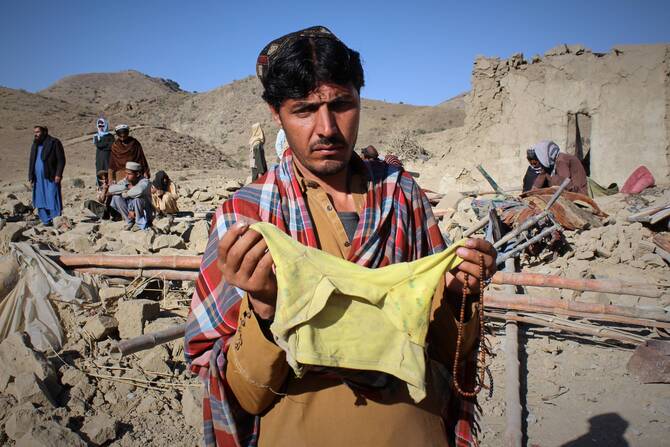
A man shows children's clothing, allegedly belonging to a victim, as locals search through the rubble at the site of an overnight attack on a home that the Afghan government said was carried out by Pakistan, in Khost province, Afghanistan, Tuesday on Nov. 25, 2025. (AP Photo)
Short Url
Updated 25 November 2025
Follow

Kabul warns of response at ‘proper time’ after alleged Pakistan airstrikes 

  • Taliban government calls alleged Pakistan airstrikes a ‘direct assault’ on Afghan sovereignty 
  • Afghanistan-Pakistan tensions have intensified since deadly border clashes in October this year

KABUL: Afghanistan said it would take a “necessary response at the proper time” after alleged overnight Pakistani airstrikes in three eastern provinces killed nine children and a woman, a Taliban government spokesman said on Tuesday. 

Pakistani forces “bombed the house of a local civilian” in the Khost province late on Monday, the Afghan Taliban government’s chief spokesman Zabihullah Mujahid said on X in a series of posts that included photos of the child victims. 

The airstrikes also targeted the border provinces of Kunar and Paktika, injuring at least another four civilians, he added. 

“The airstrikes carried out last night by Pakistani forces in Afghanistan’s Paktika, Khost, and Kunar provinces constitute a direct assault on Afghanistan’s sovereignty and expose the ongoing failures of Pakistan’s military regime,” Mujahid said. 

“The Islamic Emirate of Afghanistan strongly condemns this violation and act of aggression, and stresses that defending its airspace, territory, and citizens is its legitimate right. A necessary response will be taken at the proper time.”

Pakistan authorities have yet to comment on the alleged strikes, which came after suicide bombers targeted the headquarters of a Pakistan paramilitary force in the northwestern city of Peshawar on Monday, killing three officers and wounding at least 11 others. 

Relations between the neighboring countries have been strained since the Taliban took control of Afghanistan in 2021, following the withdrawal of US-led troops. But tensions have intensified since October this year, following deadly border clashes that killed about 70 people on both sides. 

Though the fighting ended with a ceasefire brokered by Qatar and Turkiye, talks held in Istanbul failed to produce a lasting deal. 

Pakistan accuses the Afghan Taliban of sheltering fighters from the banned Tehreek-e-Taliban Pakistan and allowing them to stage cross-border attacks — a charge Afghanistan denies, saying it does not allow its territory to be used against other countries.

Pakistan’s recent airstrikes marked a “dangerous escalation,” said Ahmad Samadi, a political science lecturer at Salam University in Kabul. 

“Targeting areas where families live not only violates basic humanitarian norms, but it also deepens mistrust between two countries that share history, culture, and long-standing social ties,” he told Arab News. 

“These incidents fuel anger on the Afghan side and complicate any effort to build constructive diplomatic engagement. If such actions continue, they risk pushing governments on both sides further away from dialogue and closer to prolonged tensions.” 

Afghans who live along the Durand Line — the 2,640-km border between Afghanistan and Pakistan — are calling for an end to the strikes.  

“We just want this to end. We want to live without fear of the next bombardment,” Abdul Hakim, a 36-year-old shopkeeper from Khost, told Arab News. 

“We have families on both sides of the Durand Line, and we should be living as good neighbors. Instead, Pakistan keeps striking our houses and taking the lives of our women and children. It’s wrong, completely wrong, and we ask our own government to put a stop to this.” 

For most of his life, 28-year-old Sharikullah said he has witnessed how Pakistan’s attacks “have fallen on ordinary homes” of “families who have done nothing” to Islamabad. 

“This isn’t the first time something like this has happened … but lately the strikes have become more frequent … We want nothing but peaceful, respectful relations with Pakistan as our neighbor, but many of us feel that their military actions only bring more insecurity and hardship to our lives,” he said.

“Our people are exhausted. We just want the killing of civilians to stop. We don’t expect anything more than Pakistan.” 


Maduro’s fall tests Venezuela’s ruling ‘club’

Updated 5 sec ago
Follow

Maduro’s fall tests Venezuela’s ruling ‘club’

  • The ousting of Nicolas Maduro as Venezuela’s president puts to the test his “Chavista” factions that have governed the oil-rich nation for 27 years
CARACAS: The ousting of Nicolas Maduro as Venezuela’s president puts to the test his “Chavista” factions that have governed the oil-rich nation for 27 years.
What happens to the so-called “club of five” powerful leftist figures, now that two of its most important members — Maduro and his wife Cilia Flores — have been captured and sent to the United States to face trial?

’Club of five’
Anointed by his mentor Hugo Chavez before the latter’s death in 2013, Maduro kept a tight grip on power until his capture by US forces on Saturday.
Maduro ruled alongside Flores and three other powerful figures: former vice president Delcy Rodriguez — now Venezuela’s interim leader — her brother Jorge, and their rival: hard-line Interior Minister Diosdado Cabello.
“It’s like a club of five,” a diplomatic source in Caracas told AFP under the condition of anonymity.
“They can speak, they have a voice in the government, but Maduro was the one who kept the balance. Now that he’s gone, who knows?“
Maduro and ‘Super Cilita’
The image of Maduro handcuffed and blindfolded as US forces transported him to New York to face trial made headlines around the world.
During months in the crosshairs of US President Donald Trump, who accused him of being a drug trafficker, the 63-year-old former bus driver deflected pressure by dancing to techno music at near-daily rallies, always broadcast live, as he chanted the mantra “No war, yes peace!” — in English.
Frequently underestimated, Maduro managed to eliminate internal resistance and keep the opposition at bay.
Murals, songs and films celebrated him, as did the animated cartoon “Super Moustache,” in which he appeared as a superhero, fighting imperialism alongside “Super Cilita,” who is based on Flores.
Toy figurines of both characters were also produced.
The military swore absolute loyalty to him, led by Defense Minister Vladimir Padrino Lopez.
Though defiant at first and calling for Maduro’s return, Venezuela’s interim leader Rodriguez called for a “balanced and respectful relationship” between the South American country and the United States on Sunday.
“The top level of government has survival as its absolute priority,” Antulio Rosales, political scientist and professor at York University in Canada, told AFP.
The Rodriguez siblings
Rodriguez controlled the economy and the oil industry as vice president while her brother Jorge is the speaker of parliament.
They are known for their incendiary rhetoric, often mixing belligerence, irony and insults against the “enemies of the fatherland.”
But behind the scenes, they are skilled political operators.
Jorge Rodriguez was the chief negotiator with the opposition and the United States, and his sister represented Maduro in various international forums.
Experts also attribute purges within government to them, such as one that sent Tareck El Aissami, a powerful oil minister until 2023, to prison.
Rodriguez took over his post shortly afterwards.
The feared policeman
Diosdado Cabello meanwhile is widely feared in Venezuela. Under his ministry, some 2,400 people were detained during protests that followed Maduro’s disputed re-election in 2024, in a move that cowed the opposition.
Cabello is seen as representing the most radical wing of “Chavismo,” and some see him at odds with the pragmatism of the Rodriguez pair, though both sides have denied this.
Cabello acted as president for a few hours when Chavez was overthrown for two days in 2002.
He accompanied Chavez in a failed coup attempt in 1992. Today he is number two in the Socialist Party behind Maduro.
The US courts have now named Cabello among those wanted for trial alongside Maduro.
They have offered $25 million for his capture.
Having kept a low profile in the hours after Maduro’s capture, he appeared by Rodriguez’s side at her first cabinet meeting as acting president on Sunday.