

Pakistan minister urges use of AI to help predict disasters, monitor climate risks

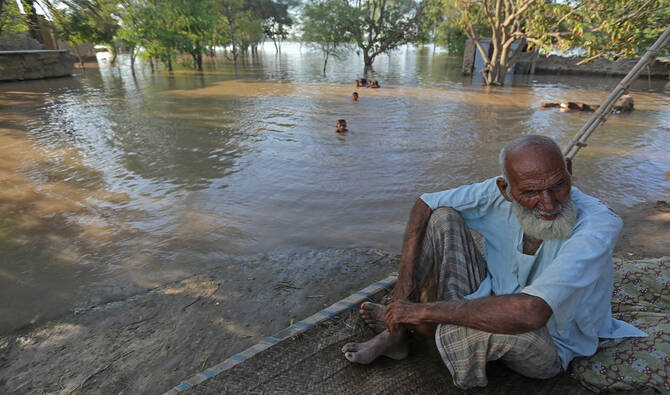
An elderly farmer sits while children swim in flood waters in Alipur, a town of Muzaffargarh district in Punjab province on September 12, 2025, after the Head Panjnad overflowed following heavy monsoon rains. (AFP/ File)
Short Url
Updated 10 February 2026
Follow

Pakistan minister urges use of AI to help predict disasters, monitor climate risks

  • Pakistan ranks among nations most vulnerable to climate change and has seen erratic changes in its weather patterns
  • Musadik Malik says Pakistan can use AI models to design interventions that create maximum impact with limited resources

ISLAMABAD: Pakistan’s Climate Change Minister Musadik Malik on Tuesday urged the use of artificial intelligence (AI) to strengthen disaster preparedness and improve monitoring of climate vulnerabilities, saying AI could help the country better manage climate risks.

Pakistan ranks among nations most vulnerable to climate change and has seen erratic changes in its weather patterns. In 2022, monsoon floods killed over 1,700 people, displaced another 33 million and caused over $30 billion losses.

Another 1,037 people were killed in massive monsoon floods last year, while record snowfall and rains last month stranded hundreds of tourists and residents in several northern districts of the country.

Malik on Tuesday highlighted the critical role of AI in climate governance, public policy and disaster risk management during a panel discussion at the National Artificial Intelligence Workshop in Islamabad.

"The most significant and impactful application of artificial intelligence lies in its predictive and preventive capabilities," he said in a statement shared by the information ministry, noting that Pakistan faces serious challenges due to sparse and fragmented data that complicates effective policymaking.

"Through AI-based modelling, we can design interventions that create the maximum impact with limited resources."

The statement came a day after Pakistan opened Indus AI Week, which is running till Feb. 15, to align policy direction, industry adoption, talent development, and innovation under a single coordinated framework, with Prime Minister Shehbaz Sharif announcing that Islamabad would invest $1 billion in AI by 2030 to modernize the nation’s digital economy.

AI can play a crucial role in identifying climate vulnerabilities on the ground and can function as a watchdog by integrating multiple technologies and monitoring systems, according to Malik. This integration enables early identification of potential disasters, allowing timely and preventive interventions before damage occurs.

He stated AI is driving a global revolution but warned that its upcoming phase, particularly the emergence of AI agents, will have significant implications for employment.

“AI agents are likely to replace certain jobs and functions,” he said. "We must be extremely careful in how we integrate AI into public service and ensure timely and efficient reallocation and reskilling of affected human resources."

The minister noted that while technology can deliver short-term gains, their sustainability depends on innovation.

“One-time productivity can be achieved through technology adoption, but lasting progress requires innovation,” he added.


One dead, four injured as gas cylinder explosion triggers fire in Karachi building

Updated 22 February 2026
Follow

One dead, four injured as gas cylinder explosion triggers fire in Karachi building

  • Fire triggered by gas cylinder explosion in Karachi’s Bismillah Residency in North Nazimabad area, say police
  • Many households in Pakistan rely on liquefied petroleum gas cylinders which are susceptible to gas explosions

ISLAMABAD: One person was killed while four others were injured in Pakistan’s southern port city of Karachi after a gas cylinder exploded, triggering a fire inside a residential building, police and rescue officials said on Sunday.

The fire was caused on Saturday night by a gas cylinder explosion at a flat in Bismillah Residency located in Karachi’s North Nazimabad area, Sindh Police said in a statement. Local media reports said the flat was located on the ninth floor of the high-rise building.

Rescue 1122 Sindh emergency service said its firefighters arrived shortly after the fire was reported and doused the flames on Sunday morning. It said all of the building’s occupants, except for the one person who was killed by the fire, were rescued.

“The child who died in the fire that broke out following a cylinder blast in a building has been identified as Burhan, son of Aoun, aged 15,” Rescue 1122 spokesperson said in a statement.

It said the injured included two women, one man and a four-year-old girl.

“All the injured were shifted to hospital after receiving immediate medical aid, and the rescue operation has been completed,” the spokesperson added.

This is the second such explosion to take place in Karachi in less than a week. At least 15 people were killed, including women and children, when a gas cylinder exploded in a residential building in the city’s Soldier Bazaar area on Thursday.

Most houses and apartment buildings in Karachi, like elsewhere in Pakistan, are supplied with natural gas for cooking. However, many households also rely on liquefied petroleum gas cylinders because of low natural gas pressure.

In July, a gas explosion following a wedding reception at a home in Pakistan’s capital, Islamabad, killed eight people, including the bride and groom.

A massive fire at a popular shopping mall in Karachi last month killed over 70 people.
