

Why are tensions flaring again between Afghanistan and Pakistan?

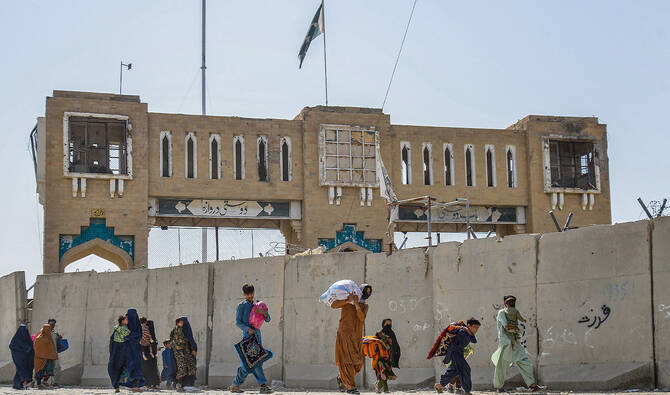
Afghan refugees deported from Pakistan arrive with their belongings at the zero point border crossing between Afghanistan and Pakistan in the Spin Boldak district of Kandahar province on October 19, 2025. (AFP)
Short Url
Updated 25 November 2025
Follow

Why are tensions flaring again between Afghanistan and Pakistan?

  • Afghan Taliban have accused Pakistani forces of air strikes in eastern Afghanistan, which killed 9 children and a woman, and injured four others
  • Bombardment followed a series of recent attacks in Pakistan, in which Islamabad says the militants came from safe havens in Afghanistan

ISLAMABAD: Tensions flared between Afghanistan and Pakistan on Tuesday as the Taliban accused Pakistani forces of air strikes in eastern Afghanistan, which killed 9 children and a woman, and injured four others.

There was no immediate comment from Islamabad. The bombardment followed a series of recent attacks in Pakistan, in which Islamabad says the militants came from Afghanistan.

Last month, dozens of people were killed in air strikes and ground fighting between the South Asian neighbors — their deadliest confrontation since the Afghan Taliban seized power in Kabul in 2021.

ACCUSATIONS AND COUNTER-ACCUSATIONS

Islamabad says that Pakistani militants are based in Afghanistan, from where they send attackers into Pakistan.

A suicide bomber killed 12 people in Islamabad this month, the first time civilians had been targeted in the Pakistani capital for a decade. A day previously, another bomber rammed an explosive-laden vehicle into the main gate of a military school in South Waziristan district, near the Afghan border, killing three people.

On Monday, three suicide bombers targeted the headquarters of a Pakistani paramilitary force in the city of Peshawar, killing three personnel and wounding at least five.

The Taliban administration in Afghanistan deny the presence on Pakistani militants there and say that they do not allow Afghan soil to be used against other countries.

WHAT HAPPENED LAST MONTH?

Islamabad says that its patience snapped after an upsurge in attacks by militants in Pakistan that followed the 2021 Taliban takeover in Afghanistan.

Pakistan carried out an air strike on the Afghan capital Kabul in October, which targeted the head of the Pakistani Taliban militant group, according to Pakistani security officials. It is not clear if he survived.

In response, late on Oct 11, Taliban forces attacked Pakistani military posts along the length of the 2,600 km (1,600 miles) border, with Pakistani forces later retaliating. Pakistan said 23 of its soldiers died and the Taliban said nine of its men were killed, though both sides claimed to have inflicted far higher damage on the other.

Both sides signed a ceasefire in Doha in October, but negotiations ended without a long-term deal after Kabul did not provide a written commitment to take action against militants sought by Islamabad. The Afghan Taliban says that it cannot be expected to guarantee security in Pakistan.

WHO ARE THE PAKISTANI TALIBAN?

In 2007, a number of jihadist outfits active in northwest Pakistan from the Pashtun ethnic group formed Tehreek-e-Taliban Pakistan (TTP), which is commonly known as the Pakistani Taliban.

The group was modelled on the Afghan Taliban, an ethnic Pashtun outfit that in the 1990s conquered Afghanistan before being ousted by a US-led invasion in 2001. But the TTP was more radical, taking its ideology from Al-Qaeda.

Over the next few years, the TTP attacked markets, mosques, airports, military bases, police stations and also gained territory — mostly along the border with Afghanistan, but also deep inside Pakistan, including the Swat Valley, where they later shot schoolgirl Malala Yousafzai.

They also fought alongside the Afghan Taliban in Afghanistan and hosted Afghan fighters in Pakistan, forming a close bond. Pakistan launched a series of military operations against the TTP on its own soil, with limited success.

In recent years, the TTP’s attacks have focused on security forces in Pakistan.

WHAT HAPPENED AFTER THE TALIBAN TOOK AFGHANISTAN?

Pakistan welcomed the return to power of the Taliban in 2021, with then Prime Minister Imran Khan, saying that Afghans had “broken the shackles of slavery.” But Islamabad soon found that the Taliban’s loyalties lay elsewhere.

Islamabad says that the TTP’s leadership and many of its fighters are based in Afghanistan. Pakistan also says that Baloch insurgents, a secular armed movement seeking independence for the western province of Balochistan, also use Afghanistan as a safe haven.

WHY IS PAKISTAN ALSO ACCUSING INDIA?

Islamabad says India, its longstanding adversary, is working with Afghanistan to support the TTP and the Baloch militants against Pakistan. New Delhi denies the claim.


Dozens killed as security forces repulse separatist attacks in Pakistan’s Balochistan

Updated 4 sec ago
Follow

Dozens killed as security forces repulse separatist attacks in Pakistan’s Balochistan

  • The attacks unfolded early Saturday when outlawed Baloch Liberation Army members attacked several cities in the restive region
  • Security official says 37 militants, 10 security personnel killed in skirmishes that revived memories of similar attack in 2024

QUETTA/ISLAMABAD: Dozens of militants and security personnel and policemen were killed as Pakistani security forces repulsed coordinated attacks by separatist militants in the southwestern Balochistan province, officials said on Saturday, in the latest incident of violence in the insurgency-hit region.

Separatist militants, affiliated with the Balochistan Liberation Army (BLA), launched “coordinated” attacks in several cities of Balochistan early Saturday, according to a senior police official, who requested anonymity.

The attacks in the provincial capital of Quetta began at around 6am with a powerful explosion, followed by intense gunfire that lasted for two hours along with multiple explosions. Residents of Dalbandin and Nuhski said they heard explosions and gunfire, while similar attacks were launched in Mastung, Gwadar, Pasni and Turbat.

A security official said Pakistani forces had repulsed the attacks and killed 37 “Indian-backed militants,” who were in continuous contact with “their handlers in Afghanistan.” Islamabad has frequently blamed such attacks on India and Afghanistan, an allegation consistently denied by Kabul and New Delhi.

“The terrorists of Fitna Al-Hindustan (Indian-backed Baloch separatist groups) launched coordinated attacks this morning at more than 12 locations, including Quetta, Noshki, Dalbandin, Pasni, and Gwadar,” the security official said.

“In these attacks, 37 terrorists have been eliminated. Throughout the operation, the terrorists were reportedly in continuous contact with their handlers in Afghanistan. Ten security personnel were martyred while few others were injured.”

Security personnel shift an injured man at a hospital in Quetta on January 31, 2026, following an attack by Baloch separatists. Ethnic Baloch separatists launched "coordinated" attacks across Pakistan's Balochistan province on January 31, killing at least four policemen, officials said, the latest violence in insurgency-hit southwest region. (AFP)

A senior official at the Civil Hospital in Quetta told Arab News they had received 15 bodies, including nine policemen.

“Eight injured with bullet wounds were brought to the hospital,” said the official, who spoke on condition of anonymity. “Five of them were later shifted to the Combined Military Hospital (CMH) Quetta.”

Balochistan, which borders Iran and Afghanistan, is the site of a decades-long insurgency waged by Baloch separatist groups who often attack security forces and foreigners, and kidnap government officials.

Shahid Rind, the Balochistan chief minister’s aide for media and political affairs, said police and paramilitary Frontier Corps (FC) had foiled the attacks and were chasing the assailants.

“After the killing of more than 70 terrorists at different places in Balochistan in the last two days, terrorists have attempted to attack at a few places in Balochistan, which have been foiled by timely action by the police and FC,” he said on X.

“At present, the pursuit of the fleeing terrorists is underway. More details will be revealed very soon.”

Family members mourn the death of a relative killed in an attack by Baloch separatists, at a hospital in Quetta on January 31, 2026. Ethnic Baloch separatists launched "coordinated" attacks across Pakistan's Balochistan province on January 31, killing at least four policemen, officials said, the latest violence in insurgency-hit southwest region. (AFP)

In a statement issued on Saturday, BLA said the group had launched ‘Operation Herof 2.0,’ which included a series of attacks in multiple cities of Balochistan.

Saturday’s attacks follow coordinated attacks carried out by the group in Aug. 2024 in various districts of Balochistan which killed dozens of people.

The separatists accuse the central government of stealing the region’s resources to fund development elsewhere in the country. The Pakistani government denies the allegations and says it is working for the uplift of local communities in Balochistan.

Pakistan Railways suspended train service from Balochistan to other parts of the country for a day, following Saturday’s attacks.

“Quetta-Peshawar bound Jaffar Express, and Quetta-Chaman passenger trains have been canceled due to the prevailing security situation in Balochistan,” Muhammad Kashif, the railways controller in Quetta division, told Arab News.