

UN: Gaza plunged into ‘human-made abyss’ as economy collapses 87%, wiping out decades of growth

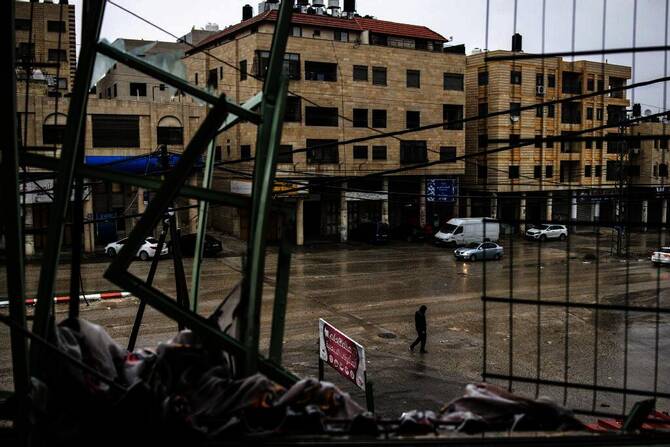
A man walks on the street below, past a destroyed apartment the morning after an Israeli military operation in which one Palestinian gun man was killed, in the Israeli-occupied northern West Bank city of Nablus, on November 25, 2025. (AFP)
Short Url
Updated 26 November 2025
Follow

UN: Gaza plunged into ‘human-made abyss’ as economy collapses 87%, wiping out decades of growth

  • The Palestinian GDP per capita by the end of last year returned to that of 2003, erasing 22 years of development progress

GENEVA: The two-year Gaza war and economic restrictions have triggered an unprecedented collapse in the Palestinian economy, wiping out decades of growth, a United Nations report said on Tuesday.
“Extensive damage to infrastructure, productive assets and public services has reversed decades of socioeconomic progress in the Occupied Palestinian Territory,” according to the report by the United Nations trade and development agency (UNCTAD).
The Palestinian GDP per capita by the end of last year returned to that of 2003, erasing 22 years of development progress, it added. The resulting economic crisis is among the ten worst globally since 1960, the report said.
The scale of the damage in Gaza after the two-year war between Israel and Hamas means the enclave will be reliant on extensive international support and recovery could still take decades, the report said.
The West Bank is also suffering its most severe downturn on record, driven by movement and access restrictions and the loss of opportunities across all sectors of the economy, the UN report said.

Gaza ‘survival’ at stake

The UN report also said that rebuilding the Gaza Strip will cost more than $70 billion and could take several decades. 
“The military operations have significantly undermined every pillar of survival,” from food to shelter to health care, “and plunged Gaza into a human-made abyss,” it said.
“The sustained, systematic destruction casts significant doubt on the ability of Gaza to reconstitute itself as a liveable space and society.”
The scale of destruction wrought on the territory has “unleashed cascading crises, economic, humanitarian, environmental and social, propelling (it) from de-development to utter ruin,” UNCTAD’s report said.
Even “in an optimistic scenario of double-digit growth rates facilitated by a significant level of foreign aid, it will take several decades for Gaza to return to pre-October 2023 welfare levels,” it said.
UNCTAD called for a “comprehensive recovery plan,” combining “coordinated international assistance, restoration of fiscal transfers, and measures to ease constraints on trade, movement and investment.”
With Gaza’s entire population facing “extreme, multidimensional impoverishment,” the UN agency is also calling for the introduction of a universal emergency basic income, providing everyone there a renewable and unconditional monthly transfer of cash.
The report showed that Gaza’s economy contracted by 87 percent over the course of 2023-2024, leaving its gross domestic product per capita at just $161 — among the lowest globally.
While the situation was not as bad in the West Bank, the report found that “violence, accelerated settlement expansion and restrictions on worker mobility have decimated the economy” there as well, “resulting in the worst economic decline since UNCTAD began to maintain records in 1972.”


Two dead in UAE, 8 injured in Qatar from waves of Iranian strikes on Gulf neighbors

Updated 8 sec ago
Follow

Two dead in UAE, 8 injured in Qatar from waves of Iranian strikes on Gulf neighbors

  • UAE defense ministry said Iran fired 137 missiles and 209 drones at the territory
  • Qatar intercepted most of the 65 missiles and 12 drones launched by Iran, said officials

ABU DHABI: Explosions rocked cities across the Gulf on Saturday, killing two people in Abu Dhabi, while smoke and flames rose from Dubai landmark The Palm as Iran launched waves of attacks in retaliation for US and Israeli strikes.

The attacks hit airports in Abu Dhabi, Dubai and Kuwait, as well as Gulf military bases and residential areas, raising fears of a wider conflict and rattling a region long seen as a haven of peace and security.

Across the UAE, Iran fired 137 missiles and 209 drones at the territory, the country’s defense ministry said, as projectiles streaked across the skies of every Gulf state but Oman, a mediator in the recent US-Iran talks.

The UAE defense ministry said most of the missiles and drones were intercepted but at Abu Dhabi’s Zayed International Airport officials said at least one person was killed and seven wounded in an “incident.”

Earlier, falling debris killed a Pakistani civilian in Abu Dhabi, the United Arab Emirates’ capital, officials said.

At Dubai International Airport four people were injured according to airport authorities and four others were also hurt at the luxury Palm development.

In Qatar, officials said Iran launched 65 missiles and 12 drones toward the Gulf state, most of which were intercepted, but eight people were injured in the salvos, with one of them in critical condition.

“We are scared of what the future is for us now, and we can’t say how the next few days are going to be,” Maha Manbaz, a nursing student in Doha told AFP.

‘Terrified’

Smoke poured from US bases in Abu Dhabi and Bahrain’s capital Manama, home of the American navy’s Fifth Fleet, witnesses saw.

A drone struck Kuwait’s international airport and a base housing US personnel was targeted. Three Kuwaiti soldiers and 12 other people were wounded, authorities said.

After Iran’s Revolutionary Guards reported missile strikes, US Central Command (CENTCOM) said on X that no American naval vessels were hit, damage to US facilities was minimal, and no US casualties had been reported.

Residential buildings were also targeted in Manama, with officials saying firefighters and civil defense teams had been dispatched to the scene.

“The sound of the first explosion terrified me,” said a 50-year-old retiree living near the US base in Manama’s Juffair area, where residents were quickly evacuated.

The UAE, Saudi Arabia and Qatar warned they reserved the right to respond to the attacks.

The oil-and-gas-rich Arab monarchies, lying just across the Gulf from Iran, are long-term American allies and host a clutch of US military bases.

“The Gulf states are sandwiched between Iran and Israel, and have to bear the worst inclinations of both,” said Bader Al-Saif, an assistant professor at Kuwait University.

“Iran’s attacks on the Gulf are misplaced. They’ll only alienate its neighbors and invite further distancing from Iran,” he added.

Conflict is unusual in the Gulf, which has traded on its reputation for stability to become the Middle East’s commercial and diplomatic hub.

‘Significant damage’

The unprecedented barrage targeted Qatar’s Al Udeid base, the region’s biggest US military base, as well as Riyadh and eastern Saudi Arabia.

The UAE, Qatar and Kuwait all announced that their airspace was closed.

An AFP journalist in Qatar saw one missile destroyed in a puff of white smoke, while another in Dubai saw a volley of Patriot interceptors taking off.

Iran fired missiles at Al Udeid last June after US strikes targeted Iranian nuclear facilities during a brief war with Israel.

The escalation also saw Saudi Crown Prince Mohammed bin Salman and UAE President Mohamed bin Zayed speak for the first time since a public row in late December.

The Saudi de facto ruler called the Emirati president and the pair discussed Iran’s retaliatory strikes on the Gulf and expressed solidarity and sympathy.

In Kuwait, an Iranian missile attack caused “significant damage” to the runway at an air base hosting Italian air force personnel, Italian Foreign Minister Antonio Tajani was quoted by the ANSA news agency as saying.

Late on Saturday, Kuwaiti officials said a drone targeted a naval base there with air defense forces intercepting the projectile, according to a post by the defense ministry on X.

For many residents in the Gulf, which has drawn a cosmopolitan, largely expat population, the reaction was one of shock.

“I heard the explosions, I don’t know what I felt,” a Lebanese woman living in Riyadh told AFP.

“We came to the Gulf because it’s known to be safer than Lebanon. Now I don’t know what to do or how to think really.”