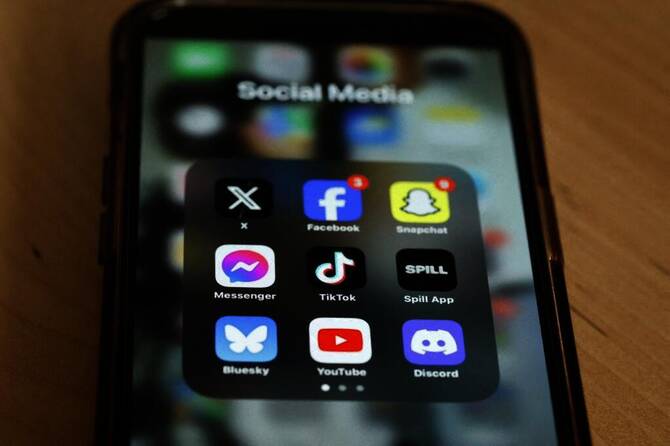
KUALA LUMPUR: Malaysia plans to ban social media accounts for people under 16 starting in 2026, joining Australia and a growing number of countries pushing tighter digital age limits for children.
Communications Minister Fahmi Fadzil said Sunday the Cabinet approved the move as part of a broader effort to shield young people from online harm like cyberbullying, scams and sexual exploitation. He said the government is studying approaches taken by Australia and other countries, and the potential use of electronic checks with identity cards or passports to verify users’ ages. He did not say when exactly the ban will be enforced.
“I believe that if the government, regulatory bodies, and parents all play their roles, we can ensure that the Internet in Malaysia is not only fast, widespread and affordable but most importantly, safe, especially for children and families,” he said.
Since January, major social media and messaging platforms with at least 8 million users in Malaysia are required to obtain a license as part of a broader tightening of state oversight over digital platforms. Licensed platforms must implement age verification, content-safety measures and transparency rules, reflecting the government’s push for a safer digital space.
Australia’s parliament enacted the world’s first ban on social media for children that will begin Dec. 10, setting the minimum age at 16. Facebook, Instagram, Snapchat, Threads, TikTok, X and YouTube as well as message board Reddit and livestreaming service Kick face fines of up to 50 million Australian dollars ($33 million) for systemic failures to prevent children younger than 16 from holding accounts.
Australia’s move is being closely watched by countries that share concerns about social media impacts on young children.
Denmark’s government also announced earlier this month plans to ban access to social media for anyone under 15, though details on how the measures would be enforced remain unclear. Norway is also moving forward with a proposed law that would set a minimum age limit of 15 for accessing social media platforms.


Malaysia to ban social media for children under 16 next year
https://arab.news/5decj
Malaysia to ban social media for children under 16 next year

- The Cabinet approved the move as part of a broader effort to shield young people from online harm like cyberbullying, scams and sexual exploitation
- The South-East Asian country joins Australia and a growing number of countries pushing tighter digital age limits for children


OpenAI’s Altman says world ‘urgently’ needs AI regulation
- Sam Altman, head of ChatGPT maker OpenAI, told a global artificial intelligence conference on Thursday that the world “urgently” needs to regulate the fast-evolving technology
NEW DELHI: Sam Altman, head of ChatGPT maker OpenAI, told a global artificial intelligence conference on Thursday that the world “urgently” needs to regulate the fast-evolving technology.
An organization could be set up to coordinate these efforts, similar to the International Atomic Energy Agency (IAEA), he said.
Altman is one of a host of top tech CEOs in New Delhi for the AI Impact Summit, the fourth annual global meeting on how to handle advanced computing power.
“Democratization of AI is the best way to ensure humanity flourishes,” he said on stage, adding that “centralization of this technology in one company or country could lead to ruin.”
“This is not to suggest that we won’t need any regulation or safeguards,” Altman said.
“We obviously do, urgently, like we have for other powerful technologies.”
Many researchers and campaigners believe stronger action is needed to combat emerging issues, ranging from job disruption to sexualized deepfakes and AI-enabled online scams.
“We expect the world may need something like the IAEA for international coordination of AI,” with the ability to “rapidly respond to changing circumstances,” Altman said.
“The next few years will test global society as this technology continues to improve at a rapid pace. We can choose to either empower people or concentrate power,” he added.
“Technology always disrupts jobs; we always find new and better things to do.”
Generative AI chatbot ChatGPT has 100 million weekly users in India, more than a third of whom are students, he said.
Earlier on Thursday, OpenAI announced with Indian IT giant Tata Consultancy Services (TCS) a plan to build data center infrastructure in the South Asian country.


