

France eyes social media ban for under-15s after school stabbing

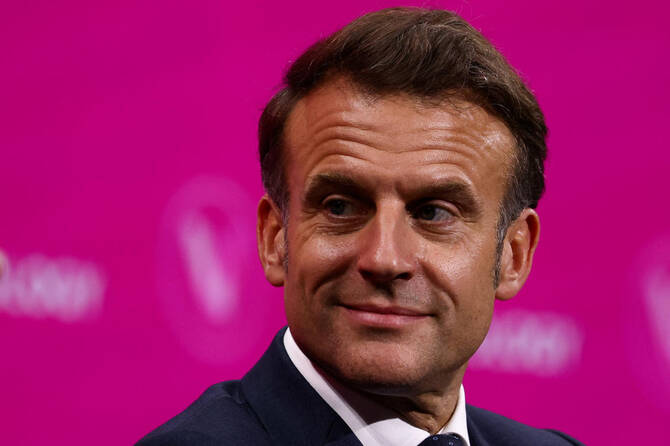
In the wake of the attack, authorities promised a raft of measures to tackle knife crime among children. President Emmanuel Macron said he “cannot wait” to implement the ban. (REUTERS/File)
Short Url
Updated 11 June 2025
Follow

France eyes social media ban for under-15s after school stabbing

  • A secondary school pupil was arrested on Tuesday after fatally stabbing a 31-year-old school assistant during a bag search in Nogent, eastern France
  • President Emmanuel Macron said France would move ahead with a ban if the EU fails to make progress on a proposal to ban the platform for children in the coming months

PARIS: French authorities have announced plans to ban social media for under-15s and the sale of knives to minors after the murder of a teaching assistant by a 14-year-old boy plunged the country into shock.

A secondary school pupil was arrested on Tuesday after killing a 31-year-old school assistant with a knife during a bag search in Nogent in eastern France.

Friends and well-wishers left flowers and messages of support in front of the secondary school struck by the tragedy.

“We share your pain,” read one message.

Laurence Raclot, who knew the teaching assistant, Melanie, said she was “stunned.”

“She was great with kids,” Raclot said. “In a quiet little town, we never would have thought this could happen.”

A former hairdresser, Melanie had retrained and worked at the school since September. She was the mother of a four-year-old boy and a councillor in a village near Nogent.

“There are no words,” added another local, Sabrina Renault. “It’s really sad for her whole family, for that little boy who’s left without his mum.”

Pupils and parents were seen entering and leaving the school, where a psychological support unit has been set up.

The suspect will remain in police custody for a further 24 hours, until Thursday morning, a police source told AFP on Wednesday. Little information has been released about his motive.

In the wake of the attack, authorities promised a raft of measures to tackle knife crime among children.

“I am proposing banning social media for children under 15,” President Emmanuel Macron said on X on Tuesday evening. “Platforms have the ability to verify age. Let’s do it,” he added.

Backed by France and Spain, Greece has spearheaded a proposal for how the EU should limit children’s use of online platforms as evidence shows that social media can have negative effects on children’s mental and physical health.

Macron said on Tuesday that if no progress was made within several months, then France would go ahead with the ban unilaterally.

“We cannot wait,” he told broadcaster France 2.

France has in recent years seen several attacks on teachers and pupils by other schoolchildren.

In March, police started random searches for knives and other weapons concealed in bags at and around schools.

On Wednesday, Prime Minister Francois Bayrou’s office said a ban on the sale of knives to minors will be implemented by a decree issued within the next two weeks.

Speaking to broadcaster TF1 on Tuesday evening, Bayrou said that the measure would come into force “immediately.”

The list will include “any knife that can be used as a weapon,” he said.

He also said parents and educators should be watching for “signs that a teenager is not doing well,” while acknowledging that there was a shortage of psychologists.

Bayrou has also called for a trial of metal detectors in schools.

Education Minister Elisabeth Borne called for a minute’s silence to be held in all French schools at midday on Thursday to honor the memory of the teaching assistant.

“The entire educational community is in shock, as is the whole nation,” she told France Inter radio on Wednesday.

Borne said she was “open to anything” to improve safety but added that ceramic blades would be invisible to metal detectors.

She also said that young people should be protected from “overexposure to screens.”

But trade unions said they were not sure how these proposals would be implemented and enforced.

“Teaching assistants have primarily educational duties within the school environment,” said Sophie Venetitay, general secretary of the SNES-FSU teachers’ union.

But, she added, “little by little, we have seen attempts to turn them into security guards.”

Remy Reynaud of the CGT Educ’action union criticized the government’s decision to introduce bag searches outside schools.

“They increase tensions,” he said.

“School management are pressuring teaching assistants to participate in the searches, which is not part of their duties.”



BBC backs Israel’s participation in Eurovision Song Contest amid expanding boycott

Updated 31 sec ago
Follow

BBC backs Israel’s participation in Eurovision Song Contest amid expanding boycott

  • Ireland, Spain, the Netherlands and Slovenia withdraw, citing concerns about the war in Gaza, after organizers clear Israel to compete
  • Critics accuse organizers of double standards, given that Russia was banned from Eurovision in 2022 after invasion of Ukraine

LONDON: The BBC has backed the European Broadcasting Union’s decision to allow Israel to participate in the 2026 Eurovision Song Contest, despite mounting opposition and an expanding boycott by European countries and public broadcasters.

National broadcasters in Ireland, Spain, the Netherlands and Slovenia have formally withdrawn from next year’s event, citing what they described as Israel’s violations of international law during its ongoing war on Gaza, which has killed more than 70,000 people, left much of the territory in ruins and prompted accusations of war crimes.

The BBC, however, said it backed the decision to allow Israel to take part in the contest.

“We support the collective decision made by members of the EBU,” a BBC spokesperson said. “This is about enforcing the rules of the EBU and being inclusive.”

Israel’s participation in the 2026 event, set to take place in the Austrian capital Vienna in May, was confirmed during the EBU’s general assembly in Geneva on Thursday. 

However, pressure continued to build in opposition to the decision, with critics accusing organizers of double standards, given that Russia was banned from Eurovision in 2022 after the invasion of Ukraine.

Following the EBU decision, Irish public broadcaster RTE said it would neither participate in nor screen the contest. It said Ireland’s participation “remains unconscionable given the appalling loss of lives in Gaza and the humanitarian crisis there.” It also condemned the killing of journalists in Gaza and the denial of access to the international media. More than 200 Palestinian journalists have reportedly been killed since the start of the war.

Slovenian broadcaster RTV said it was withdrawing from the competition “on behalf of the 20,000 children who died in Gaza.” Chairperson Natalija Gorscak said the decision reflected growing public demand to uphold European values of peace and press freedoms, noting that the international media are still banned from Gaza.

She added that Israel’s 2025 Eurovision performance had been overtly political, and contrasted the decision about Israel with the ban on Russia’s participation following the invasion of Ukraine.

Dutch broadcaster AVROTROS also withdrew from the contest, describing the decision of the EBU as “incompatible with the public values that are essential to us.”

CEO Taco Zimmerman said: “Culture unites, but not at all costs. What happened last year touches our boundaries … Universal values like humanity and a free press have been seriously violated.”

The EBU did not hold a vote on Israel’s participation in the contest. Instead, member broadcasters voted in favor of new rules for contest voting to prevent governments or other groups from unfairly promoting songs to manipulate the result.

Austria, which is set to host the competition after Viennese singer JJ won this year with “Wasted Love,” supports Israel’s participation. Germany, too, was said to back Israel.