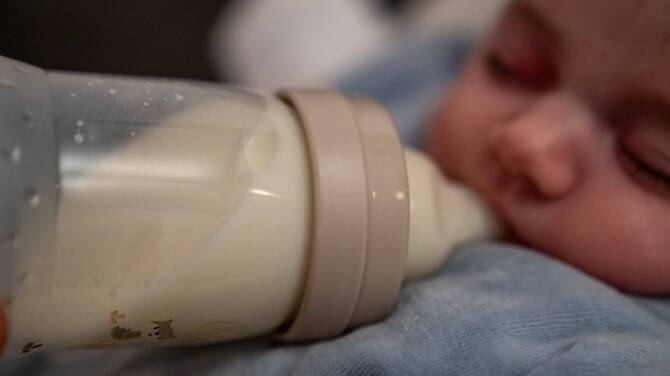
ROME: Widespread recalls of powdered milk for infants mean the risk of exposure to a toxin that can cause nausea and diarrhea are now low, two EU agencies said on Thursday.
“Given the large-scale recalls, the current likelihood of exposure to contaminated infant formula is low,” the European Food Safety Authority and the European Center for Disease Prevention and Control said in a statement.
But they said that “additional cases may still occur if recalled products remain in households rather than being returned.”
Several manufacturers, including European giants like Nestle, Danone and Lactalis, have issued recalls of infant formula that could be contaminated with cereulide in more than 60 countries since December.
French authorities said last week they were aware of three deaths of infants who consumed powdered milk affected by the recalls, and 14 hospitalizations.
But investigations are still underway and as yet no link has been established between the formula and the babies’ health, the health ministry said.
The EU agencies said that a total of seven countries in Europe had reported cases of babies with gastrointestinal symptoms following consumption of powdered milk.
The statement said cereulide had first been detected in December in batches of formula containing arachidonic acid oil from a producer in China.
The EFSA earlier said its scientists had suggested a maximum level for cereulide of 0.014 micrograms per kilogram of body weight.
This translated to 0.054 micrograms of cereulide per liter in infant formula, the Italy-based agency said.

Baby milk toxin risk ‘low’ after recalls: EU agencies
https://arab.news/wuzk4
Baby milk toxin risk ‘low’ after recalls: EU agencies
- Several manufacturers, including European giants like Nestle, Danone and Lactalis, have issued recalls of infant formula
- French authorities said last week they were aware of three deaths of infants
Guinea launches probe after nationals expelled from Germany
- The government in Conakry has been under pressure in recent days to respond to the deportations
- Ministers have summoned the charge d’affaires from Germany’s embassy to explain why the Guineans were expelled
CONAKRY: The authorities in Guinea said Thursday they were looking into why a number of its citizens had been kicked out of Germany, after an angry online response to the expulsions.
The government in Conakry has been under pressure in recent days to respond to the deportations, videos and testimony of which have been circulating on social media.
Ministers have summoned the charge d’affaires from Germany’s embassy to explain why the Guineans were expelled and to urge a halt to future deportations.
“We want our fellow citizens to have their dignity respected,” Foreign Minister Morissanda Kouyate told the diplomat before television cameras.
At a news conference on Thursday, Kouyate announced that a “bilateral commission of investigation” had been established involving both Guinea and Germany to get to the bottom of the matter.
“Instead of hurling abuse at each other... we are going to sit down at a table in the strict interest of European citizens and Guinean citizens,” he told reporters, alongside German ambassador Irene Biontino.
Some 6,000 Guineans are living irregularly in Germany, the minister said.
Biontino on Wednesday said in an interview that there had been “no offensive” recently. The deportations of irregular Guinean nationals were being conducted in line with bilateral agreements and Germany’s “sovereignty,” she added.
“A total of 30 people were deported to Guinea in January 2026. (In comparison), in January 2025, 20 people were sent back to Guinea,” a German interior ministry spokesman told AFP.
There were 169 expulsions to Guinea in 2025, they added.
In recent years, Guinea has become a key starting point for young migrants trying to smuggle themselves into north Africa and Europe in the hope of a better future.
According to a 2021 International Organization for Migration study, the Guinean diaspora was estimated at between three and five million people.
Most were living in west Africa and in France, Germany and Belgium.