

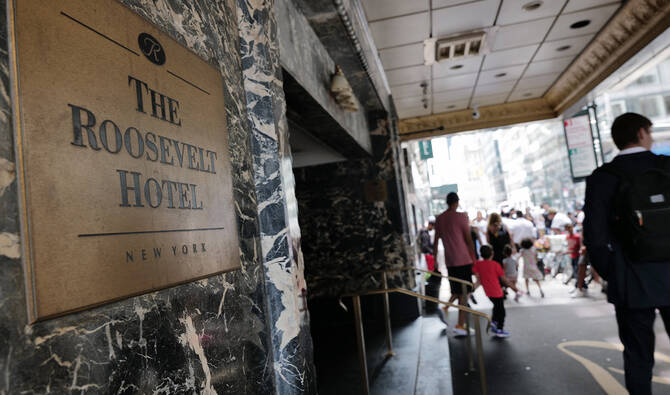

Islamabad: Pakistan and the US have formally launched a strategic economic initiative to jointly redevelop the Roosevelt Hotel in New York, the Finance Division said on Thursday, as Islamabad aims to secure maximum value for the property in line with its privatization strategy.
The hotel, a century-old Manhattan property near Grand Central Terminal and Times Square, is one of Pakistan’s most valuable overseas assets and is owned by the state through the recently privatized Pakistan International Airlines (PIA).
Closed since 2020 due to losses, the hotel has been under review for years as successive governments have weighed whether to sell, lease or redevelop it while pursuing state-owned enterprise reforms linked to International Monetary Fund bailouts.
“The Governments of Pakistan and the United States have formally launched a strategic economic initiative, including collaboration with the US General Services Administration (GSA) regarding the operation, maintenance, renovation, and redevelopment of the Roosevelt Hotel in New York,” the Finance Division said.
Both sides signed a memorandum of understanding (MoU) in Washington. The MoU was executed by GSA Administrator Edward C. Forst on behalf of the US and by Finance Minister Muhammad Aurangzeb on Pakistan’s behalf.
The signing of the agreement was witnessed by Prime Minister Shehbaz Sharif, who is in Washington to attend the inaugural meeting of the Board of Peace, and by US Special Envoy Steve Witkoff.
The Finance Division said the agreement establishes a structured, time-bound framework for joint evaluation of the technical, commercial and economic parameters of cooperation.
It said the agreement also reflects a shared commitment to transparent, disciplined and mutually beneficial progress of the transaction.
The Finance Division said that due to the hotel’s prime Manhattan location and the complexity of New York’s zoning and municipal processes, the institutional coordination aims to reduce execution risk, enhance regulatory clarity and maximize transaction value.
It said such frameworks are consistent with international practice in cross-border real estate and infrastructure projects.
“The objective remains to secure maximum value for this property in alignment with the government’s privatization strategy while strengthening Pakistan-United States economic ties,” it concluded.
Prime Minister Sharif’s aide on privatization, Muhammad Ali, last month announced that Islamabad plans to redevelop the Roosevelt Hotel into a high-rise building through a joint venture that could involve up to $5 billion in equity and debt financing.
Ali said the government had decided against an outright sale of the property after a detailed study conducted last year showed the site could support a significantly larger structure, potentially rising to 60 stories.



