

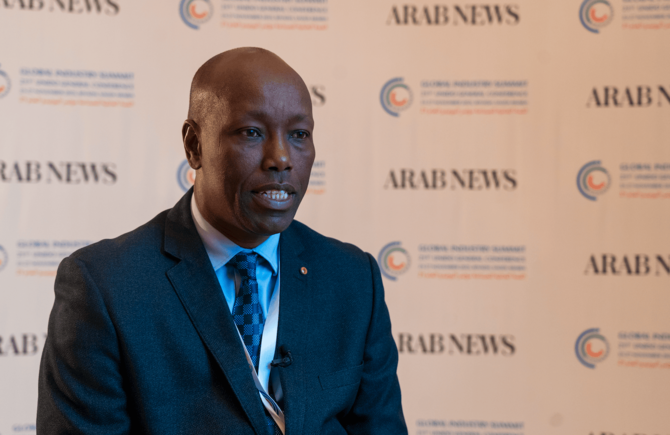

RIYADH: The economies of Saudi Arabia and Kenya do not compete, but complement each other, the African country’s minister of investments, trade and industry told Arab News on Monday.
Speaking on the sideline of the 21st General Conference of the UN Industrial Development Organization, Lee Kinyanjui said that while the Kingdom is rich in oil and industry, Kenya has a strong agricultural sector.
The minister said he expects the flow of goods between the Kingdom and his country to rise as direct flights between the two nations increase.
Kinyanjui told Arab News: “I think the critical issue to do with Kenyan companies in Saudi Arabia is that our economies are complementary. What Kenya has, and Saudi may not have, for example in Saudi Arabia, you have a lot of petroleum and petrochemicals. Therefore fertilizers, petroleum products and even a bit of manufacturing is also to be found here. Kenya, on the other hand, is a rich agricultural sector.
“Also we have a young population. We are digitally connected. So we also have a lot that we can be able to send into these markets. And I am happy that conversations and discussions have started on how, for example, fertilizer can be sold in Kenya and beyond in terms of the region.”
The minister noted that Saudi Arabia is one of his country’s critical markets for the sale of flowers, vegetables and meat — areas he hopes will develop further.
Another area of significance is tourism. Kenya is a premier safari destination, famous for its diverse landscapes, incredible wildlife, he said.
Popular parks in Kenya include the Masai Mara, Amboseli, and Lake Nakuru, where visitors can see lions, leopards, and elephants, and experience diverse activities beyond game drives, such as bird watching and cultural tours.
“We believe this is an area well coordinated by the Saudi. Tourists who want to visit are able to take advantage of the fact that it is just about five hours from Saudi (Arabia) to Nairobi. And that makes it very easy in terms of traveling with a very easy visa regime,” said the minister.
Kinyanjui said about 100,000 Saudis visit Kenya a year — a figure he believes could be higher given the country’s proximity, connectivity, and lack of a language barrier as most Saudis can speak English.
“When you look at all those factors, it should not be anything less than 500,000. So it’s an area where we can work together,” he added.
The minister described the Global Industry Summit as “critical” because it brought together key players and addressed relevant issues.
He added: “We have issues to do with market access, issues to do with technology, multilateralism, and many other factors that continue to create a shadow of our industries.
“So, players and actors from across the world have an opportunity to debate, to think through and also suggest solutions. And I think that becomes very important coming here.”
Kinyanjui said that the summit is also helping to quell uncertainty rife throughout global markets caused by various geopolitical and economic factors.
“Industries cannot be very productive when there is market anxiety,” he said, adding: ”So for that reason, we believe that there needs to be a bit more affordability. Basically manufacturing is a long term investment.
When it creates doubt, anxiety or fear or any form of short term changes, then it becomes very difficult for the existing procurement planning to go on.”
The Kenyan minister noted that unemployment is a big issue in many countries, including developed nations.
“We have countries where the economic growth has gone down significantly — in Europe, in Africa and many other places. So industry is a long term solution to some of these issues. And for that reason, we believe that this conference is very timely,” said Kinyanjui.


