
ISLAMABAD: Pakistan and Saudi Arabia have resolved to further their strategic defense, security and counter-terrorism cooperation during meetings of a top Saudi general with Pakistani civilian and military leaders, Prime Minister Shehbaz Sharif's office and the military said on Monday.
General Fayyadh bin Hameed Al-Rowaili, Chief of General Staff (CGS) of the Saudi armed forces, held separate meetings with Prime Minister Shehbaz Sharif, Pakistan Army Chief Field Marshal Asim Munir and Chairman of the Joint Chiefs of Staff Committee (CJCSC) General Sahir Shamshad Mirza.
The meetings focused on evolving global and regional security environment, with the dignitaries exploring concrete measures to deepen engagements between the armed forces of the two countries, according to the Inter-Services Public Relations (ISPR), the military’s media wing.
In his meeting with the visiting Saudi commander, PM Sharif reaffirmed his steadfast resolve to further strengthening the historic fraternal ties between Pakistan and Saudi Arabia in all domains, including defense, security and economic cooperation, Sharif’s office said.
“The Prime Minister also highlighted the shared resolve of both countries to combat terrorism and extremism in all its forms and manifestations, and to promote peace and stability in the region,” Sharif’s office said in a statement.
“General Al-Rowaili conveyed the warm greetings of the Saudi leadership to the Prime Minister and the people of Pakistan. He reiterated the Kingdom’s strong desire to elevate the existing excellent defense and strategic partnership with Pakistan to new heights.”

General Fayyadh bin Hameed Al-Rowaili, Chief of General Staff (CGS) of the Saudi armed forces, calls on Prime Minister Shehbaz Sharif in Islamabad on November, 24, 2025. (Pakistan Government)
T5.he development follows the signing of a Strategic Mutual Defense Agreement (SMDA) between Pakistan and Saudi Arabia in Sept., with the two sides pledging that aggression against one country would be treated as an attack on both.
The defense agreement, aimed at enhancing joint deterrence and strengthening military and security cooperation, was signed at a time of extreme volatility in the Middle East, where prolonged conflicts had heightened fears of wider instability, reinforcing the urgency Gulf states place on stronger defense partnerships.
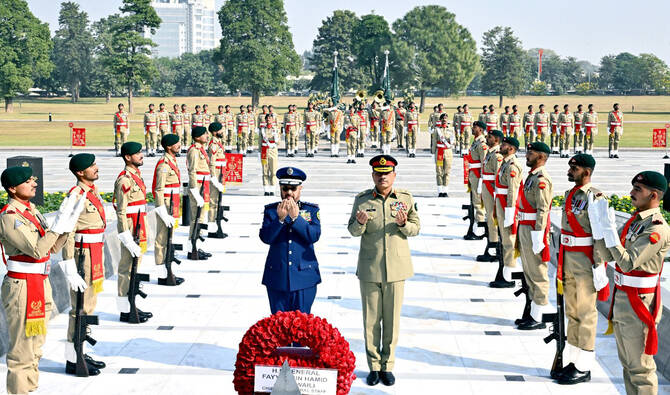
The Saudi CGS also met Army Chief Field Marshal Munir and CJCSC General Mirza in Rawalpindi. Upon arrival at Pakistan Army’s General Headquarters, he laid a floral wreath at the martyr’s monument and was presented a Guard of Honour by a smartly turned-out contingent of the Pakistan Army, according to the ISPR.
In his meeting with Field Marshal Munir, the two figures discussed matters of mutual interest, with a particular focus on strengthening the longstanding and strategic military cooperation between Pakistan and Saudi Arabia.
“They emphasized the importance of further enhancing defense collaboration, security cooperation, and counter-terrorism efforts, which continue to be pillars of the deep-rooted bilateral relationship,” the ISPR said.
The Saudi CGS appreciated Pakistan’s cooperation in multiple fields and reaffirmed his commitment to furthering the strong bonds of cooperation.
In his meeting with the Saudi general, CJCSC Gen. Mirza reiterated Pakistan’s “unwavering commitment to safeguarding the territorial integrity” of the Kingdom of Saudi Arabia, the ISPR added.
Pakistan and Saudi Arabia share longstanding ties rooted in faith, mutual respect and strategic cooperation, with Riyadh remaining a key political and economic partner of Islamabad. The Kingdom also hosts more than 2.5 million Pakistani expatriates, the largest source of remittances for Pakistan’s over $400 billion economy.
The two nations have sought to broaden their cooperation in recent years and signed dozens of memorandums of understanding to promote bilateral cooperation in multiple sectors.