
RIYADH: Saudi Arabia is advancing efforts to expand its base of integrated and foundational manufacturing industries, according to Khalid Al-Salem, president of the Royal Commission for Jubail and Yanbu.
In an interview with Al-Eqtisadiah, Al-Salem said total investments across the commission’s cities have reached approximately SR1.5 trillion ($399.9 billion), most of which are concentrated in foundational industries.
However, the Kingdom is shifting focus toward increasing the share of downstream manufacturing and linking it to existing foundational sectors to create higher added value through industrial integration.
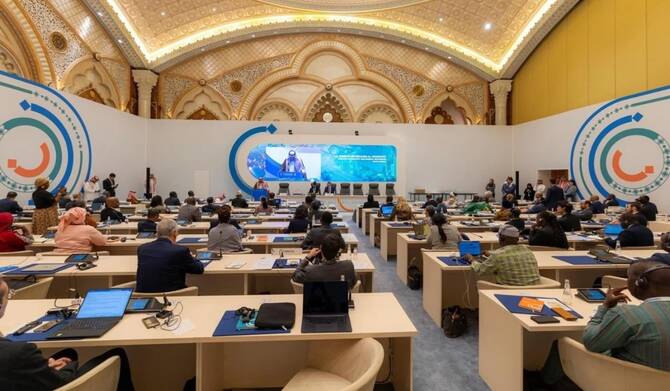
Speaking on the sidelines of the 21st General Conference of the UN Industrial Development Organization held in Riyadh, Al-Salem noted that many new investments are arriving with an integrated model, in which investors bring both foundational and downstream industries.
This strategy is supported by the Ministries of Industry and Energy through incentives offered to investors who align downstream production with core industrial output.
He highlighted a major project in Yanbu valued at approximately SR37 billion, which includes a requirement to develop final and intermediate downstream industries based on aluminum production.
Additional projects in Jubail focus on specialized polypropylene compounds aimed at sectors such as automotive and aerospace, moving away from traditional general-purpose production.
Regarding investor interests, Al-Salem said demand is diverse but predominantly focused on the mining and petrochemical sectors.
This aligns with national efforts to integrate oil refineries with petrochemical production as part of the liquids-to-chemicals strategy.
He added that the estimated value of Saudi Arabia’s mineral resources has increased by 90 percent since 2018. The Minister of Industry recently stated that the value of discovered rare earth metals in the Kingdom is estimated at SR375 billion.
Al-Salem also addressed developments in transport infrastructure, noting the launch of the railway network in Jubail and ongoing work to link Ras Al-Khair with Jubail and then to Riyadh.
These connections are expected to enhance the movement of goods and operational materials for factories.
Operational approval has been granted for Jubail Airport, which will serve private aviation and cargo. A site near the airport has been allocated to a global investor to develop logistics services.
Al-Salem said the Land Bridge project, previously outlined by the Minister of Transport, is among the Kingdom’s most significant transport initiatives. It will connect Yanbu Industrial City with Riyadh, Rabigh, and Jeddah, strengthening integration among industrial cities, especially as Yanbu’s production capacity surpasses its current port capacity.
He added that these projects and transformations will help attract global investments, support industrial integration, and enhance the international competitiveness of the Royal Commission’s cities.
Al-Salem said the commission is undergoing a strategic shift from merely providing basic infrastructure to enabling the private sector and developing integrated service systems that align with the Kingdom’s advanced industrial goals under Vision 2030.
He also highlighted opportunities tied to clean energy, pointing to the Ministry of Energy initiatives in carbon capture and green hydrogen.
He said these projects represent a strategic opportunity for the commission’s industrial cities, noting their appeal to global investors seeking digital and environmentally conscious industrial environments.
He referred to several partnerships aligned with this direction, including collaborations in 3D printing, logistics projects with SABIC, and initiatives in inspection and calibration services.
He said these services are increasingly essential to industrial operations and that the commission is working to enable the private sector to deliver them, enhancing the cities’ attractiveness to investors.
Khalil bin Salamah, vice minister of Industry and Mineral Resources for Industrial Affairs, stated that Saudi women now make up more than 40 percent of the industrial workforce in the micro, small, and medium-sized enterprise sector. He added that their presence is also growing in managerial and leadership roles.
Speaking at the UNIDO conference, bin Salamah said Saudi Arabia has launched five new industrial cities, bringing the total to 39, and has expanded four existing special economic zones.
He said the country is positioning itself as a regional hub for green steel, electric vehicles, and renewable energy component manufacturing, aligning with global decarbonization goals and UNIDO’s sustainability focus.
He emphasized that the Kingdom’s manufacturing vision extends beyond infrastructure, aiming to build value chains that empower people, foster innovation, and preserve the environment.
Bin Salamah also highlighted opportunities for Saudi youth, noting that more than 65 percent of the population is under 35.
He added: “To channel this energy and harness this promise, institutions such as the National Academy for Industry and the Factories of the Future Program have trained more than 80,000 young Saudi men and women in fields such as robotics, automation, and AI-based production systems — technologies that will shape their future.”
Gerd Muller, director-general of UNIDO, affirmed that Saudi Arabia plays a leading role in the Arab world and said the organization is committed to strengthening future cooperation.