Gavi, UNICEF sign deal to cut malaria vaccine price  

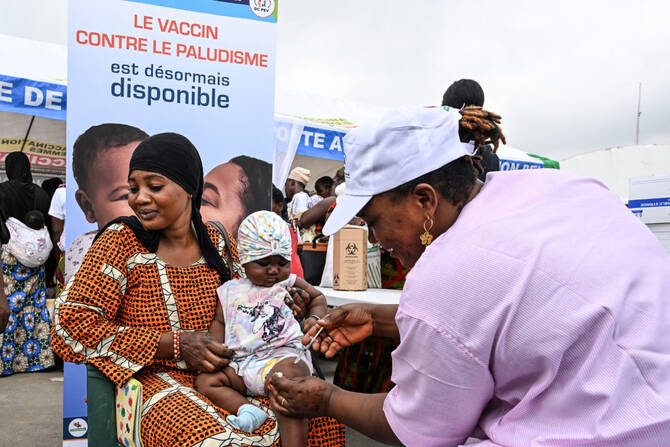
A health worker vaccinates a baby against malaria during the launch of the vaccination campaign for children from zero to 23 months at La Marie d'Abobo, a popular commune in Abidjan on July 15, 2024. (AFP)
Short Url
Updated 24 November 2025
Follow

Gavi, UNICEF sign deal to cut malaria vaccine price  

  • Deal to reduce the cost of the R21 vaccine, made by the Serum Institute of India, to $2.99 a dose from around $4
  • Babies require four doses of the vaccine to be fully protected against malaria. That means a full course of R21 will cost $11.96

LONDON: Global vaccine alliance Gavi and its partner UNICEF will pay 25 percent less for a new malaria vaccine made by the Serum Institute of India within roughly a year’s time, allowing them to reach more children despite cuts in international aid.
The deal will reduce the cost of the R21 vaccine to $2.99 a dose from around $4. Unicef buys the vaccines with funding from Gavi, a partnership that works with governments to immunize children in the world’s poorest countries.
Gavi estimates the price drop will save $90 million, which can fund 30 million more doses for up to 7 million more children over the next five years.
Gavi raised $3 billion less than its target at a fundraising event earlier this year as international donors, led by the United States, focused on other priorities.
“At this critical juncture of unprecedented decline in funding for international aid, Unicef is determined to continue our proactive work with partners,” said Leila Pakkala, director of UNICEF’s supply division, in a statement.
Babies require four doses of the vaccine to be fully protected against malaria, which still claims more than 500,000 lives annually, mainly children under 5 years old in sub-Saharan Africa. That means a full course of R21 will cost $11.96.
Treating a case of uncomplicated malaria in sub-Saharan Africa costs $4 to $7 per outpatient visit, while severe cases requiring hospital care can cost more than $70, according to World Health Organization figures quoted by Gavi.
The other malaria vaccine, made by GSK, is priced at around $10 a dose. Earlier this year, Bharat Biotech and GSK pledged to halve that price when Bharat takes over production in 2028.


Putin says there are points he can’t agree to in the US proposal to end Russia’s war in Ukraine

Updated 7 sec ago
Follow

Putin says there are points he can’t agree to in the US proposal to end Russia’s war in Ukraine

Russian President Vladimir Putin says some proposals in a US plan to end the war in Ukraine are unacceptable to the Kremlin, indicating in comments published Thursday that any deal is still some ways off.
US President Donald Trump has set in motion the most intense diplomatic push to stop the fighting since Russia launched the full-scale invasion of its neighbor nearly four years ago. But the effort has once again run into demands that are hard to reconcile, especially over whether Ukraine must give up land to Russia and how it can be kept safe from any future aggression by Moscow.
Trump’s special envoy, Steve Witkoff, and son-in-law Jared Kushner planned to meet later Thursday with the Ukrainian delegation led by Rustem Umerov following the Americans’ discussions with Putin at the Kremlin, but there was no immediate confirmation whether that meeting took place.
The meeting at the Shell Bay Club, a golf property developed by Witkoff in Hallandale Beach, was tentatively set to begin at 5 p.m. EST, according to an official familiar with the logistics. The official was not authorized to discuss the matter publicly because the meeting has not yet been formally announced and spoke on condition of anonymity.
Putin said his five-hour talks Tuesday with Witkoff and Kushner were “necessary” and “useful,” but also “difficult work,” and some proposals were unacceptable.
Speaking to the India Today television channel before he landed Thursday in New Delhi for a state visit, Putin said the American proposals discussed at the Kremlin meeting were based on earlier discussions between Russia and the US, including his meeting with Trump in Alaska in August, but also included new elements.
“We had to go through practically every point, which is why it took so much time,” he said. “It was a meaningful, highly specific and substantive conversation. Sometimes we said, ‘Yes, we can discuss this, but with that one we cannot agree.’“
Trump said Wednesday that Witkoff and Kushner came away from the marathon session confident that Putin wants to find an end to the war. “Their impression was very strongly that he’d like to make a deal,” he added.
Putin said the initial US 28-point peace proposal was trimmed to 27 points and split into four packages. He refused to elaborate on what Russia could accept or reject, and none of the other officials involved offered details of the talks.
The Russian leader praised Trump’s peace efforts, noting that “achieving consensus among conflicting parties is no easy task.”
“To say now what exactly doesn’t suit us or where we could possibly agree seems premature, since it might disrupt the very mode of operation that President Trump is trying to establish,” Putin said.
He emphasized that Russia will fulfill the goals it set and take all of the eastern Donetsk region. “All this boils down to one thing: Either we take back these territories by force, or eventually Ukrainian troops withdraw,” he said.
European leaders, left on the sidelines by Washington as US officials engage directly with Moscow and Kyiv, have accused Putin of feigning interest in Trump’s peace drive.
French President Emmanuel Macron met in Beijing with Chinese leader Xi Jinping, seeking to involve him in pressuring Russia toward a ceasefire. Xi, whose country has provided strong diplomatic support for Putin, did not say respond to France’s call, but said that “China supports all efforts that work toward peace.”
Russian barrages of civilian areas of Ukraine continued overnight into Thursday. A missile struck Kryvyi Rih on Wednesday night, wounding six people, including a 3-year-old girl, according to city administration head Oleksandr Vilkul.
The attack on Ukrainian President Volodymyr Zelensky’s hometown damaged more than 40 residential buildings, a school and domestic gas pipes, Vilkul said.
A 6-year-old girl died in the southern city of Kherson after Russian artillery shelling wounded her the previous day, regional military administration chief Oleksandr Prokudin wrote on Telegram.
The Kherson Thermal Power Plant, which provides heat for over 40,000 residents, shut down Thursday after Russia pounded it with drones and artillery for several days, he said.
Authorities planned emergency meetings to find alternate sources of heating, he said. Until then, tents were erected across the city where residents could warm up and charge electronic devices.
Russia also struck Odesa with drones, wounding six people, while civilian and energy infrastructure was damaged, said Oleh Kiper, head of the regional military administration.
Overall, Russia fired two ballistic missiles and 138 drones at Ukraine overnight, officials said.
Meanwhile, in the Russia-occupied part of the Kherson region, two men were killed by a Ukrainian drone strike on their vehicle Thursday, Moscow-installed regional leader Vladimir Saldo said. A 68-year-old woman was also wounded in the attack, he said.