Saudi project clears 875 explosive devices in Yemen

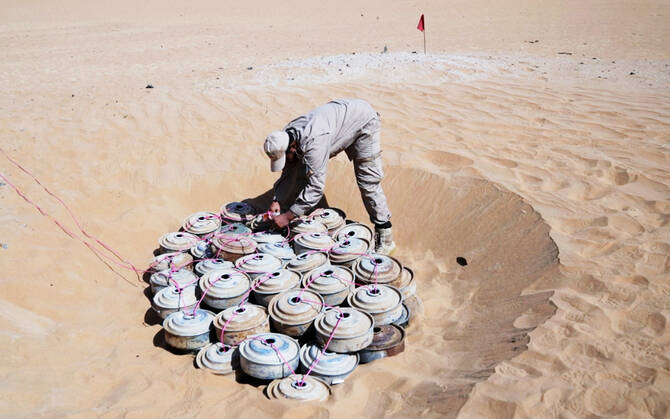
The demining operations took place in Marib, Aden, Jouf, Shabwa, Taiz, Hodeidah, Lahij, Sanaa, Al-Bayda, Al-Dhale and Saada. (Supplied/Project Masam)
Short Url
Updated 23 November 2025
Follow

Saudi project clears 875 explosive devices in Yemen

RIYADH: Members of Saudi Arabia’s Project Masam removed 875 explosive devices from various regions of Yemen last week.

The total included 498 unexploded ordnances, 367 anti-tank mines, seven anti-personnel mines and three improvised explosive devices, according to a recent report.

Ousama Al-Gosaibi, the initiative’s managing director, said that 525,499 mines have been cleared since the project began in 2018.

The explosives were planted indiscriminately and posed a threat to civilians, including children, women and the elderly.

The demining operations took place in Marib, Aden, Jouf, Shabwa, Taiz, Hodeidah, Lahij, Sanaa, Al-Bayda, Al-Dhale and Saada.

The project trains local demining engineers and provides them with modern equipment. It also offers support to Yemenis injured by the devices.

Teams are tasked with clearing villages, roads and schools to facilitate the safe movement of civilians and delivery of humanitarian aid.


Fifth beekeeping season begins at Saudi royal reserve

Updated 9 sec ago
Follow

Fifth beekeeping season begins at Saudi royal reserve

RAFHA: The Imam Turki bin Abdullah Royal Nature Reserve Development Authority on Sunday launched the fifth annual beekeeping season for 2026 to empower the local community and regulate beekeeping within the reserve.

The launch supports the authority’s goals of biodiversity conservation, sustainable environmental practices, and economic returns for beekeepers, the Saudi Press Agency reported.

This year’s season includes three main periods linked to spring flowers, acacia, and sidr, with each period’s start date serving as the deadline for participation applications.

The authority urged beekeepers to review the season details and join scheduled virtual meetings to ensure organized participation under the approved regulations.

The beekeeping season also promotes ecotourism by showcasing the reserve’s scenic and pristine environment, reinforcing its status as a unique ecotourism hub.

Covering 91,500 sq. km, the reserve is the Kingdom’s second-largest royal protected area, home to diverse wildlife, plants, and trees, and featuring several ancient historical and heritage sites.