

Egypt unveils $1bn Startup Charter to boost innovation, jobs

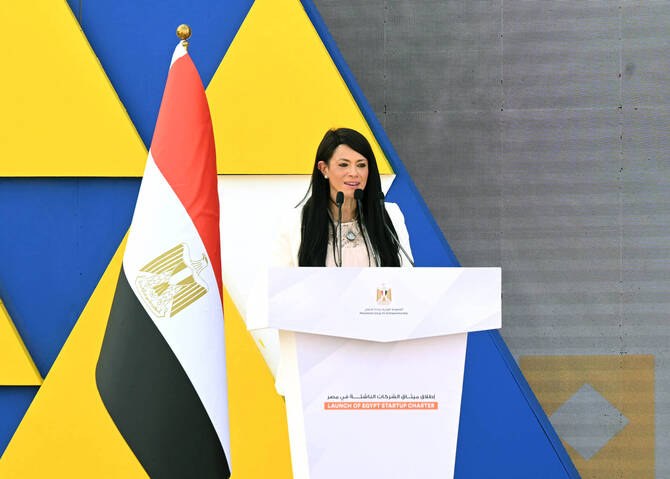
Egypt’s Minister of Planning, Economic Development, and International Cooperation Rania Al-Mashat speaks at an event organized to launch the country’s first national Startup Charter. Photo/Supplied
Short Url
Updated 08 February 2026
Follow

Egypt unveils $1bn Startup Charter to boost innovation, jobs

JEDDAH: Egypt has launched its first-ever national Startup Charter, committing $1 billion in funding and new policies to stimulate innovation, create jobs, and drive economic growth.

The initiative follows over a year of consultations involving 15 national entities and more than 250 representatives from the startup ecosystem, entrepreneurs, and parliamentary bodies, according to an official statement from the Egyptian Cabinet.

The charter is designed to support up to 5,000 startups, generate an estimated 500,000 direct and indirect jobs, and accelerate international expansion, as outlined by the Ministerial Group for Entrepreneurship.

Egypt’s startup ecosystem has gained significant traction in recent years, with startups attracting $228 million in venture capital and debt financing during the first five months of 2025 alone, marking a notable increase from the previous year. Official figures indicate that total funding for the sector reached $614 million in 2025, a sign of growing investor confidence and a more diverse financing landscape.

The official launch took place on Feb. 7 at the Grand Egyptian Museum, attended by Prime Minister Mostafa Madbouly, Minister of Planning and Economic Development Rania Al-Mashat, key members of the entrepreneurial ministerial group, the governor of Giza, ambassadors, and various stakeholders from the startup ecosystem and venture capital funds.

“The Startup Charter represents a strategic framework to enhance the capabilities of startups and the entrepreneurial ecosystem, aiming for rapid, sustainable economic growth driven by competitiveness and innovation, while also contributing to job creation,” said the Cabinet’s statement.

The charter sets out several key objectives over the next five years, including accelerating startup expansion into international markets, developing local talent to combat brain drain, promoting venture capital, and attracting investments through a unified financing initiative. It also seeks to connect critical challenges in various sectors with innovative solutions from startups.

In her speech at the event, Al-Mashat emphasized that the charter is not just a theoretical document but a practical and adaptable tool that will evolve to meet technological advancements and market needs. She described it as the first step toward modernizing Egypt’s policies and legislation to better support startups.

Al-Mashat also highlighted that the priorities of the charter were determined after extensive consultations with key stakeholders, aiming to create a dynamic and sustainable business environment that fosters innovation and attracts investment.

One key feature of the Startup Charter is the introduction of a unified definition of startups — newly established companies with a focus on rapid growth, flexibility, and innovation. This definition will allow startups to access a range of incentives and benefits, including official classification certifications from small and medium enterprise authorities.

Additionally, it includes a unified financing initiative designed to coordinate available funding resources from government entities. The initiative aims to amplify the impact of these resources by up to four times, with the goal of mobilizing $1 billion over the next five years through government-backed guarantees, joint investments with venture capital funds, and collaboration with private-sector investors.


Saudi Exchange shows resilience on Aramco shares, defying regional trend

Updated 10 sec ago
Follow

Saudi Exchange shows resilience on Aramco shares, defying regional trend

RIYADH: Saudi Arabia’s Tadawul All Share Index showed signs of resilience on March 2, buoyed by gains in Saudi Aramco, even as the Middle East region continues to grapple with escalating tensions.

As of 11:50 a.m., Saudi time, the Kingdom’s benchmark index maintained stability, seeing only a marginal decline of 0.74 percent to 10,398.64. 

Aramco’s share price increased by 1.16 percent to SR26.10 ($6.95), compared to the previous close of SR25.80.

The gains posted by Saudi Aramco and the stable movement of the Kingdom's benchmark index came even as most Gulf markets declined after Israel and the US launched strikes on Iran, triggering retaliatory attacks and raising fears of a broader regional conflict.

On March 1, the UAE’s Capital Market Authority announced a two-day closure of the Dubai Financial Market and Abu Dhabi Securities Exchange, effective March 2 and March 3, citing escalating regional tensions and its regulatory mandate to maintain market stability.

Boursa Kuwait declined by 2.25 percent, while Bahrain’s benchmark and Muscat Qatar Stock Exchange edged down by 1.53 percent and 3.26 percent, as of 11:00 a.m. Saudi time. 

Investors are keeping a close eye on oil markets, particularly the Strait of Hormuz, as tensions escalate in the region.

Tony Hallside, CEO of STP Partners, told Arab News that Gulf equities have opened with volatility rather than panic, with sharp early drawdowns followed by partial rebounds as investors separate direct conflict risk from oil upside and government balance sheet strength.

“Local and regional investors are broadly de-risking around the edges, raising cash, shortening time horizons, and rotating toward defensives and energy-linked exposure, while foreign flows tend to get more selective until the Hormuz and escalation trajectory is clearer,” said Hallside.

He added: “The key tell is dispersion: energy strength alongside broader market weakness, and a premium placed on liquidity and balance sheet quality.”

Abdulrahman Al-Sudairy, CEO of Vault Saudi, told Arab News that regional markets reacted sharply to heightened uncertainty on March 2, with a clear flight to safety as investors shifted into a risk-off mode.

“Selling pressure was evident across most sectors, while energy names held up better as markets priced in rising supply risks,” said Sudairy.

He added: “Looking ahead, volatility is likely to remain elevated. Oil prices are poised to open significantly higher, and until there is greater clarity on the geopolitical front, we expect equities to stay under pressure while commodities continue to take center stage.”

Sudairy also discussed the vitality of prioritizing global diversification over concentration.

“We are reminding clients that volatility is not the same as permanent loss; history shows that reacting emotionally to headlines often does more damage to long-term wealth than the events themselves. Our stance is to remain disciplined, look past the short-term noise, and focus on fundamental resilience,” he added.

Hallside said the most obvious divide after the conflict is between energy and non-energy cyclical stocks. Oil and upstream-linked companies tend to benefit from higher crude prices, while sectors such as tourism, aviation, and retail, as well as real estate and banking, may face near-term pressure if risk premiums rise and borrowing costs increase.

“Regionally, anything exposed to cross-border trade flows, shipping lanes, or discretionary demand is the most headline sensitive,” added the STP Partners official.