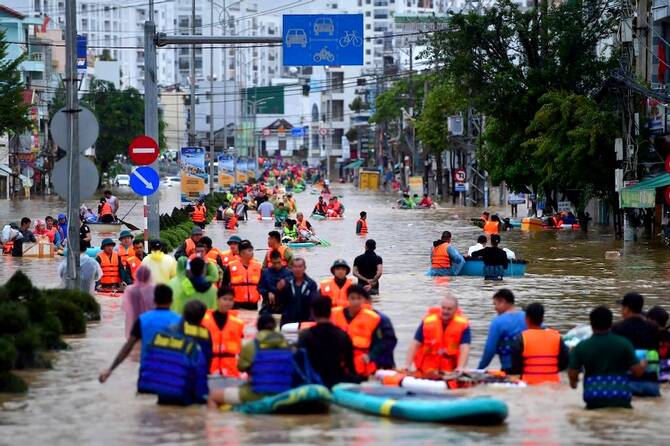
HANOI: Heavy rain, severe flooding and landslides in Vietnam have killed at least 90 people in the last week, authorities said Sunday, leaving others stranded on rooftops and mountain roadways blocked.
Relentless rain has lashed south-central Vietnam since late October and popular holiday destinations have been hit by several rounds of flooding, with economic losses estimated in the hundreds of millions of dollars.
Whole sections of coastal Nha Trang city were inundated last week, while deadly landslides struck highland passes around the Da Lat tourist hub.
In the hard-hit mountainous province of Dak Lak, 61-year-old farmer Mach Van Si said the floodwaters left him and his wife stranded on their sheet-metal rooftop for two nights.
“Our neighborhood was completely destroyed. Nothing was left. Everything was covered in mud,” he said on Sunday.
By the time they climbed a ladder to their roof, Si said he was no longer scared.
“I just thought we were going to die because there was no way out,” he said.
More than 60 deaths, of the 90 recorded since November 16, were in Dak Lak, where tens of thousands of homes were inundated, the environment ministry said in a statement.
‘Big soggy mess’
At the Tuy Hoa market in the province, the floodwaters have receded but Vo Huu Du, 40, said some of the hats, bags and shoes she sells were still soaked or lying in mud.
“My goods look like one big soggy mess,” she said. “I don’t even know where to start.”
She and other vendors once considered five centimeters (two inches) off the ground a safe level to raise their merchandise to avoid flood damage — but no more.
“All these years, the highest water level back in 1993 only reached our ankles,” said Du. “But now the water has come in over one meter (three feet) high.”
“All the vendors are devastated, not just me,” she added.
Ceramics seller Nguyen Van Thoai, 60, gestured to piles of damaged goods to be cleared from paths between vendor stalls, calling it “a real loss.”
“I don’t even know where to put all this market stock,” he said. “We might need to clean it for a month and still won’t be done.”
More than 80,000 hectares (200,000 acres) of rice and other crops across Dak Lak and four other provinces were damaged in the last week, with over 3.2 million livestock or poultry killed or washed away by floodwaters.
Authorities have used helicopters to airdrop aid to communities cut off by flooding and landslides, with the government deploying tens of thousands of personnel to deliver clothing, water-purification tablets, instant noodles and other supplies to affected areas, state outlet Tuoi Tre News said.
Several locations on national highways remained blocked on Sunday due to flooding or landslides, according to the environment ministry, and some railway sections were still suspended.
The ministry estimated economic losses of $343 million across five provinces due to the floods.
Natural disasters have left 279 people dead or missing in Vietnam and caused more than $2 billion in damage between January and October, according to the national statistics office.
The Southeast Asian nation is prone to heavy rain between June and September, but scientists have identified a pattern of human-driven climate change making extreme weather more frequent and destructive.


![]()

Vietnam flooding kills at least 90
Short Url
https://arab.news/8x3rp
Vietnam flooding kills at least 90
- Relentless rain has lashed south-central Vietnam since late October
- Popular holiday destinations have been hit by several rounds of flooding


Latest updates





© 2026 SAUDI RESEARCH & PUBLISHING COMPANY, All Rights Reserved And subject to Terms of Use Agreement.