HANOI: Heavy rain swept central Vietnam on Monday, triggering landslides and floods, killing at least seven, injuring dozens and stranding thousands.
The deluges have wreaked widespread destruction across a region already battered weeks ago by floods from record rainfall and the powerful typhoon Kalmaegi.
Rainfall through Wednesday is expected to reach 30–60 centimeters (12–24 inches) in parts of central Vietnam, with some areas likely to exceed 85 centimeters (33 inches).
Landslide causes bus crash
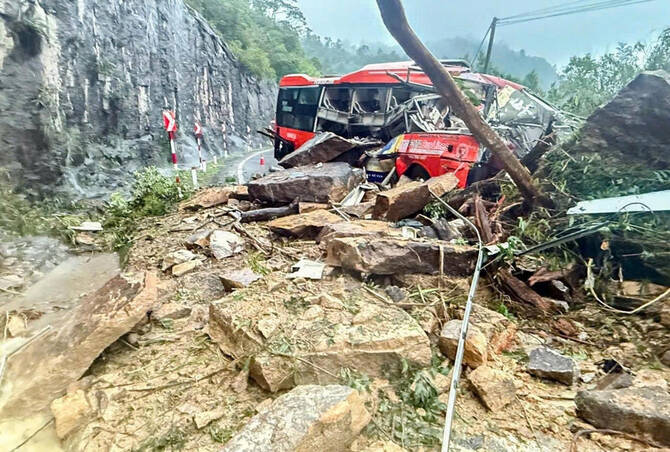
The hard-hit province of Khanh Hoa, a coastal region with hilly inland terrain, recorded one of its heaviest rainfall in years on Sunday night when earth and rocks collapsed on a bus traveling through the Khanh Le pass in the central highlands, state media reported.
The landslide crushed the front of the bus at around 9.30 p.m. local time, killing six people and trapping many passengers. Rescuers struggled for hours to reach the scene as heavy rain had also caused landslides on both sides of the pass, cutting off access. Rescue teams were only able to reach the bus after midnight, according to state media.
“Rocks and soil fell down with a loud bang. I was thrown on the roof of the bus before falling down,” Nguyen Long Cuong, the 39-year-old bus conductor, told state media VN Express.
The bus was carrying 32 people from Vietnam’s financial capital, Ho Chi Minh City and was traveling from Da Lat in Vietnam’s central highlands to the coastal city of Nha Trang. The injured were taken to a nearby hospital. State media said two of the dead bodies were still trapped under the debris as the treacherous terrain hindered the work.
The winding, 33-kilometer (20-mile) stretch carved into steep mountainsides is scenic and popular with tourists but prone to landslides in the rainy season.
The rains have triggered multiple landslides on major routes in Vietnam’s Central Highlands and traffic on several hilly passes has been suspended, state media said.
Also in Khanh Hoa, waterlogged soil collapsed on 10 workers at the Khanh Son pass on Sunday night, killing one and injuring another, while another remained missing, state media said. The seven others were able to flee to safety.
People stranded as floods hit
Flooding also hit the port city Cam Ranh and the coastal district of Cam Lam Sunday night, submerging more than 100 meters (328 ft) of railway lines under water and debris. Over 800 passengers on four trains were still stranded on Monday evening.
Flood waters inundated the Du Long Industrial Park on Monday, which houses several factories, including German and South Korean companies. Rains submerged factories by 1 meter (3.2 feet) of water and forced the power cuts, forcing thousands of workers to halt operations.
Torrential rain also flooded a national highway in the province of Dak Lak, prompting police to block the road and redirect traffic.
In the city of Hue, floods triggered landslides on Sunday in mountainous areas, blocking a major highway that runs from northern to southern Vietnam and cutting off several villages, isolating thousands, while in Quang Ngai province, rainfall of 150 to 235 mm (5.9–9.3 inches) collapsed a bridge over a stream, stranding 1,200 residents in remote hamlets.
On Sunday night, a tornado tore through the southern areas of Danang city and Quang Ngai province, ripping roofs from dozens of houses, uprooting trees and scattering debris.
Vietnam is among the world’s most flood-prone countries, with nearly half its population living in high-risk areas. Scientists warn that a warming climate is intensifying storms and rainfall across Southeast Asia, making floods and landslides increasingly destructive and frequent.


![]()

Heavy rain triggers landslides and floods in central Vietnam, killing seven
Short Url
https://arab.news/nh2bv
Heavy rain triggers landslides and floods in central Vietnam, killing seven
- The deluges have wreaked widespread destruction across a region already battered weeks ago by floods
- Vietnam is among the world’s most flood-prone countries, with nearly half its population living in high-risk areas


Latest updates


© 2026 SAUDI RESEARCH & PUBLISHING COMPANY, All Rights Reserved And subject to Terms of Use Agreement.