

Smaller EU nations push for greater Africa role

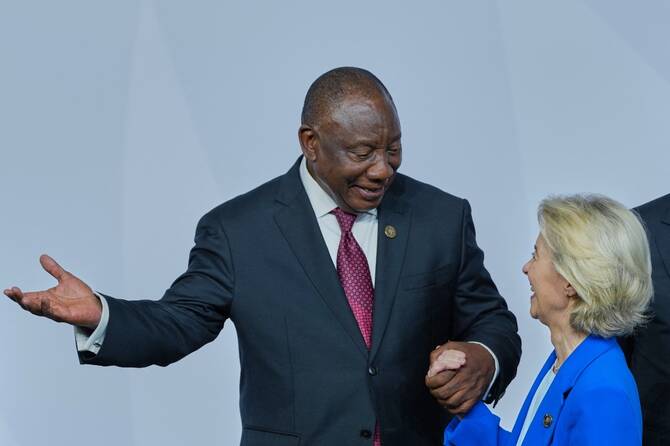
South African President Cyril Ramaphosa speaks with EU Commission President Ursula Von der Leyen at the G20 Summit in Johannesburg, South Africa. (AFP)
Short Url
Updated 23 November 2025
Follow

Smaller EU nations push for greater Africa role

  • Africa has emerged as a renewed diplomatic battleground in recent years, with China, the United States and Russia competing for its minerals, energy potential and political support

JOHANNESBURG: From Finland opening diplomatic outposts in Senegal to Czech instructors training Mauritanian security forces, a group of smaller European nations has joined a global scramble for influence in Africa.
Estonia, Romania and Malta are among European Union countries that have sought to boost their presence on the continent over the past five years, revamping diplomatic and trade links.
“There is a wave of second-generation Africa policy refreshes completed and... underway,” said Alex Vines of the European Council on Foreign Relations.
“It shows the growing importance of Africa across the EU including for its smaller member states.”
Africa has emerged as a renewed diplomatic battleground in recent years, with China, the United States and Russia competing for its minerals, energy potential and political support.
The EU styles itself as the continent’s “leading partner” in areas ranging from trade to security, a role it will try to reinforce at a summit with the African Union in Angola on Monday and Tuesday.
Yet it has suffered setbacks at times, fueled by resentment at the West’s colonial past, with China securing strategic resources in some countries and Russia taking over as preferred security partner in others.
Burkina Faso, Niger and Mali have, for example, turned to the Kremlin for support after cutting ties with France following a string of military coups.

- ‘Back in the game’ -

This has led to a strategic rethink in many corners of the 27-nation EU.
“We needed to somehow get back into the game,” a European diplomat told AFP.
Some EU nations with no former empires have sought to use their history — and in some cases their past domination by Russia — as an asset to establish relations seen as egalitarian, not top-down.
“We are not seen as the big oppressor from the past telling them to do this thing or the other,” said a second diplomat speaking on condition of anonymity.
Estonia’s painstaking transition from ex-Soviet republic to EU member has helped it find some common ground with African nations, said Daniel Schaer, the Baltic country’s ambassador to Kenya and South Africa.
“In the ‘90s, we had all of these advisers coming to tell us how we should do things. So I think our advice is in some ways fresh,” he said.
Similarly, Kaarina Airas, who is in charge of Africa policy at Finland’s foreign ministry, said her country’s struggle for independence has helped generate goodwill.
“Our African partners want trade, they want political relations with us and not only development aid,” she told AFP.
After a policy review in 2021, Finland opened a new embassy in Senegal, followed by Sweden and Denmark, and is aiming to double trade with Africa by 2030.
Estonia has deployed its tech expertise to digitalize private and public services from Namibia to Uganda, while Hungary has gained a foothold in Chad, opening a humanitarian aid center and a diplomatic mission in the capital, with plans to launch a military mission to train local forces.
Such efforts often pursue national political and business interests, from fighting Islamist militants to curbing migration and winning contracts for local firms.
But they have allowed the EU to diversify its offer at a time when African nations have no shortage of suitors.

- ‘A good path’ -

Whether that will pay dividends remains to be seen, said Geert Laporte of ECDPM, a European think-tank.
Some initiatives experienced teething problems as a few countries started their new engagements almost from scratch or with limited resources.
As Estonia still has only one embassy in Africa — in Egypt — Schaer said he spends about half his time traveling.
And Airas said it has taken some time for Finnish businesses to build knowledge and opportunities in Africa, as many — aside from telecoms group Nokia — had practically no experience there.
Trade figures show encouraging signs for the inroads made by smaller EU nations.
While still a small fraction of Europe’s total, Estonia’s trade in goods with the continent has almost doubled since 2019, while Hungary’s was up 35 percent over the same period, EU figures show.
The Czech Republic, Finland and Denmark, have also seen significant increases, albeit at a slower pace than the 25 percent recorded by the EU as a whole.
“We are on a good path,” said Airas.


Georgia’s street dogs stir affection, fear, national debate

Updated 3 sec ago
Follow

Georgia’s street dogs stir affection, fear, national debate

TBILISI: At a bus stop in central Tbilisi, two tagged dogs dozed on a bench as some commuters smiled at them and others cast angry glances.
In the streets of the Georgian capital, such scenes are part of daily life: community-fed “yard dogs,” yellow municipal tags on their ears, lounge outside bakeries, metro entrances and school gates.
The free-roaming canines stir both affection and fear. What to do with their swelling numbers — in the tens of thousands in Tbilisi alone — has become a nationwide dilemma.
Stray animals tied the top spot for public concerns in a poll by the National Democratic Institute, with 22 percent of respondents naming it the most pressing issue.
Many welcome the dogs as a symbol of Tbilisi, a showcase of Georgian hospitality and the warm street life that draws tourists to the capital.
“Street dogs in Georgia have made a more positive impact on tourism and the image of Georgia than people and culture alone,” said journalist Elena Nikoleisvili, 51, who helps street dogs.
“If anything, these adorable creatures should be the symbol of the capital — like the cats of Istanbul.”
On cafe terraces, regulars slip bones under tables as mongrels curl up between patrons’ feet, while each neighborhood and cul-de-sac has its own local canine mascot.

- ‘Drop in the ocean’ -

Others worry about safety.
“They bark and scare folks,” said plumber Oleg Berlovi, 43.
“Two weeks ago, a dog bit my kid and we needed shots. Animals are great, but they need looking after.”
According to the World Health Organization, dogs are the main vectors in human rabies cases globally.
Georgia still records a handful of human deaths from the disease each year and administers tens of thousands of post-exposure treatments, according to the Global Alliance for Rabies Control.
City officials say the answer is steady, humane population control.
“The state’s policy is to manage these animals by the most humane methods possible and to reduce to a minimum the number of stray dogs on the streets,” Nicoloz Aragveli, who heads Tbilisi city hall’s animal monitoring agency, told AFP.
A recent count put the capital’s stray dog population at about 29,000, and around 74 percent have been neutered, Aragveli said.
“We plan to do more so that we reach 100 percent,” he said.
The city runs weekly school lessons and a door-to-door registration drive to raise awareness and track owned pets.
Legislative changes have also tightened penalties for abandoning animals and for violating care and ownership rules — steps officials say will help halt the flow of pets to the streets.
But journalist Nikoleisvili said the authorities only responded after a public backlash, and “could do much more.”
The number of dogs that have been neutered in Tbilisi — around 50,000 over the last decade — is “a drop in the ocean,” she said.

- ‘Guilty party’ -

Volunteers, like theater director Zacharia Dolidze, who builds kennels, also play a big role in caring for the dogs.
“There are days I make 20 kennels. I’ve built about 2,500 in seven years,” the 40-year-old said.
He collects regular donations to help pay for materials.
Shelter operators say there are big gaps in addressing what they call one of Georgia’s biggest issues.
“You can make regulations, but if you cannot enforce them, that’s not going to help,” said Sara Anna Modzmanashvili Kemecsei, who runs a shelter that houses about 50 dogs.
In many regions, “there are absolutely no neutering campaigns.”
“I can’t really see that the government is on top of the issue, so there are lots of volunteers,” she said. “They are really good at managing these animals.”
Politics has also injected fresh uncertainty.
Last year, the government pushed a “foreign influence” law that complicates NGOs’ access to funding from foreign donors such as UK animal welfare charity Mayhew, which runs a program to vaccinate and neuter strays in Tbilisi.
Volunteers meanwhile continue to juggle feeding, sheltering and basic care.
Nino Adeishvili, 50, is a geologist and university lecturer who looks after around 10 dogs.
Her group organizes rabies shots and fundraises on Facebook for deworming, flea treatment and food.
“On the street, a dog is still unprotected,” she said.
“The guilty party is the human.”