

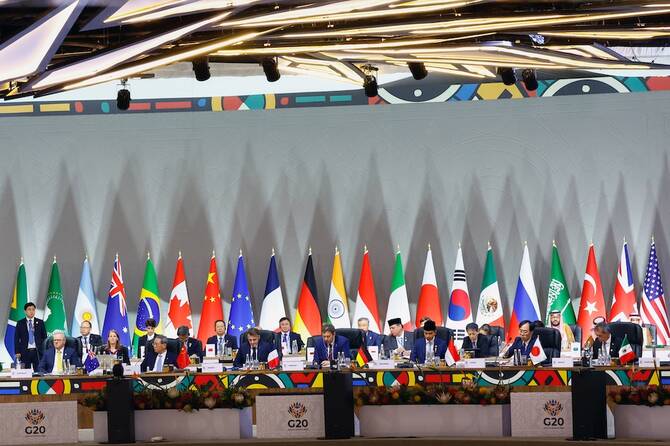

JOHANNESBURG: World leaders from the Group of 20 rich and developing economies broke with tradition and adopted a declaration at the start of their summit in South Africa on Saturday despite opposition from the United States, which is boycotting the two-day talks in a diplomatic rift with the host country.
Vincent Magwenya, the spokesperson for South African President Cyril Ramaphosa, said a leaders’ declaration was adopted unanimously by the other members at the start of the talks in Johannesburg.
“Normally the adoption of the declaration happens right at the end. But ... there was a sense that we should actually move to have the summit declaration adopted first as the first order of the day,” Magwenya told reporters.
There were no details of what was in the declaration, but South Africa promoted it as a victory for the first G20 summit to be held in Africa that has been overshadowed by the US boycott ordered by President Donald Trump.
The Trump administration had put pressure on South Africa not to adopt a leaders’ declaration in the absence of an American delegation, South African officials said.
Comments that shouldn’t have been broadcast
South Africa’s summit has an ambitious agenda to make progress on solving some of the long-standing problems that have afflicted the world’s poorest nations. Leaders and top government officials came together at an exhibition center near the famous Soweto township in South Africa, once home to Nelson Mandela.
Many of South Africa’s priorities, especially a focus on climate change and confronting global inequality, have met resistance from the US But as he opened the summit, Ramaphosa said that “consensus has emerged” in the US’s absence.
Then, in comments to leaders that were apparently mistakenly broadcast during what was meant to be the start of closed-door discussions, Ramaphosa could be heard saying: “There’s been overwhelming consensus and agreement that one of the other tasks we should undertake right at the beginning ... which is by overwhelming consensus to adopt our declaration now.”
South Africa’s foreign minister walked over and whispered in Ramaphosa’s ear, and the South African leader said: “OK. I’m told that the cameras are still on. They should be off.”
South Africa’s agenda
South Africa, which gets to set the agenda as the country holding the rotating G20 presidency, wants leaders to agree to more help for poor countries to recover from climate-related disasters, reduce their foreign debt burdens, transition to green energy sources and harness their own critical mineral wealth — all in an attempt to counter widening global inequality.
“We’ll see,” United Nations Secretary-General António Guterres said on whether the G20 could prioritize developing world countries and make meaningful reforms. “But I think South Africa has done its part in putting those things clearly upon the table.”
The two-day summit will take place without the world’s biggest economy after Trump boycotted over his claims that South Africa is pursuing racist anti-white policies and persecuting its Afrikaner white minority. The Trump administration has also made clear its opposition to South Africa’s G20 agenda from the start of the year.
Moving on from US boycott
The monthslong diplomatic rift between the US and South Africa deepened in the buildup to the summit this weekend, but while Trump’s boycott threatened to undercut the agenda, some of the leaders were eager to move on.
“I do regret it,” French President Emmanuel Macron said of Trump’s absence, “but it should not block us. Our duty is to be present, engage and work all together because we have so many challenges.”
The G20 is actually a group of 21 members that comprises 19 nations, the European Union and the African Union.
The bloc was formed in 1999 as a bridge between rich and poor nations to confront global financial crises. While it often operates in the shadow of the Group of Seven richest democracies, G20 members together represent around 85 percent of the world’s economy, 75 percent of international trade and more than half the global population.
But it works on consensus rather than any binding resolutions, and that is often hard to come by with the different interests of members like the US, Russia, China, India, Japan, the Western European nations France, Germany and the UK, and others like Indonesia, Saudi Arabia and South Africa.
Doubts over a declaration
G20 summits traditionally end with a leaders’ declaration, which details any broad agreement reached by the members. South Africa said the US was exerting pressure on it to tone down the final document to a unilateral statement from the host country.
Ramaphosa responded to that earlier this week by saying “we will not be bullied.”
Even so, the direction of the G20 bloc is likely to change sharply given that the US takes over the rotating presidency from South Africa at the end of this summit.
The only role the US will play at this summit, the White House said, will be when a representative from the United States Embassy in South Africa attends the formal handover ceremony.
South Africa said it’s an insult for Ramaphosa to hand over to a junior diplomatic official.
“We have communicated to the American government that the president will not be handing over to a junior official of the embassy,” South African Foreign Ministry spokesperson Chrispin Phiri said, adding he didn’t expect there would be a handover ceremony on Sunday.


