

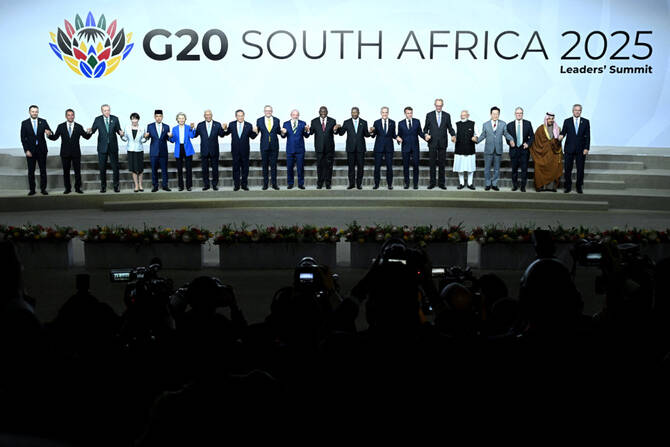
G20 summit in South Africa adopts declaration despite US boycott, opposition

World Leaders including Turkish President Recep Tayyip Erdogan, Japan's Prime Minister Sanae Takaichi, Indonesia's Vice President Gibran Rakabuming Raka, European Commission President Ursula Von der Leyen, European Council President Antonio Costa, China's Prime Minister Li Qiang, Australia's Prime Minister Anthony Albanese, Brazil's President Luiz Inacio Lula da Silva, South African President Cyril Ramaphosa, Angola's President Joao Lourenco, Canadian Prime Minister Mark Carney, France's President Emmanuel Macron, German Chancellor Friedrich Merz, India's Prime Minister Narendra Modi, South Korea's President Lee Jae Myung, Britain's Prime Minister Keir Starmer, Saudi Arabia's Foreign Minister Prince Faisal bin Farhan Al Saud and Argentinian Foreign Minister Pablo Quirno pose for a "family photo" at the G20 Summit, in Johannesburg, South Africa, November 22, 2025. (Pool via REUTERS)
Short Url
Updated 23 November 2025
Follow

G20 summit in South Africa adopts declaration despite US boycott, opposition

  • The declaration, which was drafted without US input, “can’t be renegotiated,” South African President Ramaphosa
  • The mention of climate change was a snub to Trump, who doubts the scientific consensus that global warming is caused by human activities

JOHANNESBURG/WASHINGTON: Group of 20 leaders adopted a declaration addressing the climate crisis and other global challenges on Saturday over US objections, prompting the White House to accuse South Africa of weaponizing its leadership of the group this year.
The declaration, which was drafted without input from the United States, “can’t be renegotiated,” South African President Cyril Ramaphosa’s spokesperson told reporters, reflecting strains between Pretoria and US President Donald Trump’s administration, which boycotted the event.
“We had the entire year of working toward this adoption and the past week has been quite intense,” spokesperson Vincent Magwenya said.
Hours later, the White House said Ramaphosa was “refusing to facilitate a smooth transition of the G20 presidency” after initially saying he would pass the gavel to ‘an empty chair.’“
“This, coupled with South Africa’s push to issue a G20 Leaders Declaration, despite consistent and robust US objections, underscores the fact that they have weaponized their G20 presidency to undermine the G20’s founding principles,” said White House spokeswoman Anna Kelly. Trump looks forward to “restoring legitimacy” to the group next year, when the US holds the rotating presidency.

Ramaphosa, host of this weekend’s gathering of Group of 20 leaders in Johannesburg, had earlier said there was “overwhelming consensus” for a summit declaration.
But at the last minute Argentina, whose far-right President Javier Milei is a close ally of Trump, quit the negotiations right before the envoys were about to adopt the draft text, South African officials said.
“Argentina, although it cannot endorse the declaration ... remains fully committed to the spirit of cooperation that has defined the G20 since its conception,” its foreign minister Pablo Quirno said at the summit. Ramaphosa noted this, but went ahead with it anyway.
In explanation, Quirno said Argentina was concerned about how the document referred to geopolitical issues.
“Specifically it addresses the longstanding Middle East conflict in a manner that fails to capture its full complexity,” he said. The document mentions the conflict once, saying members agree to work for a just, comprehensive, and lasting peace in ... the Occupied Palestinian Territory.”

Declaration mentions climate change
Envoys from the G20 — which brings together the world’s major economies — drew up a draft leaders’ declaration on Friday without US involvement, four sources familiar with the matter said.
“It is a longstanding G20 tradition to issue only consensus deliverables, and it is shameful that the South African government is now trying to depart from this standard practice,” a senior Trump administration official said on Friday.
The declaration used the kind of language long disliked by the US administration: stressing the seriousness of climate change and the need to better adapt to it, praising ambitious targets to boost renewable energy and noting the punishing levels of debt service suffered by poor countries.
The mention of climate change was a snub to Trump, who doubts the scientific consensus that global warming is caused by human activities. US officials had indicated they would oppose any reference to it in the declaration.
In opening remarks to the summit, Ramaphosa said: “We should not allow anything to diminish the value, the stature and the impact of the first African G20 presidency.”
His bold tone was a striking contrast to his subdued decorum during his visit to the White House in May, in which he endured Trump repeating a false claim that there was a genocide of white farmers in South Africa, brushing aside Ramaphosa’s efforts to correct his facts.
Trump said US officials would not attend the summit because of allegations, widely discredited, that the host country’s Black majority government persecutes its white minority.

Trump rejects South Africa’ G20 agenda
The summit came at a time of heightened tensions between world powers over Russia’s war in Ukraine and fraught climate negotiations at the COP30 in Brazil.
“While the G20 diversity sometimes presents challenges, it also underscores the importance of finding common ground,” Japan Cabinet Public Affairs Secretary Maki Kobayashi told Reuters.
Commenting on Argentina’s absence from the final envoy meeting to agree on the text, Magwenya said: “Argentina (had) been participating quite meaningfully ... in all the deliberations,” then never showed up to endorse the declaration on Friday. He added: “We have what we call sufficient consensus.”
The US president had also rejected the host nation’s agenda of promoting solidarity and helping developing nations adapt to weather disasters, transition to clean energy and cut their excessive debt costs.
“This G20 is not about the US,” South African Foreign Minister Ronald Lamola told public broadcaster SABC. “We are all equal members of the G20. What it means is that we need to take a decision. Those of us who are here have decided this is where the world must go.”
But in a sign of the many geopolitical fissures underlying the agreed text, EU Commissioner Ursula von der Leyen warned in a speech about “the weaponization of dependencies” which she said “only creates losers.”
This was an apparent veiled reference to China’s export curbs on rare earths vital for the world’s energy transition, as well as defense and digital technology.
China’s Premier Li Qiang called for unity among the G20 during a speech at the summit on Saturday, saying that differences in interests among parties and shortcomings in global cooperation are key obstacles to international unity.
“The G20 should face up to these problems, explore solutions and promote a return to the right track of unity and cooperation,” Li said in a statement from China’s Foreign Ministry.
The South African presidency on Saturday reiterated its rejection of a US offer to send the US charge d’affaires for the G20 handover.
“The president will not hand over to a junior embassy official the presidency of the G20. It’s a breach of protocol that is not going to be accommodated,” Magwenya said.
Lamola later said that South Africa would assign a diplomat of the same rank as a charge d’affaires to hand over the G20 presidency at the Foreign Affairs Department.


US intel did not suggest a preemptive strike from Iran before US-Israeli attacks, AP sources say

Updated 5 sec ago
Follow

US intel did not suggest a preemptive strike from Iran before US-Israeli attacks, AP sources say

WASHINGTON: Trump administration officials told congressional staff in private briefings Sunday that US intelligence did not suggest Iran was preparing to launch a preemptive strike against the US, three people familiar with the briefings said.
The administration officials instead acknowledged there was a more general threat in the region from Iran’s missiles and proxy forces, two of the people said. The third person, however, said the administration emphasized that Iran’s missiles and proxy forces posed an imminent threat to US personnel and allies in the region.
The officials did not provide any clarity about what would happen next in Iran after the joint US-Israeli operation, the two people said. All three people insisted on anonymity to discuss details that have not been made public.
The information conveyed to the congressional staff contrasts with the message from President Donald Trump. “Our objective is to defend the American people by eliminating imminent threats from the Iranian regime. A vicious group of very hard, terrible people,” he said in a video message after launching strikes on Iran.
Senior Trump administration officials, who like others were not authorized to comment publicly and spoke on condition of anonymity, had told reporters Saturday that there were indicators that the Iranians could launch a preemptive attack.
The White House and Pentagon did not immediately reply to requests for comment on Sunday night. Details of the briefing were first reported by Politico.
On Tuesday, Secretary of State Marco Rubio, Defense Secretary Pete Hegseth, CIA Director John Ratcliffe and Gen. Dan Caine, chairman of the Joint Chiefs of Staff, will brief the full membership of Congress on the US military operation against Iran, the White House said Sunday. Rubio also was slated to brief Hill leadership Monday, the same day Hegseth and Caine are planning a press conference about the operation.
Three strikes, three locations, within a single minute
The military operation came after authorities from Israel and the US spent weeks tracking the movements of senior Iranian leaders, including Supreme Leader Ayatollah Ali Khamenei, and shared information that allowed the strikes to be carried out in a surprise daylight attack, according to an Israeli military official and another person familiar with the operation.
The eventual barrage of US-Israeli attacks on Iran came so quickly that they were nearly simultaneous — with three strikes in three locations hitting within a single minute — killing Khamenei and some 40 senior figures, including the head of the paramilitary Revolutionary Guard and the country’s defense minister, the Israeli military official said Sunday.
The official said a variety of factors created a golden opportunity to take out much of Iran’s leadership, like weeks of training and monitoring the movements of senior figures as well as intelligence in real-time before the attack began that key targets were gathered together.
Striking by day also gave an additional element of surprise, said the official, who said so many major, rapid-fire strikes were critical to keep key officials from fleeing after the first strike. The official said Israel closely cooperated with its US counterparts and had used a similar tactic at the beginning of last June’s war — which resulted in the killing of several senior Iranian figures.
The official also noted Khamenei having posted defiant tweets taunting President Donald Trump in the days before the attack.
The details about the strikes came as the conflict entered its second day, with Trump saying in a video message Sunday that he expected it would continue until “all of our objectives are achieved.” He did not spell out what those objectives were.
The Republican president also said the US military and its partners hit hundreds of targets in Iran, including Revolutionary Guard facilities, Iranian air defense systems and nine warships, “all in a matter of literally minutes.”
CIA had long tracked top Iranian leaders
Before the attacks, the CIA had for months tracked the movements of senior Iranian leaders, including Khamenei.
The intelligence was shared with Israeli officials, and the timing of the strikes was adjusted in part because of that information about the Iranian leaders’ location, according to the person familiar with the planning.
The intelligence-sharing between US and Israel reflects the preparation that went into the strikes, which threw the future of the Islamic Republic into uncertainty and raised the risk of escalating regional conflict.
The US regularly shares intelligence with allies including Israel. Those partnerships, and the accuracy of the intelligence they yield, is often critical not only to the success of a military operation but also to the public’s support for it.
Virginia Sen. Mark Warner, the senior Democrat on the committee, told The Associated Press that, historically, “our working relationship with the Mossad and Israel is really strong.” Mossad is the Israeli spy agency.
Warner said he has serious concerns about the justification for the strikes, Trump’s long-term plans for the conflict and the risks that US service members will face. The military announced Sunday that three American troops had been killed in the Iran operation.
“No tears will be shed over their leadership being eliminated, but always the question is: OK, what next?” Warner said.
Iran has signaled it’s open to talks with the US
A senior White House official said Iran’s “new potential leadership” has suggested it is open to talks with the United States. That official, who spoke on condition of anonymity to discuss internal administration deliberations, said Trump has indicated he’s “eventually” willing to talk but that for now the military operation “continues unabated.”
The official did not say who the potential new Iranian leaders are or how they made their alleged willingness to talk known. Separately, Trump told The Atlantic that he planned to speak with Iran’s new leadership.
“They want to talk, and I have agreed to talk, so I will be talking to them,” he said Sunday, declining comment on the timing.